Regularly reconciling your books with your bank statements can help you catch bookkeeping errors, prevent fraud and ensure your records match reality.
Bank reconciliation is the process of comparing your books to your bank statements for a given period of time, and making sure the records match.
As your business grows and your finances get more complicated, the occasional bookkeeping or accounting error is bound to creep in. Regularly reconciling your books can help you catch mistakes before they become problems while protecting you against fraud, helping you stay on top of cash flow and receivables, and generally giving you peace of mind. Here’s how it works.
Key takeaways
Bank reconciliations help you catch mismatches between your books and your bank statements.
Those differences are often due to timing (deposits that are still in transit or checks that haven’t cleared the bank yet), or items that are missing from your books (like bank fees or interest).
Businesses typically reconcile at the end of the month, along with other bookkeeping tasks like posting receipts or sending out invoices.
In the process of reconciling, you’ll make adjustments to your records so your final book balance lines up with what’s on your bank statement.
What is a bank reconciliation?
While it might sound complicated, ‘bank reconciliation’ simply refers to the process of comparing your financial records—like your check register, spreadsheet ledger or the transactions in your accounting software—with your bank statements to make sure the two match up.
Businesses will usually reconcile their books in this way once a month, along with other ‘month end’ tasks like posting receipts, sending out invoices, paying the bills and topping up petty cash.
Why are bank reconciliations so important?
In a perfect world, your financial records and your bank statement would align perfectly, but timing differences and human error can create discrepancies between the two. Bank reconciliations can help you catch errors you make when recording income or expenses in the books and ensure the assets on your balance sheet match reality. Bank reconciliations can help you identify:
Recording errors, like transposed numbers, double entries and missing entries
Outstanding checks and withdrawals that you’ve recorded, but that haven’t cleared the bank yet
Deposits in transit that the bank hasn’t posted yet
Bank fees or interest that appear on your bank statement but not in your records
Bank reconciliations can be particularly useful for independent businesses, where owner-operators may rely on pen and paper account books that can be difficult to compare to bank statements at a glance.
Regularly reconciling your books can also help you spot unauthorized or fraudulent bank transactions, and even help you stay on top of any payments your customers might be behind on.
How does a bank reconciliation work?
Step 1: Get your books and bank statements together
Get a hold of your financial records—your accounting software, spreadsheets, receipts, or handwritten account books—and monthly statements for any bank accounts you use for business transactions.
Step 2: Compare bank deposits with income
Go through each item of income in your books for the month and ensure there’s a corresponding deposit recorded on your bank statement for each one. If there’s any income that isn’t accounted for on the bank statement (or vice versa) find out why. Keep an eye out for deposits in transit, recording errors, and any outstanding checks you’ve recorded but haven’t cleared the bank yet.
Step 3: Compare bank withdrawals with expenses
Repeat the above process for expenses and withdrawals, and note any recording errors, outstanding checks and payments in transit. Keep an eye out for any banking or interest fees that might not appear in your books.
Step 4: Make adjusting entries
After you make your way through steps two and three and note any discrepancies, you’ll have to adjust your books to correct these discrepancies using adjusting journal entries. Make an adjusting entry for any items that are missing or wrong in your books: bank fees, interest, bounced checks, or recording errors.
After making all necessary adjustments, your book balance should match the ending balance on your bank statement.
Bank Reconciliations: An Example
Let’s walk through a simple bank reconciliation for a hypothetical agricultural business named Ambrook Beef Inc. Their bank statement for March 2025 contains the following transactions:
Beginning balance: $10,000
Deposit: $7,500 (cattle auction)
Withdrawal: $4,200 (feed supplier)
Withdrawal: $1,000 (utilities)
Withdrawal: $500 (equipment repair)
Withdrawal: $25 (bank fees)
Ending balance: $11,775
Let’s also assume Ambrook Beef’s books for March 2025 contain the following:
Beginning balance: $10,000
Deposit: $7,500 (cattle auction)
Withdrawal: $4,200 (feed)
Withdrawal: $1,000 (utilities)
Ending balance: $12,300
Ambrook Beef Inc.’s bank statement shows a balance of $11,775, while their books show $12,300.
After taking a closer look, Ambrook Beef Inc. realizes that the $500 equipment repair payment wasn’t recorded in the books properly. Scanning over the March statement again, they notice they forgot to record $25 in banking fees as well.
To fix this, they record adjusting entries totaling $525. This brings the new book balance to $11,775. The bank and book balances now match, and the reconciliation is complete!
How often should you reconcile your bank accounts?
It’s common for businesses to reconcile their accounts at least once a month, soon after they’ve received their statements. But if you have a high volume of transactions, you might want to reconcile weekly so it’s easier to spot errors.
Remember to reconcile all accounts that hold or move money for your business, not just your main business checking account. For example, you’ll also want to check your business credit card statements against the books.
Frequently asked questions (FAQs) about reconciliations
What is a bank reconciliation in simple terms?
A bank reconciliation is a process where you confirm that the cash balance in your books matches your bank statement. You compare your ledger to your statement for the same period, look for discrepancies between the two, and make adjustments to your records until they match.
How often should you do a bank reconciliation?
Most independent businesses reconcile their accounts (including checking accounts, credit cards, or loan accounts) at least once a month, but some owners who manage a high volume of transactions might reconcile weekly.
What are the most common reconciling items?
Common reconciling items include bank fees, interest earned, bounced customer checks, automatic payments you didn’t record, or recording errors like transposed numbers and duplicate entries.
Who should do the bank reconciliation?
Many owner-operators do reconciliations themselves. If you have a bookkeeper or a financial expert you work with, like an Ambrook account manager, they can also review reconciliations.
Can accounting software do bank reconciliations automatically?
Accounting software can typically make reconciliations faster and easier. For example, Ambrook can show you the difference between your ledger and your statements, then track the remaining difference in balance as you reconcile. That said, you’ll still need to review unmatched items, record adjustments, and confirm the ending balance matches your statement yourself.
Reconcile your accounts with Ambrook
Ambrook’s software makes it easier to reconcile accounts by helping you compare your ledger against your bank statements. It’s also built for business owners in farming, ranching, construction, trucking, and property management: You can break down your operation’s probability by field, job, enterprise, and other metrics that matter to you.
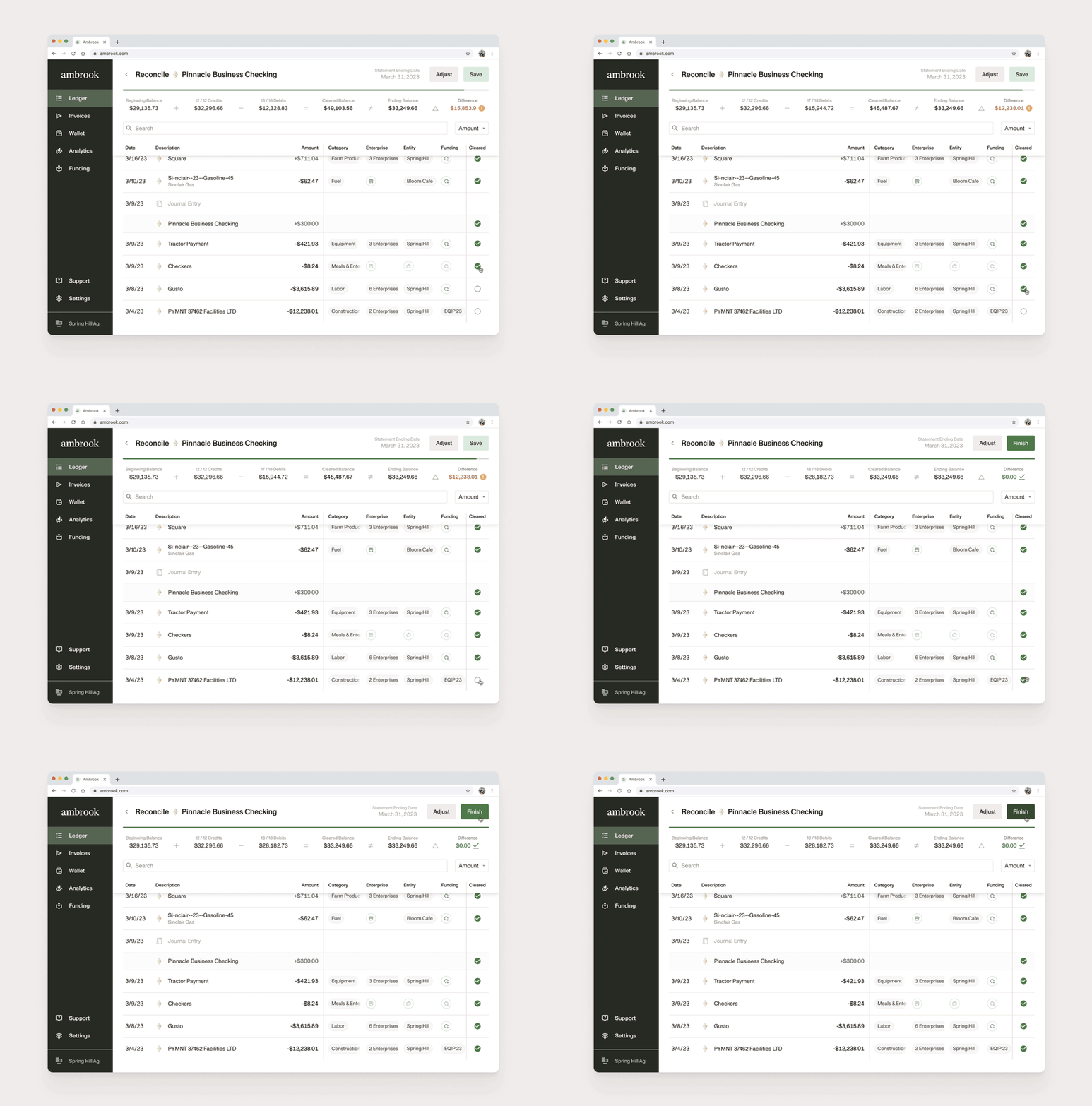
Ambrook makes comparing your ledger to your bank statement as easy and satisfying as checking items off a grocery list.
With powerful bookkeeping and smart tagging functionalities, dedicated payment cards, automatic expense reporting and a custom chart of accounts that grows with your business, Ambrook gives operators what they need to see their numbers clearly. Interested in learning more? Start a 30-day free trial today.
This resource is provided for general informational purposes only. It does not constitute professional tax, legal, financial or accounting advice. Consult a qualified professional about your specific situation.
Want to learn more about Ambrook?