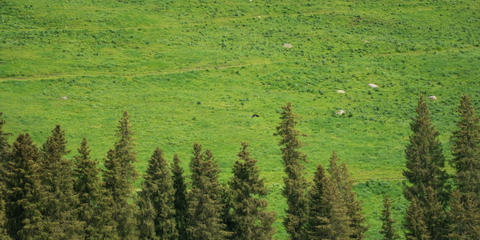
The Conservation Partners Program provides vital grant funding to support organizations that provide staff and technical assistance to private landowners in order to maximize the benefits of Farm Bill programs on working lands.
The Conservation Partners Program awards competitive grants that accelerate the adoption of regenerative agriculture principles and conservation practices on private lands. Grant recipients provide technical assistance to landowners and operators to help them:
-
Develop management plans
-
Design and implement best practices
-
Participate in Farm Bill programs
-
Share their experiences and lessons learned
Grants are geographically targeted to place expert staff where they can both fulfill unmet technical assistance needs and maximize the soil, water, and wildlife benefits of Farm Bill conservation programs.
The program is a partnership between NFWF and the USDA Natural Resources Conservation Service (NRCS), the U.S. Environmental Protection Agency (EPA), the U.S. Fish and Wildlife Service (USFWS), the Great Lakes Restoration Initiative (GLRI), General Mills, PepsiCo, and The J.M. Smucker Co. Grant recipients provide technical assistance to farmers and ranchers to develop conservation plans, design and implement conservation practices, and enroll in Farm Bill conservation programs, especially the Conservation Stewardship Program (CSP) and the Environmental Quality Incentives Program (EQIP). Successful projects supplement and complement NRCS technical assistance capacity by helping to reduce the Farm Bill conservation practice planning, contracting, and implementation backlog.
The 2026 funding opportunity targets four geographies: the Great Plains, the Upper Mississippi River Basin, the Great Lakes Basin, and Western Working Lands. Since 2011, the program has awarded 333 grants worth more than $93 million and leveraged an additional $94 million in matching contributions.
Eligibility
Eligible applicants include non-profit 501(c) organizations, state government agencies, local governments, municipal governments, tribal governments and organizations, and educational institutions. To be competitive, applicant organizations must demonstrate capacity and experience commensurate with the scale of the project being proposed and the funding being requested.
Individuals, federal government agencies, and for-profit entities are not eligible to apply for grant funding.
Ineligible uses of grant funds:
-
Grant funds cannot be used to provide technical assistance for Regional Conservation Partnership Program (RCPP) and Advancing Markets for Producers (AMP) initiative projects, which already have dedicated, USDA-funded technical assistance budgets.
-
Grant funds from NRCS cannot be used to provide financial assistance to agricultural producers, though projects may leverage other funding for this purpose. Financial assistance means direct payments to agricultural producers to perform or implement conservation practices, including payments for costs like materials, equipment, labor, etc. The prohibition also applies to the direct purchase of materials, equipment, or labor required for producers to implement practices. Successful projects will develop conservation plans that enable agricultural producers to qualify for and receive financial assistance and cost share payments through NRCS Farm Bill programs.
-
Applicants are encouraged to rent equipment where possible and cost-effective or use matching funds to make those purchases.
-
NFWF funds and matching contributions are strictly prohibited from being used for political advocacy, fundraising, lobbying, litigation, terrorist activities, or in violation of the Foreign Corrupt Practices Act.
Projects must align geographically with the Great Plains (portions of Arkansas, Colorado, Kansas, Iowa, Missouri, Minnesota, Montana, Nebraska, New Mexico, North Dakota, South Dakota, Oklahoma, Texas and Wyoming); the Upper Mississippi River Basin (Iowa, Missouri, Illinois, Kentucky, and the portions of Minnesota, Wisconsin, Indiana and Ohio outside the Great Lakes Basin); the Great Lakes Basin (Michigan and the portions of Minnesota, Wisconsin, Illinois, Indiana, Ohio, Pennsylvania and New York in the basin); or Western Working Lands (Washington, Oregon, California, Idaho, Nevada, Utah, Arizona, and western Montana, Wyoming, Colorado, New Mexico and Texas).
Details
Deadline
July 22, 2026
Organization
Financial Instrument
Grant
Minimum Award Amount
$250,000
Maximum Award Amount
$750,000
Stackable with Other Programs
Conditional — Grant funds cannot be used to provide technical assistance for Regional Conservation Partnership Program (RCPP) or Advancing Markets for Producers (AMP) initiative projects, which already have dedicated USDA-funded technical assistance budgets. NRCS grant funds also cannot be used to provide financial assistance to agricultural producers, though projects may leverage other funding for that purpose. Matching contributions are encouraged but the landowner portion of Farm Bill cost-share is not an eligible source of match.
Terms
Typical grant awards will range from $250,000 to $750,000, with an estimated average grant size of approximately $500,000.
Project Period: the project start date cannot be before October 1, 2026 and should be within 6 months of the award announcement period; the project end date should be within 24 months of the project start date.
Project Scale: the program seeks to foster systems change and achieve conservation benefits at a landscape scale, supporting projects that generate impact on the order of thousands or tens of thousands of acres, with a strong preference for projects on the larger end of the scale.
Matching Contributions: the ratio of matching contributions to grant funding requested is an important criterion considered during the review process. Matching contributions are not required, but applicants are encouraged to offer higher match ratios to be more competitive. Match may include cash, in-kind contributions of staff and volunteer time, work performed, materials and services donated, or other tangible contributions, and eligible indirect costs. The landowner portion of cost-share required to obtain funding from Farm Bill programs is NOT an eligible source of match.
Payment Timeline: after award announcements, NFWF staff work with grantees to prepare grant agreements electronically in Easygrants. Once grant agreements are finalized, funds are typically paid to grantees on a reimbursable basis; funds may be advanced to qualified grantees on an as-needed basis.
Reporting: all applicants must include a required set of Easygrants metrics (jobs created/sustained, participants receiving government cost share, dollar value and acres covered by government cost share, people with changed behavior, project footprint acreage, number of management plans with BMPs, and acres covered by conservation plans); Great Lakes Basin projects must additionally report acres with enhanced nutrient management and pounds of nitrogen, phosphorus and sediment avoided annually. Grant recipients may be required to submit field-level implementation data using an NFWF template.
NFWF notes that its ability and the extent to which it is able to make awards is contingent upon receipt of funds from federal agencies and/or other funding partners.
Application Instructions
All application materials must be submitted online through NFWF's Easygrants system:
-
Go to https://easygrants.nfwf.org to register in NFWF's Easygrants online system (existing users log in). Enter your applicant information and disable your pop-up blocker before beginning.
-
From your homepage, click "Apply for Funding" and select Conservation Partners Program 2026 from the list of options.
-
Follow the instructions in Easygrants to complete your application. Once started, an application may be saved and returned to later for completion and submission.
2026 timeline (dates subject to change): Applicant Webinar June 10, 2026 at 1:00 PM ET; Full Proposals Due July 22, 2026 by 11:59 PM ET; Review Period July-November 2026; Awards Announced December 2026. The 2026 Request for Proposals is now marked CLOSED on the program page.
Applicants should confer with the NRCS State Conservationist and staff in the state in which the project is located. A Tip Sheet, Applicant FAQ, proposal narrative template, and applicant webinar recording are posted with the RFP. For questions contact Greg Pilchak (greg.pilchak@nfwf.org, 202-938-0640) or Dalton Schmitz (Dalton.Schmitz@nfwf.org, 202-992-9456); for Easygrants issues contact easygrants@nfwf.org / 202-595-2497 (9:00 am-5:00 pm ET, Monday-Friday).
Forms
Resources
-
Program page: https://www.nfwf.org/programs/conservation-partners-program
-
2026 Request for Proposals (web): https://www.nfwf.org/programs/conservation-partners-program/conservation-partners-program-2026-request-proposals
-
2026 RFP (PDF): https://www.nfwf.org/sites/default/files/2026-05/cpp_rfp_2026.pdf
-
2026 Tip Sheet (PDF): https://www.nfwf.org/sites/default/files/2026-07/cpp_2026_tip\_sheet.pdf
-
2026 Applicant FAQ (PDF): https://www.nfwf.org/sites/default/files/2026-05/cpp_2026_applicant\_faq.pdf
-
Program Fact Sheet (PDF, March 2026): https://www.nfwf.org/sites/default/files/2026-03/NFWF-CPP-20260311-FS-Final.pdf
-
November 2025 Grant Slate (PDF): https://www.nfwf.org/sites/default/files/2026-03/NFWF-CPP-20260311-GS-Final.pdf
-
Award announcement, $8.7 million / 12 grants (Mar 18, 2026): https://www.nfwf.org/media-center/press-releases/nfwf-announces-8-7-million-grants-conservation-partners-program
Related Programs

480-a Enrollment Incentive Program
New York City Watershed Agricultural Council
- GrantNY

A Vibrant Future
International Fresh Produce Association, U.S. Department of Agriculture
- GrantClimate-SmartALCAFLGALABerriesGrapesFruitsVegetables

Acequia and Community Ditch Fund (New Mexico)
New Mexico Department of Agriculture
- GrantWater ManagementConservationLegal & FinanceResearchNM
ACRE3 Agricultural Energy Efficiency
Colorado Department of Agriculture
- GrantCost ShareLoanAlternative EnergyConservationIrrigationStorageGreenhouseCOAny
Updated September 4, 2026
Image Credit: T Y
This information was gathered from public sources. Ambrook is not responsible for or able to affect the results of any financial programs listed, nor are they responsible for any incorrect information that is listed or is on the hyperlinked external sites. All information is subject to change.
Explore hundreds more programs on Ambrook.