
As part of its continued efforts to grow Rhode Island's green economy, DEM has partnered with the Rhode Island Office of Energy Resources to administer the RI Agricultural Energy Grant Program that provides grant awards of up to $20,000 for eligible energy efficiency and renewable energy projects at RI Farms. This funding helps local farmers "green" their operations and benefit from the related energy and cost savings through energy efficiency projects and by transitioning to renewable power. Funding for this program is made possible through the Regional Greenhouse Gas Initiative (RGGI).
Eligibility
Open to Rhode Island agricultural operations. Individual farms qualify — you do not need to be an institution — but the applicant has to be a commercial agricultural business, not a hobby or residential property. All tests below are from the program's own Guidance Document (Version Four, August 2024), which states: "Eligible applicants include agricultural entities and operations that fulfill all of the following requirements."
Where you must be. "Agricultural entities must have a physical location in Rhode Island with the ability to enter into a legal agreement with the State," and "The proposed clean energy investment must be implemented/installed at a Rhode Island-based location." The guidance is blunt about it: "Only Rhode Island Agricultural Operations are eligible for the program."
What you must be. "The applicant must be considered an 'Agricultural Operation.' Agricultural Operations include any commercial enterprise which has as its primary purpose: horticulture, viticulture, floriculture, forestry, stabling of horses, dairy farming, aquaculture, the raising of livestock (including the production of fiber), furbearing animals, poultry, or bees." If your operation is not on that list you are not automatically out — "Applicants may seek program eligibility for operations not listed above by requesting an eligibility determination from DEM's Chief of Agriculture." Farm stands count too: "Eligible farm stands which meet the intent of an Agricultural Operation to sell agricultural products, the majority of which are produced by the applicant's operation."
Income floor — $2,500. "The Agricultural Operation must be able to demonstrate that it has produced at least $2,500 in income from agricultural operation in one of the last two (2) calendar years through tax documentation." Two carve-outs matter: "The leasing of agricultural land to another agricultural operation is NOT considered agricultural income and does NOT count towards the agricultural income requirement," and "Agricultural entities that are considered non-profit (with a 501(c)(3) or similar non-profit designation) are considered eligible applicants for this program and are not required to meet the $2,500 agricultural income requirement to participate."
Site control. "The applicant must own the property or has otherwise received permission from the property owner on which the proposed project will be implemented." Leased ground is workable with the owner's permission.
Energy audit. "The Agricultural Operation must have received a general energy efficiency audit or commit to scheduling an energy efficiency audit prior to funds being awarded." OER may waive this "In the event the completion of an energy audit is impossible or impractical for the proposed project." Free, no-obligation audits are available to RI farms through RI Energy (1-888-633-7947) — identify your property as a farm.
Cost share. "There is an applicant cost-share requirement of at least 10% of total project costs."
Sequencing — sign with a vendor first. "After a Rhode Island Agricultural Operation enters a contract with a vendor for energy efficiency or renewable energy equipment, they are eligible to apply to OER for an Agricultural Energy Grant."
Repeat applicants — hard caps. Three separate limits apply if you have been funded before: "Applicant has not applied to the Agricultural Energy Program within one calendar year of a previous award"; "Applicant is limited to one Agricultural Energy Program grant received per calendar year, and there is a maximum of three awards received by any single agribusiness"; and "Applicant has not been previously awarded two Agricultural Energy Program grants for renewable energy projects and one Agricultural Energy Program grant for energy efficiency projects."
Eligible technologies — a published list, but NOT a closed one. Renewable energy: photovoltaics (PV), small scale wind, biomass, energy storage. Energy efficiency: envelope insulation, LED lighting, HVAC systems (especially heat pump technologies), automatic temperature controls, variable speed motors/drives/pumps, solar thermal. If your technology is not on that list you can still apply: "If there is a technology not included on this list that an Agricultural Operation would like to apply for, please contact OER prior to applying. A project will not automatically be deemed ineligible if not included on this list. All final determinations on Clean Energy Investment eligibility reside solely with OER."
Also excluded at the applicant level. "Proposals from applicants whose operation is out of compliance with any federal, state or local laws or regulations."
No acreage minimum, years-in-operation minimum, or beginning/veteran/socially-disadvantaged restriction is published. Awards are competitive: "Grant awards are based on the availability of funds and awarded from highest to lowest ranking scores," and "submission of an application does not guarantee an award."
Details
Financial Instrument
Grant
Maximum Award Amount
$20,000
Contract Length
1 year
Terms
Award ceiling. "As of the effective date of this document, the maximum energy efficiency or renewable energy grant award amount per applicant, per calendar year shall be $20,000.00. These grant funds shall be for the direct costs associated with the materials and labor related to project construction." The cap is per applicant per calendar year, and "Grants of up to $20,000.00 will be awarded on a competitive basis" — "awarded from highest to lowest ranking scores" as funds allow. No minimum award is published.
Your cost-share. "There is an applicant cost-share requirement of at least 10% of total project costs." You must also "demonstrate contributions from other sources and include those in the project economics calculation in the application form" — USDA REAP, NRCS EQIP, the RI Renewable Energy Fund, the federal ITC, or your own committed funds all count.
How you get paid — half up front, half after inspection. "Projects will receive an initial payment of 50% of their awarded amount upon contract execution with their vendor, submission of documentation to OER that materials have been purchased, and proof of payment for those materials. The remaining 50% of the award will be paid upon completion of the project and submission of a final paid invoice." Final payment requires a passed post-installation inspection: "Only once a project has been inspected and approved by OER will the awardee receive the remaining 50% of funds awarded." You submit a W-9 and documentation of incurred and paid costs before any money moves. "Any project costs incurred prior to an executed contract with OER are NOT eligible for reimbursement from OER."
Timeline. "All projects must be completed within one (1) calendar year of the award date. Extensions may be approved on a case-by-case basis at the sole discretion of OER." After the award letter you have 30 business days to return a signed W-9, a signed vendor contract, and an initial paid invoice.
Eligibility gates that affect the money. You must be a Rhode Island agricultural operation that "produced at least $2,500 in income from agricultural operation in one of the last two (2) calendar years" (501(c)(3) nonprofits are exempt from that income test); own the project site or have owner permission; and have had, or commit to schedule, an energy efficiency audit — free audits are available through RI Energy. A pre-award site visit is required, and "An initial site visit DOES NOT guarantee funding."
Eligible technologies. Renewables: photovoltaics, small-scale wind, biomass, energy storage. Efficiency: envelope insulation, LED lighting, HVAC (especially heat pumps), automatic temperature controls, variable speed motors/drives/pumps, solar thermal. Renewable projects must be net metered; you cannot combine this with the Renewable Energy Growth program. Audits and feasibility studies are not fundable, and already-completed or interconnected projects are ineligible. Funding comes from RGGI auction proceeds and is subject to availability.
Current round. "Applications will be accepted on a rolling basis throughout the summer, and are due by 5:00pm on Friday, November 6, 2026."
Application Instructions
For more information, contact the Division of Agriculture at (401) 222-2781 or Abigail Hasenfus at (401) 574-9117 ext. 3 or abigail.hasenfus@energy.ri.gov.
Related Programs

480-a Enrollment Incentive Program
New York City Watershed Agricultural Council
- GrantNY

A Vibrant Future
International Fresh Produce Association, U.S. Department of Agriculture
- GrantClimate-SmartALCAFLGALABerriesGrapesFruitsVegetables

Acequia and Community Ditch Fund (New Mexico)
New Mexico Department of Agriculture
- GrantWater ManagementConservationLegal & FinanceResearchNM
ACRE3 Agricultural Energy Efficiency
Colorado Department of Agriculture
- GrantCost ShareLoanAlternative EnergyConservationIrrigationStorageGreenhouseCOAny
Updated September 4, 2026
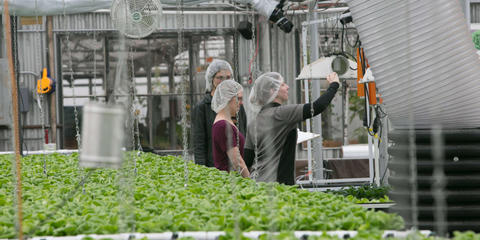
Image Credit: Green Voltaics Energy
This information was gathered from public sources. Ambrook is not responsible for or able to affect the results of any financial programs listed, nor are they responsible for any incorrect information that is listed or is on the hyperlinked external sites. All information is subject to change.
Explore hundreds more programs on Ambrook.