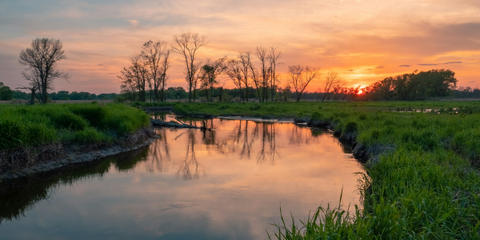
The Nebraska Buffer Strip Program, administered by the Nebraska Department of Agriculture from fees assessed on registered pesticides, enrolls cropland adjacent to perennial and seasonal streams, ponds, and wetlands in buffer strips designed to filter agrichemicals such as fertilizers and pesticides. Two kinds of buffer strips are eligible: filter strips (narrow strips of grass, minimum width 20 feet, maximum 120 feet) and riparian forest buffer strips (trees and grass, minimum width 55 feet, maximum 180 feet). It can be used in conjunction with the USDA CRP, CREP, or other programs, or by itself, and offers rental rates for irrigated and non-irrigated cropland. Rental rates (per acre): irrigated cropland with CRP/CREP/other government-funded programs = $250/acre minus payments from other programs; irrigated cropland without = $225/acre minus other program payments; non-irrigated cropland with CRP/CREP/other = 20% of the average CRP soil rental rate; non-irrigated cropland without = 120% of the average CRP soil rental rate plus $5/acre, minus any other program payment. In no case may payments from all programs exceed $250 per acre.
Eligibility
Nebraska landowners with cropland adjacent to perennial and seasonal streams, ponds, and wetlands. Filter strips must be a minimum of 20 feet wide (maximum 120 feet); riparian forest buffer strips a minimum of 55 feet wide (maximum 180 feet).
Details
Organization
Financial Instrument
Cost Share
Terms
Paid as an annual per-acre rental rate, not as a lump-sum award. The rate depends on whether the ground is irrigated and whether you are stacking this with a federal program:
-
"For irrigated cropland where CRP, CREP, or other governmentally-funded programs are also used, rental rates are $250 per acre minus payments from the other programs."
-
"For irrigated cropland where CRP, CREP, or other governmentally-funded programs are not used, the rental rate is $225 per acre minus any other program payments."
-
"For non-irrigated cropland enrolled in CRP, CREP or other governmentally-funded programs, the rental rate is equal to 20% of the average CRP soil rental rate."
-
"For non-irrigated cropland without CRP, CREP, or other governmentally-funded programs, the rental rate per acre is equal to 120% of the average CRP soil rental rate plus $5 per acre, minus the payment rate from any other programs."
Hard ceiling across all sources: "In no case may payments from all programs exceed $250 per acre." Because the state rate is computed net of federal payments, stacking CRP or CREP does not raise your total — it changes who pays which share.
Other value in the deal. Beyond rent, the program offers "incentives for partnering with other government programs" and "incidental haying and grazing allowances."
Eligibility dimensions that determine how many acres you can enroll. Filter strips (grass) must be at least 20 feet wide and no more than 120 feet; riparian forest buffer strips (trees and grass) at least 55 feet and no more than 180 feet. Only cropland adjacent to perennial and seasonal streams, ponds, and wetlands qualifies.
Not published: no contract length, no total per-landowner dollar cap, no absolute award ceiling, no cost-share percentage for establishment, and no application fee appear on the program page. The program is funded from fees assessed on registered pesticides. Enrollment runs through your local Natural Resources District or the NRCS office, and those offices set the contract paperwork.
Application Instructions
Interested landowners contact their local Natural Resources District (NRD) or USDA Natural Resources Conservation Service (NRCS) office to begin the application.
Related Programs

Acequia and Community Ditch Fund (New Mexico)
New Mexico Department of Agriculture
- GrantWater ManagementConservationLegal & FinanceResearchNM
ACRE3 Agricultural Energy Efficiency
Colorado Department of Agriculture
- GrantCost ShareLoanAlternative EnergyConservationIrrigationStorageGreenhouseCOAny
ACRE3 Irrigation Hydropower Programs
Colorado Department of Agriculture
- GrantCost ShareLoanHydro PowerAlternative EnergyIrrigationConservationWater ManagementEquipmentCOAny

AgriCapture Grassland Carbon Credits
AgriCapture
- Environmental MarketCarbon CreditsCarbon CaptureConservationSoil HealthNational
Updated October 12, 2026
Image Credit: Dave Hoefler
This information was gathered from public sources. Ambrook is not responsible for or able to affect the results of any financial programs listed, nor are they responsible for any incorrect information that is listed or is on the hyperlinked external sites. All information is subject to change.
Explore hundreds more programs on Ambrook.