
Regenerative Farmer Network Grant (RFNG)
Michigan Department of Agriculture and Rural Development
Closed February 27, 2026
The Regenerative Farmer Network Grant (RFNG) provides annual funding from the Michigan Department of Agriculture and Rural Development (MDARD) to help farmers across Michigan build peer-to-peer networks focused on regenerative agriculture.
By fostering farmer-led collaboration, RFNG accelerates the adoption of regenerative practices through shared knowledge, mutual support, and hands-on experience. Regenerative farmer networks play a vital role in scaling sustainable agriculture across the state, empowering farmers to lead, innovate, and support one another in building healthier soils, stronger communities, and a more resilient food system.
Funding priorities — networks that demonstrate consistent and creative approaches to regenerative practices, including: projects that highlight the five pillars of regenerative agriculture (integrating livestock, minimizing disturbance, promoting diversity, maintaining living roots, covering soil); on-farm education and/or research with a clear plan to share results with the broader farming community; a comprehensive outreach plan promoting the environmental, financial, and community benefits of regenerative agriculture; projects that emphasize farmer-to-farmer mentorship and farmer-led efforts; innovative projects that advance regenerative knowledge by layering, adapting, or piloting new practices; the formation of a new network in an area with little to no farmer-led regenerative activity; and marketing initiatives that develop new markets, enhance branding, and boost consumer awareness of regenerative products.
The 2026 cycle awarded nearly $500,000 to create 12 new farmer networks: Ionia Resilient Farmer Network ($45,000), Regenerative Ecology & Livestock Integration Collective ($45,000), Michigan Forever Green Field Crops ($40,397.10), NEMI Regenerative Ag Network ($29,750), Michigan RegenVine Network ($45,000), Grown in Detroit: Regenerative Network ($42,500), Southern Michigan Small Grains Pilot Network ($43,965), Washtenaw County Agroecology Network ($44,238.60), West Michigan Small Scale Regenerative Farmer Network ($45,000), Regenerative Tree Fruit Network ($31,500), Regenerative Pear Growers Network ($42,500), and From The Ground League of Growers ($42,500).
Eligibility
A farmer network for the purpose of this grant is a nonprofit collaborator plus five eligible farmers.
-
The minimum commitment is five farmers, and the five farmers must be determined before the start of the program.
-
Each of the five primary farms must meet a $6,000 gross farm revenue threshold. All forms of farm income count (livestock, produce, flowers, and more); the collaborator determines how farmers meet the threshold. Additional farms earning less than $6,000 may still join the network alongside those five.
-
The five primary farmers must be located within Michigan. Additional out-of-state farmers may join as members but cannot count toward the five required farms or receive grant funding.
-
The fiduciary must be a nonprofit or a conservation district. Networks may form their own nonprofit to serve as fiduciary. Community colleges and universities are eligible as grant administrators under the nonprofit eligibility rules.
-
Eligible nonprofits are organizations formed under Michigan state law as nonprofit corporations or associations with IRS recognition under 501(c) for tax exemption; they must be legally incorporated under Michigan's Nonprofit Corporation Act, maintain corporate governance with at least three directors and adopted bylaws, and stay in active good standing. Applicants incorporated outside Michigan should be legally incorporated as nonprofits in their state, and the nonprofit must be either Michigan-based or a national nonprofit. The applicant's mission should be in part connected to conservation or agriculture.
-
Networks do not need to be their own legal entity.
Eligibility verification is not required as part of the application; documentation and proof of eligibility are needed only if the project is audited.
Details
Release Date
January 15, 2026
Deadline
February 27, 2026
Financial Instrument
Grant
Maximum Award Amount
$50,000
Total Program Funding
$500,000
Stackable with Other Programs
Conditional — Per the program FAQ: a farm or nonprofit may have an open MDARD grant and still qualify for RFNG, but grant funds may not cover the same expenses across multiple grants and recipients must ensure there is no overlap in funding (other MDARD programs may separately prohibit concurrent active grants — check each program's language). Farms may also receive funding from multiple sources such as a university, but grantees should not receive funding for the same practice (for example, NRCS cost-share for cover cropping plus RFNG funds for the same purpose).
Terms
Awards of up to $50,000 are offered for the creation of farmer-led networks. Total funding available for the 2026 grant period was $500,000, with a stated MDARD goal of supporting a minimum of 10 networks in the first funding cycle.
Matching funds must be at least 30% of the total requested grant funds and must be directly related to the work of the farmer-led network. Match may be cash or in-kind and is not required to be specific to administrative costs. In-kind contributions can include labor, installation, equipment rental, meeting space, and similar expenses; the network determines the labor rate. The only rate set by MDARD is mileage, at $0.70 per mile. Applicants may provide their own template for tracking in-kind hours.
Individual farms within a network may receive different amounts; some farmers may choose to receive no funding but still participate. New farms joining the network after the grant agreement is signed may receive grant funds if the network agrees.
Funding can be used to expand existing practices (for example implementing them on additional acres, scaling up, or stacking practices). Projects cannot occur before the grant period and completed projects cannot be reimbursed; existing projects can be enhanced and expanded during the grant period.
Grant recipients submit one report at the end of the grant period; reporting content is outlined in the contract between the network and MDARD. MDARD requires networks to send a representative to an annual statewide meeting hosted by the department during the 2027 grant year.
Application Instructions
Applications for the Regenerative Farmer Network Grant are NOT submitted through MiAgGrants. Prospective applicants must complete the grant application available on MDARD's website and email it to MDARD-RFNG@michigan.gov.
For the 2026 cycle, MDARD began accepting applications January 15, 2026 and applications were due by 5 p.m. ET on Friday, February 27, 2026. An informational webinar was held February 4, 2026 at 3 p.m. ET.
All applications are subject to a competitive process: applications are reviewed and ranked by a committee of MDARD and partner organization staff using a scoring rubric published in the Request for Proposals. Staff from MDARD's Soil, Water, and Climate Section are available to support applicants by answering questions and clarifying the application criteria.
As of 2026-09-03 the 2026 cycle is closed and the 2026 recipients have been announced; no 2027 application package is currently posted. MDARD states it currently plans to fund this program for multiple years, with future years depending on state budgets passed by the legislature.
Farmers who simply want to join an existing network (rather than apply for funding) can do so at any time — contact MDARD-RFNG@michigan.gov to find out if there is a network nearby, or contact a local Conservation Technician using MDARD's CTAP Technical Assistance District Map.
Resources
Regenerative Farmer Network Grant FAQ: https://www.michigan.gov/mdard/business-development/grantfund/regenerative-farmer-network-grant/regenerative-farmer-network-grant-faq
MDARD press release announcing the 2026 application period (January 15, 2026): https://www.michigan.gov/mdard/about/media/pressreleases/2026/01/15/mdard-now-accepting-applications-for-new-regenerative-agriculture-grant
MDARD press release announcing the 2026 awards (July 9, 2026): https://www.michigan.gov/mdard/about/media/pressreleases/2026/07/09/mdard-awards-nearly-500000-to-create-regenerative-farmer-networks-across-michigan
CTAP Technical Assistance District Map (local Conservation Technicians): https://www.michigan.gov/mdard/-/media/Project/Websites/mdard/documents/environment/Regenerative-Ag/CTAP-TechnicalAssistanceDistrictMap.pdf
Michigan agriculture / network events: https://www.michigan.gov/mdard/environment/michigan-agriculture-events
Wisconsin DATCP Producer-Led Watershed Protection Grant (examples of established farmer networks): https://datcp.wi.gov/Pages/Programs\_Services/ProducerLedProjects.aspx
SARE Creating Farmer Networks Toolkit: https://www.sare.org/resources/creating-farmer-networks-a-toolkit-for-promoting-vibrant-farm-communities/
SARE Farmer Field Day Toolkit: https://www.sare.org/resources/the-farmer-field-day-toolkit/
Related Programs

480-a Enrollment Incentive Program
New York City Watershed Agricultural Council
- GrantNY

A Vibrant Future
International Fresh Produce Association, U.S. Department of Agriculture
- GrantClimate-SmartALCAFLGALABerriesGrapesFruitsVegetables

Acequia and Community Ditch Fund (New Mexico)
New Mexico Department of Agriculture
- GrantWater ManagementConservationLegal & FinanceResearchNM
ACRE3 Agricultural Energy Efficiency
Colorado Department of Agriculture
- GrantCost ShareLoanAlternative EnergyConservationIrrigationStorageGreenhouseCOAny
Updated September 4, 2026
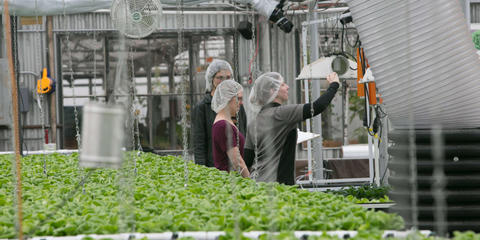
Image Credit: Seth Yeanoplos
This information was gathered from public sources. Ambrook is not responsible for or able to affect the results of any financial programs listed, nor are they responsible for any incorrect information that is listed or is on the hyperlinked external sites. All information is subject to change.
Explore hundreds more programs on Ambrook.