


We’re open sourcing the six-week curriculum we created to enable everyone at Ambrook to build their own AI workflows and automations.
This January was our busiest month ever, with 4x the customer signups we’d had the year before, all showing up at once to set up their books, dig into the product, and brace for tax season.
The ensuing three months up until Tax Day (April 15) were intense. We wouldn’t have survived it without our previous investment into process automation, internal tools, and engineering automations, but it was clear that a step-change was needed to handle this new level of scale. We knew that we couldn’t just rely on our engineering team to be building new internal tools and processes.
This was the inspiration for Momentum Month, a company-wide sprint where everyone on our team — engineers and operators — learned to identify, build, run, and evaluate their own AI workflows and automations. At Ambrook, we believe everyone should be a builder.
In just six weeks, we saw a snowball of impact across the company:
We built a declarative pipeline where agents triage incoming issues, scope them, write the fix, open a deploy-ready PR, and review the code as a first pass, with a single human code-review checkpoint at the end. We also started to introduce auto-approve for some PRs. Engineering shifted from writing most bug fixes to reviewing them.
We built a shared evals harness so anyone on the team can measure whether a skill’s output is actually good, moving us from eyeballing quality to testing against real cases.
We improved our support AI resolution rate from 20% to 50% (2.5x) with content automation loops that update help center articles to better train AI responses.
We built tools to enable our services team to use Claude to orchestrate tens of thousands of data reads/writes in Ambrook via MCP, with a review interface to safely execute deterministic changes.
Everyone on the team shipped a small feature or bug fix in the product. Our 75th percentile time-to-resolution for bugs dropped 35%.
We built a workflow to programmatically generate per-customer demo accounts with full dummy data (transactions, chart of accounts, fixed assets, liabilities, bills, invoices) customized to their industry and profile.
Our sales team built an agent to automatically brief reps with pre-read information for all calls (with suggested talk tracks and value props) to build rapport with leads on the phone, reducing call prep time from 5-10 minutes to under 60 seconds.
With new AI tools launching every few weeks, we wanted to give the team the training and foundation alongside the new expectation that everyone become a builder.
Today, we’re open-sourcing the Momentum Month process and curriculum we created to build AI fluency in everyone on the team, no matter their technical background. Read on!
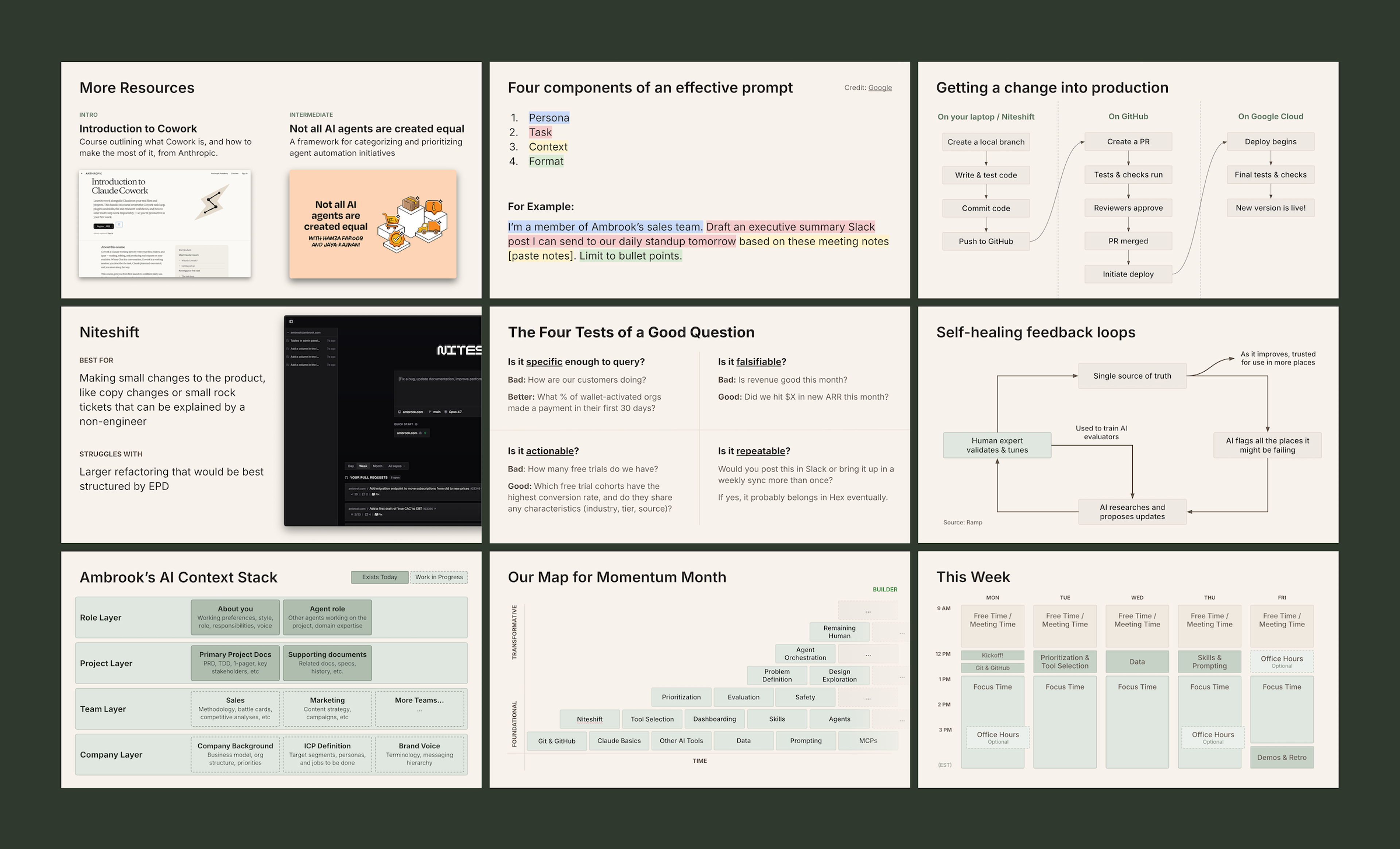
A selection of our Momentum Month curriculum.
The Setup
To prepare for the 6-week sprint, the two of us (Dan and Paige, leads of our Product and Ops teams, respectively) sat down with folks across Ambrook. We asked them a series of questions to help us understand what we needed to automate and the tools we’d need to equip the team with. These questions included:
Tell me about your day.
What kinds of data or tools do you use regularly?
How many hours of meetings do you have a week? Internal? External?
What have you done 10x in the last 2 weeks that took 5 minutes or more?
If we hired someone to help you with your job, what would you delegate to them?
What kind of work regularly falls to the bottom of your list, even though it’s important?
If you could wave a magic wand and remove one painful or tedious part of your job, what would it be?
Last time you were OOO or on vacation, what broke?
If you were CEO, what would you tell the team to automate?
From these conversations, we decided on a few things:
We asked the team to remove all recurring meetings. We’d add back only the ones that felt mission-critical.
We asked everyone at Ambrook to do the same exercise (if they weren’t one of the people we originally interviewed) so they had a prioritized list to work from.
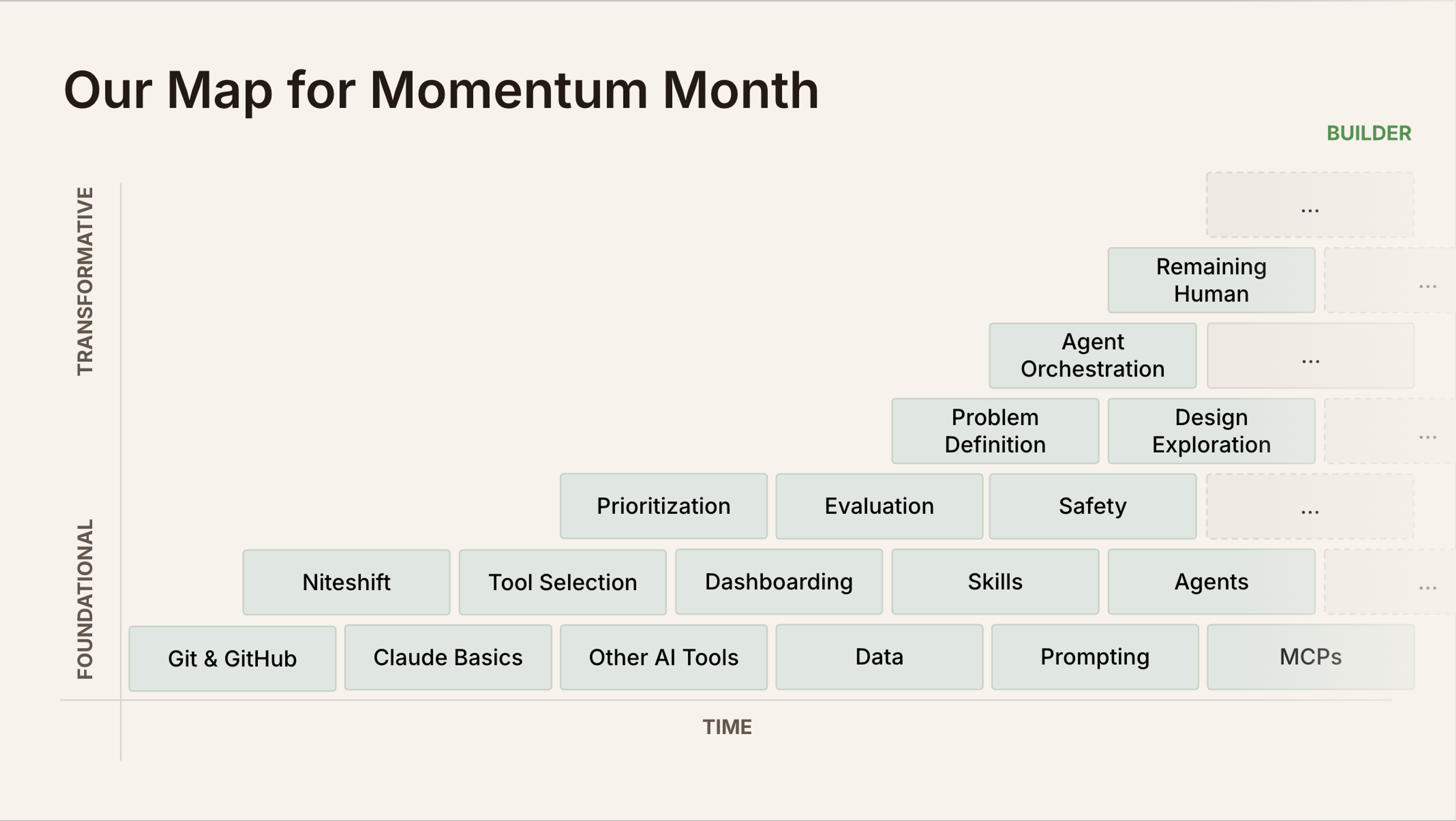
We created a “platform” pod that was responsible for building the core infrastructure that would unlock individual workflows — improving and consolidating core data systems, setting up the right MCPs, adjusting internal documentation that was distributed across multiple sources, and allowing Claude to work within the tools that teams used every day.
The Structure
A typical week had:
Tech Talk(s): a team member walking the team through a structural concept (agents, growth data architecture, automated triggers). Our final “tech talk” was hosted by our tech lead John, ruminating on how we stay human in the age of AI.
Pre-reads: short, opinionated pieces (e.g., Anthropic on building effective agents, Simon Willison on the lethal trifecta, an intro to skills and prompting).
Office hours with an engineer who could unblock you.
An individual mapping exercise: a list of things that each person could automate from their own workflow.
We broke the content into 10 slide decks, each of which contain the pre-read materials (and more) in their appendices:
We also restructured our team into small pods of 3-4 people. While we generally kept engineering and non-engineering pods separate, the latter we paired with a ”visiting engineer,” embedded as a TA rather than a builder. The visiting engineer’s job was to consult, share patterns, and surface structural blockers. They were explicitly not allowed to write the automations for their podmates.
We spent the first two weeks focused on individual automations, and the last four weeks connecting these to business goals, such as marketing funnel improvements or support efficiency, where teams were working on a set of skills together. In both cases, instead of engineers building for everyone, we had everyone building for themselves.
The Outcome
Before Momentum Month, we’d only seen individual-level workflow improvements. Users were using AI to draft, summarize, brainstorm, and code, each optimizing their workflows inside the confines of their own work. Claude skills were not shared or crossfunctional. As a result, the benefits weren’t compounding to keep up with the rate the company was growing.
Taking the time to make everyone a builder on top of shared infrastructure meant that every part of the company moved faster coming out of Momentum Month:
We built a v1 of our company brain. Every system became accessible to the organization, via an MCP or well-defined API that allows the team to avoid data entry across systems.
We created a declarative engineering, product, and design process. Now, agents use skills to triage and identify issues that can be scoped, fixed, and deployed with only a single human code review checkpoint.
Everyone on the team shipped a small feature or bug fix in the product. Our 75th percentile time-to-resolution for bugs dropped 35% — and teams across the company are empowered to file (and often fix) what they see.
Non-engineers authored skills pushed to our shared repo. Everyone can benefit from the repeatability they’ve created, and everyone can receive the feedback from their peers to make their skills better.
Operators across the company now have the tools and language to solve workflow and customer problems together. One salesperson who had identified the “jargon” as a blocker feels much more confident discussing the tradeoffs of an MCP and a webhook.
Our CX team has now shipped many small features themselves. We’ve always valued the customer-product feedback loop, but letting people independently identify and fix each tiny papercut multiplies the value of those microinteractions. One teammate said “learning how to problem-solve and unblock myself” was the most impactful part (she’s now one of our top bug squashers). An account manager was “impressed with the company’s willingness to invest in everyone’s knowledge and skills,” something we’re proud to keep doubling down on.
AI can be framed as an identity crisis, a threat to our jobs, or worse. We chose to treat it as a chance to rethink how we build the company and the team, sharpening our instinct for where judgment and intuition matter most in each workflow, the things AI can’t replace. Now the whole organization helps build the product, translating each person’s perspective and manual work into improvements.
Maybe most important: we left the sprint with new empathy for our customers, who — like millions of other businesses — are starting to adopt AI. Some are well ahead, some haven’t started. Helping others on the team become more AI-fluent gave us what we need to introduce more AI workflows into the product thoughtfully. For our customers to win, they’ll need to embrace these tools too.
What’s Next
This period was the reset we needed for everyone on the team to transform how we operate. To leverage what we’ve learned, we’re committing to:
Rethinking our team structure. We’re moving to smaller, high-agency “pods” of cross-functional teams tasked with a common goal. Engineers still have the right expertise to review code; operational teams can go deeper with the right customers. This helps us make the most of AI tools and move much faster to solve problems.
Building a true papercut-fixing engine. We’re starting a leaderboard for non-engineers filing tickets that get fixed. They’re the ones in the best position to document this friction, and we have the tools to more readily solve these — even with a small team.
Extending loops to handle more complex tasks. As new models are released and we continue to iterate on the product, we’ll have more work to do to speed up our idea-to-production pipeline even further.
Enabling our customers to become builders, too. We learned from how our teammates used these tools, and are committing to offering our customers the same opportunity. Building a community of Ambrook builders will help our customers win too.
Six weeks doesn’t make a team fluent in everything. But it has helped us understand the possibilities, and the investment it takes to make that happen. The compounding is just getting started.
If you want to compound with us, we’re hiring across all roles: ambrook.com/careers.