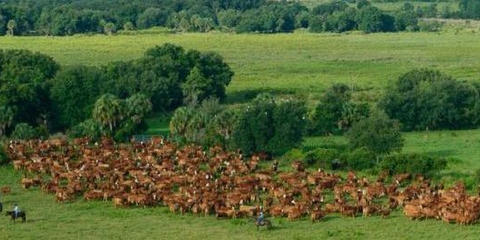
Florida Rural and Family Lands Protection Program (RFLPP)
Florida Department of Agriculture and Consumer Services
Closed January 23, 2026
The Rural and Family Lands Protection Program (RFLPP) is an agricultural land preservation program designed to protect important agricultural lands through the acquisition of permanent agricultural land conservation easements. The program is written into Section 570.70, Florida Statutes, and Chapter 5I-7, Florida Administrative Code (F.A.C.). Projects are reviewed by a Technical Review Team, ranked through a formal process by the Rural and Family Lands Protection Program Selection Committee, and approved by the Governor and Cabinet.
The program is designed to meet three needs:
-
Protect valuable agricultural lands.
-
Create easement documents that work together with agricultural production to ensure sustainable agricultural practices and reasonable protection of the environment without interfering with agricultural operations in such a way that could put the continued economic viability of these operations at risk.
-
Protect natural resources, not as the primary purpose, but in conjunction with the economically viable agricultural operations.
Originally created in 2001 with the passage of the Rural and Family Lands Protection Act, the program has successfully acquired permanent rural lands protection easements for over 232,000 acres of working agricultural land to date. The Rural and Family Lands Protection Program recognizes that working agricultural lands are essential to Florida's economic future. Agricultural lands are being increasingly threatened by urban development. To counter this trend, the Rural and Family Lands Protection Program coordinates with farmers and ranchers to ensure sustainable production practices while reasonably protecting natural resources. The program’s conservation easements ultimately provide a two-fold benefit: protecting a viable agricultural sector while providing rural landscapes and open space.
Eligibility
-
Landowners of agricultural land in Florida.
-
The land must be agricultural land consistent with the program's goal of limiting subdivision and conversion of agricultural and natural areas.
-
The project must be consistent with the Program Goals and Objectives in Rule 5I-7.001, F.A.C.
-
The land must serve at least one public purpose: wildlife habitat, protection of water resources, open space with significant natural areas, or agricultural land threatened by conversion.
-
The landowner must be willing to sell a perpetual rural lands protection easement that restricts future development of the land.
-
Any planned division of the property must be specified in the application and may not create a parcel smaller than the county's average farm size.
Details
Release Date
December 15, 2025
Deadline
January 23, 2026
Financial Instrument
Easement
Total Program Funding
$400,000,000
Terms
FDACS buys a permanent agricultural conservation easement from you — you keep the land and keep farming it, and you are paid once for the development rights you give up. Neither the program page nor the application portal publishes a payment rate, a per-acre figure, or a per-project cap; the amount is set project by project through the statutory appraisal process (s. 570.71(10), F.S. requires the department to adopt rules establishing "an appraisal process").
What the statute does fix (s. 570.71, F.S., the authority the program runs under):
-
Payment form: "Payment for conservation easements and rural land protection easements shall be a lump-sum payment at the time the easement is entered into." One payment at closing, not installments.
-
No cost-share or match is required of the landowner.
-
You keep the fee: "Easements purchased pursuant to this act may not prevent landowners from transferring the remaining fee value with the easement."
-
Large deals get extra scrutiny: the department submits a purchase agreement to the Board of Trustees for approval "only if the purchase price exceeds $5 million."
Two optional companion agreements have different, term-limited economics: resource conservation agreements pay "annual payments to landowners for services that actively improve habitat and water restoration or conservation" for "a term of not less than 5 years and not more than 10 years" (available only after you enter an easement); agricultural protection agreements run 30 years, and "Landowners entering into an agricultural protection agreement may receive up to 50 percent of the purchase price at the time the agreement is entered into, and remaining payments on the balance shall be equal annual payments over the term of the agreement." No more than 10 percent of program funds may go to those two agreement types.
Budget context: awards are competitive — projects are ranked by a Selection Committee and "approved by the Governor and Cabinet" — and the program has acquired easements "on over 232,000 acres of working agricultural land" to date.
Application Instructions
Applications are accepted only during an application review cycle, which FDACS announces in the Florida Administrative Register and on the program page. The most recent cycle ran from 8 a.m. Eastern on December 15, 2025, to 5 p.m. Eastern on January 23, 2026, and is now closed. That cycle was announced in late November 2025; the one before it closed January 29, 2025.
How to apply: submit through the online portal at https://rflppapplication.fdacs.gov/, which is linked from the program page, https://www.fdacs.gov/Consumer-Resources/Protect-Our-Environment/Rural-and-Family-Lands-Protection-Program. New applicants create an account first; FDACS publishes a guide at https://www.fdacs.gov/content/download/120217/file/rflpp-guide-create-or-access-your-account.pdf. The rule also allows a mailed application on Form FDACS-11207 (Rev. 10/25) to Florida Department of Agriculture and Consumer Services, Rural and Family Lands Protection Program, 315 South Calhoun Street, Suite 500, Tallahassee, FL 32301-1843. Applications must arrive by 5:00 p.m. Eastern on the last day of the cycle, and late applications are returned.
If your property is already on the ranked acquisition list, you must log in to the portal and confirm your original application, or submit a new Form FDACS-11207, by the cycle deadline. Projects that are not confirmed are removed from consideration.
If you plan to divide the property, describe the division in the application. The Selection Committee must approve it, and no resulting parcel may be smaller than the county's average farm size in the USDA Average Size of Farms by County table (2022 version).
You may also upload an optional 90-second video about your property for evaluators. It is not required.
What happens next: staff review each application within 30 days of receipt and send a notice of deficiency if something is missing, which you must answer within five business days. A Technical Review Team evaluates eligible projects, the Selection Committee ranks them, and the Governor and Cabinet approve the ranked list. After ranking, FDACS may prioritize projects that bring matching public or private funds.
Questions: RFLPP@FDACS.gov or (850) 681-5828.
Resources
FAQ:
What is the Rural and Family Lands Protection Program?
The Rural and Family Lands Protection Program (RFLPP) is an agricultural land preservation program, administered by the Florida Department of Agriculture and Consumer Services, designed to protect important agricultural lands through the acquisition of permanent rural lands protection easements. A thriving rural economy with a strong agricultural base, healthy natural environment, and viable rural communities is essential to Florida.
The program is designed to meet three needs:
-
Protect valuable agricultural lands.
-
Create easements that work together with agricultural production to ensure sustainable agricultural practices and reasonable protection of the environment.
-
Protect natural resources in conjunction with economically viable agricultural operations.
How is the RFLPP unique compared to other land conservation programs in the state?
The Rural and Family Lands Protection Program engages solely in acquiring development rights through rural lands protection easements, or less than fee simple acquisitions. By acquiring conservation easements on agricultural-producing land, landowners can continue farming operations and contribute to the local tax roll while preserving wildlife habitat and the environment. Additionally, by purchasing development rights through a conservation easement, the RFLPP does not impose an additional burden on the taxpayer by having to maintain state-owned lands.
What is a Rural Lands Protection Easement?
Rural Lands Protection Easements are less-than-fee acquisitions of development rights on a tract of productive agricultural land. These easements compensate property owners for restrictions on the future development of their land in perpetuity while allowing them to continue their agricultural activities.
Who is eligible to apply?
To be eligible for acquisition, agricultural land must be consistent with the program’s goals and objectives of bringing under public protection lands that serve to limit subdivision and conversion of agricultural and natural areas that provide economic, open space, water, and wildlife benefits in rural areas.
For the purposes of selecting and ranking eligible projects, funding prioritization is based on projects that are ranch, timberlands, or agriculture operations that contribute to a safe, affordable, and abundant food supply and are managed using sustainable practices; perpetuate the viability of ongoing agricultural operations on the property; are at risk of conversion to non-agricultural use; and perpetuate the protection of wildlife, water, and other natural resources.
What lands are eligible for conservation? What criteria are used to determine eligibility?
Agricultural land that is consistent with the program’s goals and objectives, and meets at least one of the public purposes identified below, will be reviewed and evaluated to determine the degree of potential value. A technical review team will analyze available data, maps, and information related to the property, its natural features and species habitat, hydrology, agricultural operation, and potential for conversion to non-agricultural use.
-
Land must meet at least one of the following public purposes:
-
Promotion and improvement of wildlife habitat;
-
Protection and enhancement of water bodies, aquifer recharge areas, wetlands, and watersheds;
-
Perpetuation of open space on lands with significant natural areas; or
-
Protection of agricultural lands threatened by conversion to other uses.
Who approves applications to the RFLPP?
The Rural and Family Lands Selection Committee, appointed by the Commissioner of Agriculture, prioritizes applications after reviewing projects and hearing public testimony. The Governor and Cabinet, sitting as the Board of Trustees of the Internal Improvement Trust Fund, ultimately approve the eligible projects submitted to the program.
Land Planning and Administration
-
Rural and Family Lands Protection Program
Program Resources
Contact Us
(850) 681-5828
↑
Document reader download links:
Need more information?
Share this page
Call Us
©2025 Florida Department of Agriculture and Consumer Services
Florida Capitol — Tallahassee, Florida 32399-0800
Questions? 1-800-HELP-FLA (1-800-435-7352) or 1-800-FL-AYUDA (1-800-352-9832), Monday – Friday 8:00 a.m.–5:00 p.m. EST | LIVE CHAT
Related Programs

Acequia and Community Ditch Fund (New Mexico)
New Mexico Department of Agriculture
- GrantWater ManagementConservationLegal & FinanceResearchNM
ACRE3 Agricultural Energy Efficiency
Colorado Department of Agriculture
- GrantCost ShareLoanAlternative EnergyConservationIrrigationStorageGreenhouseCOAny
ACRE3 Irrigation Hydropower Programs
Colorado Department of Agriculture
- GrantCost ShareLoanHydro PowerAlternative EnergyIrrigationConservationWater ManagementEquipmentCOAny

Advancing U.S. Pork Sustainability and Market Value Grant
National Pork Board, U.S. Department of Agriculture
- GrantClimate-SmartALARAZCACODEFLGAIAIDILINKSKYLAMEMDMIMNMOMSMTNCNDNENHNVNYOHOKORPASCSDTNTXUTVAWAWIWYPorkSoybeansCorn
Updated September 29, 2026
Image Credit: Florida Department of Agriculture and Consumer Services
Run this program? Email fundinglibrary@ambrook.com to request changes to this listing.
This information was gathered from public sources. Ambrook is not responsible for or able to affect the results of any financial programs listed, nor are they responsible for any incorrect information that is listed or is on the hyperlinked external sites. All information is subject to change.
Explore hundreds more programs on Ambrook.