Minta Ohlsen is explaining the math on a $100,000 repair decision.
"Is it better to just sell this piece of equipment? Get rid of it? Not even offer that option anymore?" she asks, posing the questions, before walking through the logic: "No. Because we can see we're spending this amount of money to fix it. And we're seeing that it makes us only this much. It doesn't pencil out."
She's talking about one of the heavy construction machines her family uses to build agricultural infrastructure across Northeast Kansas: terraces, irrigation ponds, the kind of earthwork that takes weeks and requires specialized equipment most operators don't own.
It's the kind of decision that used to feel like guesswork. Now, Minta can pull up enterprise tracking in Ambrook and see exactly what each piece of machinery (the D8, the scrapers, the D6 dozers) actually generates in revenue.
That clarity matters. Because Minta and her husband aren't just running a construction company. They're running a construction company, a 1,600-acre row crop operation, and a cow-calf herd.
And over the last few years, they've lost the three other people who used to help run all of it.
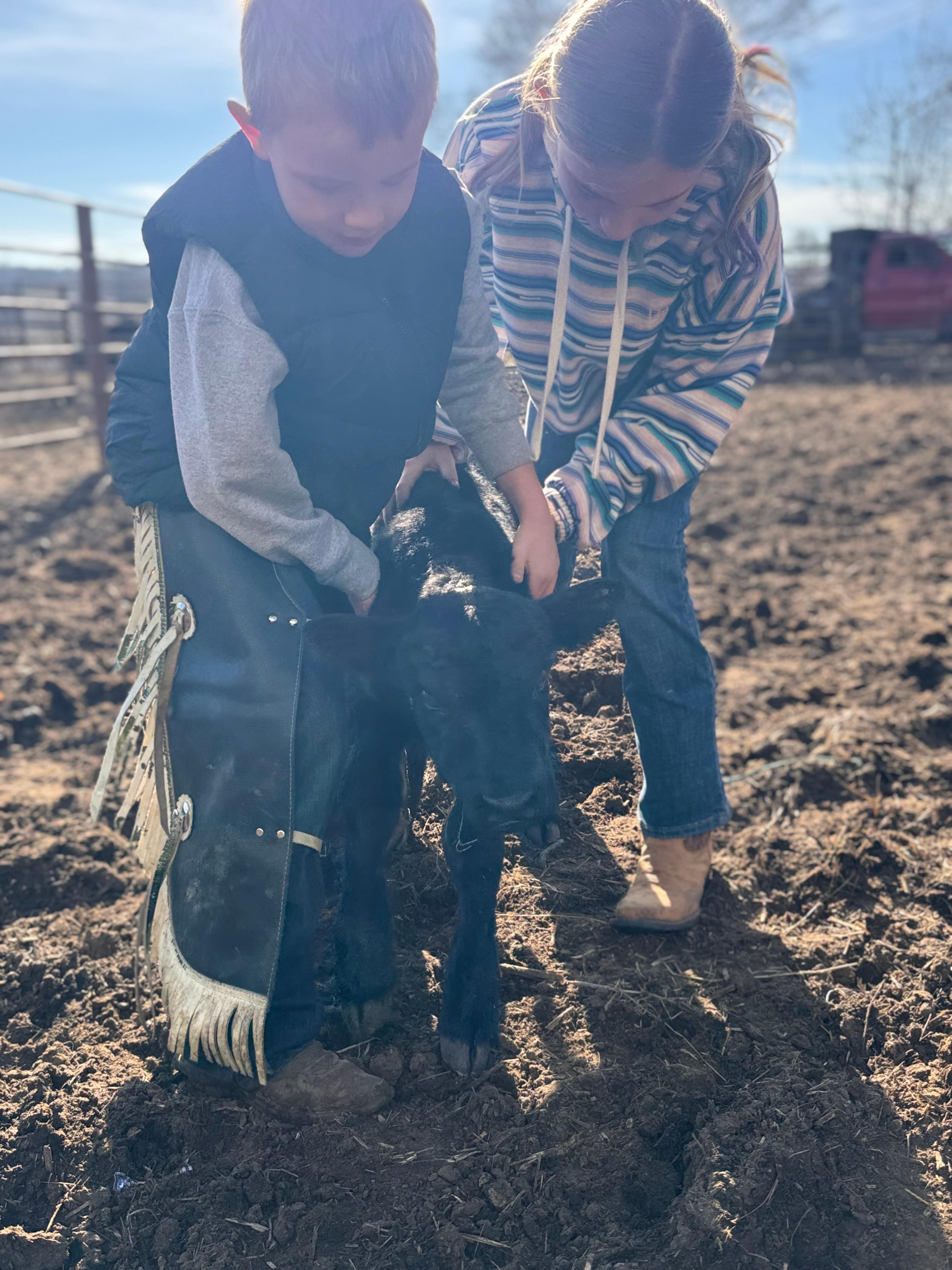
Minta runs the books for a 1,600-acre operation, a construction company, and a cattle herd, all while keeping family life running smoothly.
Background: A construction business built across generations
Minta didn't grow up planning to run the books for a multi-enterprise agricultural operation. But she grew up around them.
Her mom worked for Kansas Farm Management, a company that does bookkeeping and tax filing for farmers. Minta spent years watching her mom work through farm financials, learning the codes and categories that make agricultural accounting different from anything else.
"I've just always seen her doing these numbers, you know, growing up in that office," Minta says.
When she married her husband, she brought that background into his family's operation: a construction business that builds ag infrastructure, plus the family farm and cattle operation.
At first, the construction side was small. Her husband had a dump truck. Then a 10% share in the family company. But when his uncle passed in 2018, and then his father in 2023, everything shifted fast.
"We lost all three of those other people that were helping run this huge organization," Minta says.
Her husband's grandfather had run the farm and cattle twenty to twenty-five years ago. Then her husband's uncle and father took that on, running the construction jobs and splitting the farming work.
When it was time to spray fields, his dad could stay on the construction job site and manage the crew. During hay season, they'd swap. There was always someone who could be in two places.
Now there's one person: Minta's husband. And he can't be on a job site building an irrigation pond when it's time to plant.
The challenge: A construction billing system that didn't work
For years, Minta managed the books using QuickBooks. She learned it. She made it work. But she never stopped fighting it.
The biggest problem was construction invoicing.
"I would have to have a company that did the bills, and then a separate company that would do our invoices," Minta explains. "I couldn't ever get it to show just the accounts receivable. I couldn't sync the bill to the accounts receivable."
The result: income double-counted. She'd record a check when it deposited, but also have the accounts receivable sitting there. They'd never connect.
"It would throw all the rest of your numbers off," she says.
Even her mom, who worked in QuickBooks professionally, couldn't figure out why Minta's accounts receivable was always inflated.
Without accurate numbers, Minta couldn't answer the questions that mattered: Which jobs were actually profitable? Which pieces of equipment were worth repairing? Should they keep taking every construction job that came their way, or pull back?
"We were just winging it sometimes," she admits.
Finding Ambrook: "Just give it another try"
Minta first saw Ambrook in a Facebook ad. She'd been complaining to her mom about QuickBooks, probably while running the auger cart during harvest, calling between loads to talk through the books.
"Phones listen to you," Minta laughs. "I swear, you have a conversation and then Facebook is like, 'Hey, check this out.'"
She tried another program first. Got a few months in. Hit a wall trying to import older transactions. And decided to cancel.
Then Ambrook's support team called to check in.
"I said, 'Well, to be honest, I'm really thinking about canceling it because I can't figure out how to get the older transactions to go through,'" Minta recalls. "And they're like, 'Yeah, just give us the file. We'll get it all set up.'"
That's when things changed. The team imported her transactions, walked her through setup, and Minta started actually using it.
"Once all those transactions got in there and were in there correctly, then it was a lot easier," she says.
What changed: Construction billing that actually connects
The first thing Minta noticed was something that should have been simple all along: bills and payments that matched.
"On our construction jobs, I'm able to actually match the bills up so it doesn't double-tack the income," she says. "Now everything connects."
No more inflated income. No more separate companies to track different functions. Just clean books that showed what was real.
The invoicing itself got simpler too. In QuickBooks, every line item needed a category. In Ambrook, she could just describe the work.
"I can have a line that I put 'Dozer' or 'D8' and then 'ripping out terraces.' Just being able to do my own description, the price per hour, how many hours it was, makes it way better."
The unlock: Seeing which equipment actually makes money
But the feature that changed how they run the construction side was enterprise tracking.
Minta had always wanted to track enterprises. She'd heard about it in QuickBooks but could never figure it out. In Ambrook, she set it up in minutes.
Now she tracks construction by equipment type: the D8, the scrapers, the D6 dozers, pipe costs. Each one is its own enterprise. When an expense comes in, she can assign it. When a job is billed, she can see which machinery drove the revenue.
"Just being able to see which pieces of machinery are we making the most money on makes a huge difference."
That visibility unlocked decisions that used to feel impossible.
When a major piece of equipment needed a $100,000 repair, Minta could pull up the enterprise data and show her husband: this is what it costs to fix, but this is what it makes us. The decision became obvious.
"It's not a better option to sell it," she says. "Because this is what it makes us."
Making decisions with real numbers
The construction business runs differently now.
After their employee retired at 67, they had a choice: replace him and keep trying to take every job, or scale back strategically.
"Do we really need to replace that on the construction side?" Minta asked.
Her husband doesn't love managing people. The stress of running a large crew, being pulled between job sites and farming, wasn't sustainable. But without clear financials, it was hard to know if they could afford to scale back.
Now, Minta can show him the full picture.
They've decided to focus: terrace building in the off-season, when farming is quiet. November through March, as long as weather's good, they can take on those jobs without the stress of being in two places at once.
"Once farming is over, you can build terraces," Minta says. "Maybe you just focus on building terraces for people instead of trying to take on every single job that anyone ever asks us to do and be so stressed out that you're never home."
They don't need to make as much from construction with one fewer employee. The farm income covers more. And the construction work they do take on is profitable. Minta can prove it.
Impact: "Look at this. We're fine."
Minta's husband is 37. He lost his father at 36. And he carries a fear that a lot of third-generation operators carry.
"There's that saying: first generation buys it, second generation pays for it, and third generation loses it," Minta explains. "He is third generation. So in the back of his mind, he's like, 'Am I going to make it? Am I going to make it? Is it going to be okay?'"
Now, when that fear comes up, Minta can .
"I can pull up Ambrook and say, 'Look at this. We're fine,'" she says. "Here's the numbers here, how it breaks down. We're making money."
That reassurance isn't vague. It's specific. She can show him exactly what each enterprise (construction equipment, corn, soybeans, cattle) is generating. She can show him what they spent, what they made, and where they're headed.
For someone carrying the weight of keeping a multi-generational operation alive, that clarity is everything.
"I can pull up Ambrook and say, 'Look at this. We're fine. We're making money.'"
Looking ahead: Investing with confidence
They're not just surviving anymore. They're planning.
Minta and her husband are investing in what they can control: grain storage, so they're not forced to sell at harvest when prices are worst. Irrigation, so they can manage water and yields. Their own equipment, so they can build infrastructure without outsourcing costs.
"We can't control the market," Minta says. "But we can control having our own storage."
On the construction side, they're investing strategically too. They know which equipment pays for itself. They know which jobs to take and which to turn down. They know they can scale back without losing profitability.
"It's just really easy to search and navigate the functionality of the app," Minta says.
"It's user-friendly. It's easy. So I can make decisions based off of what I'm seeing when I'm looking at the whole picture of what's going on."
Building something that lasts
Minta still runs the books from her phone between auger cart loads during harvest. She still prints out reports for their accountant. She still juggles a daughter and a son, taking her daughter and the neighbor kids to dance practice, plus managing a farm and a construction company and cattle.
But she's not winging it anymore.
When a construction invoice comes in, it connects to the payment. When a piece of equipment needs repair, she can see if it's worth it.
When her husband worries they won't make it, she can show him they will.
The construction business that his grandfather started, that his father and uncle built, that he's now running alone, it's not just surviving. It's profitable. And Minta can prove it.