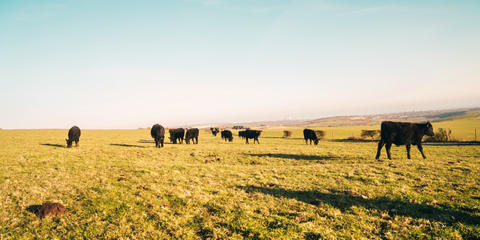
The Utah Grazing Improvement Program seeks to improve the productivity, health, and sustainability of Utah rangelands and watersheds. It’s believed that well planned and managed livestock grazing is the most important landscape-scale tool for maintaining healthy rangelands, watersheds, and wildlife habitats. Healthy rangelands contribute to a healthy livestock industry and productive rural economies. The goals are to strengthen Utah’s livestock industry, improve rural economies, and to enhance the environment. The program includes three grants:
Utah Grazing Improvement Program Grant
-
Applications are open annually through January 1.
-
The Utah Grazing Improvement Program (GIP) provides cost-share grants to rangers for rangeland improvements. Eligible projects include any restoration work that will improve rangeland health, productivity and management. In order for proposals to be competitive, a recommended maximum request is $100,000.
-
Project examples: elimination of invasive species, reseeding, livestock water development and improvements, fencing, grazing management planning, and any other projects that improve watershed and rangeland health and productivity.
UGIP Predatory Animal Control Grant
-
2022 Application window open through June 17, 2022.
-
This grant is open to eligible livestock producers who have suffered predation losses and provides reimbursement for up to 50% of the cost of the contracted amount for practices used to stop or reduce predation. A total of $150,000 is available.
UGIP Small Livestock Producers Grant
-
2022 Application window open through June 17, 2022
-
This grant is open to small livestock producers (50 animal units or less) for projects that will improve grazing management on federal, state, or private land. A total of $100,000 is available with an award maximum of up to $10,000.
Eligibility
Individual livestock producers apply — this is a producer cost-share program, not a partner-only fund. The umbrella test, verbatim: "Grants are available to livestock producers operating in the State that graze cattle, sheep, goats, and horses."
So three things must be true before anything else: you graze livestock (cattle, sheep, goats or horses), you operate in Utah, and your project improves rangeland — "project examples include water developments, fencing, and vegetation treatments."
The three tracks then have their own published eligibility:
-
Utah Grazing Improvement Program Grant — "Eligibility: livestock operations." Maximum request $200,000. Deadline December 31. No herd-size floor or ceiling is published for this track.
-
Small Livestock Operation Grant — the only track with a hard size test, and it cuts both ways: "Eligibility: 20 to 75 animal units (minimum: 20 cows, 100 sheep, 130 goats or equivalent animal units)." Below 20 animal units you are too small; above 75 you are too large for this track (use track 1 instead). You "must be producing food and fiber for sale" — so hobby and non-commercial operations do not qualify. Excluded uses: "Not for purchasing/leasing land or livestock." Maximum request $10,000. Deadline December 31.
-
Predatory Animal Control Grant — "Eligibility: livestock producers who have suffered predation losses." A documented loss is the gate. Maximum request $150,000. Deadline August 31, and the page currently marks this track closed.
The program page reads "Now Accepting Applications." Statutory basis: the 2006 Rangeland Improvement Act (HB145) established GIP "to provide cost-share grants for projects that improve rangeland management and sustainability."
Not published anywhere on the page: the cost-share percentage or producer match you must bring, any acreage minimum, any revenue test, any land-tenure requirement (the page does not state whether the project must be on private, state or federal allotment), and any audience restriction such as beginning or veteran producer.
How to apply. The program page names a separate application for each track — "Grazing Improvement Program Grant Application," "Small Livestock Operation Grant Application" and "Predatory Animal Control Grant Application" — but the underlying application URLs are not exposed in the page's HTML, so there is no confirmed self-serve link. UDAF does not publish an instruction to apply through a coordinator; the regional coordinators are listed on the page as contacts, and calling yours is the practical way to get the form and the project requirements. GIP Division Director is Troy Forrest, (435) 279-3603.
Details
Deadline
December 31, 2026
Organization
Financial Instrument
Cost Share
Maximum Award Amount
$200,000
Terms
Cost-share grants for rangeland projects — water developments, fencing, vegetation treatments. Three tracks with separate ceilings, all published on the UDAF page:
-
Utah Grazing Improvement Program Grant — "Maximum Request: $200,000." Eligibility: livestock operations. Deadline December 31.
-
Small Livestock Operation Grant — "Maximum Request: $10,000." For operations of "20 to 75 animal units (minimum: 20 cows, 100 sheep, 130 goats or equivalent animal units)." Must be "producing food and fiber for sale." Explicitly "Not for purchasing/leasing land or livestock." Deadline December 31.
-
Predatory Animal Control Grant — "Maximum Request: $150,000" for "livestock producers who have suffered predation losses." Deadline August 31; currently marked closed.
Eligible operations graze cattle, sheep, goats or horses in Utah.
The cost-share percentage and any producer match requirement are NOT published on the program page — the statute (2006 Rangeland Improvement Act, HB145) established GIP "to provide cost-share grants for projects that improve rangeland management and sustainability," but the producer's share is not stated. Ask your regional coordinator (contacts are listed by region on the page) for the current match expectation before you budget. No contract length is published either.
Application Instructions
Contact your regional coordinator for an application and information on project requirements and work with your coordinator to applying for grant funds. Find your county coordinator using this map.
Resources
-
Representatives and Contacts (For GIP assistance in your area)
-
Utah Rangeland Improvement Act (Utah Code Annotated: Title 4, Chapter 20)
Related Programs
ACRE3 Agricultural Energy Efficiency
Colorado Department of Agriculture
- GrantCost ShareLoanAlternative EnergyConservationIrrigationStorageGreenhouseCOAny
ACRE3 Irrigation Hydropower Programs
Colorado Department of Agriculture
- GrantCost ShareLoanHydro PowerAlternative EnergyIrrigationConservationWater ManagementEquipmentCOAny

ADM re:generations
ADM
- Environmental MarketCarbon CreditsCarbon CaptureSoil HealthCover CropsClimate-SmartNationalCornSoybeansWheatCanolaPeanuts

Advancing U.S. Pork Sustainability and Market Value Grant
National Pork Board, U.S. Department of Agriculture
- GrantClimate-SmartALARAZCACODEFLGAIAIDILINKSKYLAMEMDMIMNMOMSMTNCNDNENHNVNYOHOKORPASCSDTNTXUTVAWAWIWYPorkSoybeansCorn
Updated September 4, 2026
Image Credit: Ben Collins
Run this program? Email fundinglibrary@ambrook.com to request changes to this listing.
This information was gathered from public sources. Ambrook is not responsible for or able to affect the results of any financial programs listed, nor are they responsible for any incorrect information that is listed or is on the hyperlinked external sites. All information is subject to change.
Explore hundreds more programs on Ambrook.