“There is a lot of divine design around reindeer.”
It’s a common adage in ranching that one doesn’t name their livestock. It makes the act of slaughter for food harder, and blurs the line between farmed animal and pet. Yet one type of rancher is built differently: reindeer herders. They’re accustomed to naming their animals precisely because this sector of the agritainment industry is built on tourism and visitors returning year after year, mostly around Christmastime. That gives herders a lot of time the rest of the years to care for their creatures and become quietly enamoured by them.
“It’s very different from elk, or other deer farming,” said Jane Atkinson, owner of Running Reindeer Ranch in Fairbanks, Alaska.
In North America, reindeer are often considered a cousin to caribou because while they are domesticated, caribou are their wild counterpart. But part of it is also semantics: While they are the same species, Rangifer tarandus, the word caribou is only used on this continent. The rest of the world calls various caribou subspecies reindeer. Caribou are native to Alaska, and reindeer are native to Eurasia, from countries such as Finland, Norway, and Russia.
But both animals are in deep trouble. An August analysis found that by 2100, caribou populations in North America could decline by up to 80 percent due to global warming. There are nine million reindeer and caribou grazing throughout the Arctic Circle today, but the future outlook became increasingly dire when the Trump administration announced that it was re-opening oil and gas drilling leases in Alaska’s Arctic National Wildlife Refuge — deep in the state’s far-North caribou range.
Reindeer herders who make their living through holiday tourism under no circumstances slaughter their livestock; this festive corner of ranching has everything to do with their conservation.
Eating Rudolph?
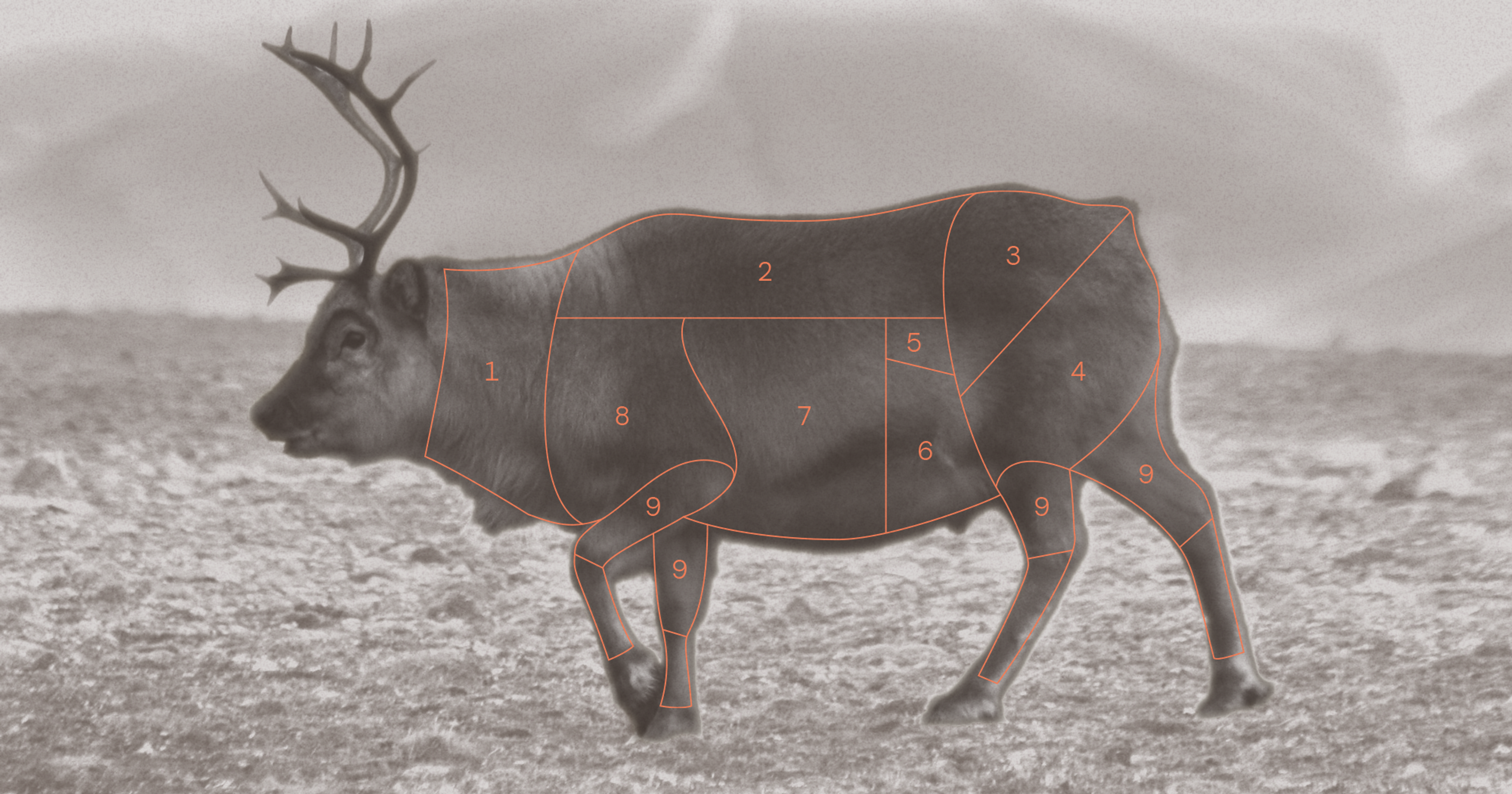
Often, there is an interplay between mammal conservation and human consumption. Some animals, such as bison, have been buoyed off of the edge of extinction by becoming a protein that can be raised, ranched, and slaughtered for food. But reindeer are not thought of as a food product in the United States for a simple fact: They’re far too expensive to eat.
“When I bought my first two reindeer [in 2015], they were a fifth of the price of one reindeer now,” said Cassandra Hoover, a reindeer farmer in the Poconos in Pennsylvania. “So in 10 years, the price of them has gone up exponentially.”
Lauren Waite, the farm manager of the Williams Reindeer Farm in Palmer, Alaska, said that when her grandfather was working their family reindeer farm 25 years ago, reindeer sold locally for $500. Now, they easily go between $15,000 to $30,000 each.
It wasn’t always this way. The first reindeer entered the United States in 1892 from the Russian Far East as a source of meat for Indigenous tribes who lived in the Arctic. These groups had always been subsistence hunters, not herders, but Presbyterian Minister Sheldon Jackson argued that herding animals would provide a greater economic livelihood for Arctic peoples.
Reindeer are not thought of as a food product in the United States for a simple fact: They’re far too expensive to eat.
But the experiment of importing reindeer as a food source was a fraught one because more animals fell into ownership by missionary groups than tribal communities. In 1937, Alaska responded with the Reindeer Act, which restricted animal ownership to solely Native populations. In those years, Canada bought thousands of head of reindeer stock from Alaska, and established its own herding communities.
But things changed by the 1980s, Atkinson says, when ranchers identified a loophole: If a reindeer was imported into Alaska from Canada, anyone could own it, not just Native peoples. “It’s really only been 30 years since non-Native people have been able to own reindeer in the state,” Atkinson said. Due to that, the larger agritainment industry in the Arctic has slowly but surely emerged over the past generation or so.
For example, when Waite’s family began their farm, the original intention was to raise reindeer for meat, but the family fell in love with them. Now, they have about 120 reindeer, which is the largest captive herd in North America, Waite said. The business sustains itself through selling live reindeer to other herders and from agritourism to the farm.
Seeing Is Believing
In 2019, the last wild caribou in the lower 48 that migrated from the far north was captured and transferred to Canada to await rejoining another herd. The only place to see these animals in the continental United States now is at reindeer farms, and the only state where you can still see caribou in the wild is Alaska. The question is for how long.
Knowledge and conservation advocacy are a chain of events, Waite said. A family may be watching TV one night, and see wild caribou or reindeer on a show. From there, they may visit a reindeer farm and actually get to interact with the animal in-person. Before long, maybe they take their annual vacation to Denali National Park, and see that these animals do have a place, still, in wild ecosystems.
“From my perspective as a reindeer farmer, I would love for more wild caribou to be preserved,” she said. “That’s what we think contributes to conservation today, that people have positive experiences with our animals.“
“That’s what we think contributes to conservation today, that people have positive experiences with our animals.“
Reindeer have many idiosyncrasies, which contributes to a passionate subculture and community of herders. For example, when there is a herd of reindeer and a threat is detected, they immediately move the babies and weak members of the herd into the middle of the group, and run circles around them, like a clock, to confuse predators until they give up. Their antlers are like a fingerprint, and each animal (typically) grows back the same rack year after year. The long hair on their necks protects them from the Arctic cold, but also serves as an optical illusion: Their necks look lower than they actually are, so if a predator jumps to bite into their throat, they’ll miss by a few inches, giving them time to run away.
“There is a lot of divine design around reindeer,” said Hoover.
Atkinson argues that her business is different from a zoo where people can run from one exhibit to the next. People have to learn about the reindeer if they come on a tour to her farm, she says, which is important to her. There is so much to understand about wild animals, a changing climate, laws, and regulations. A single tour may barely scratch the surface, but people are interested in taking on that responsibility.
“By sharing that information, us herders help conservation in that way,” Atkinson said. “We donate a lot of money to caribou conservation, [...] and only through that education do people understand what is really going on.”