Trump announced plans to increase grazing on public lands. Critics say the land can’t support any more.
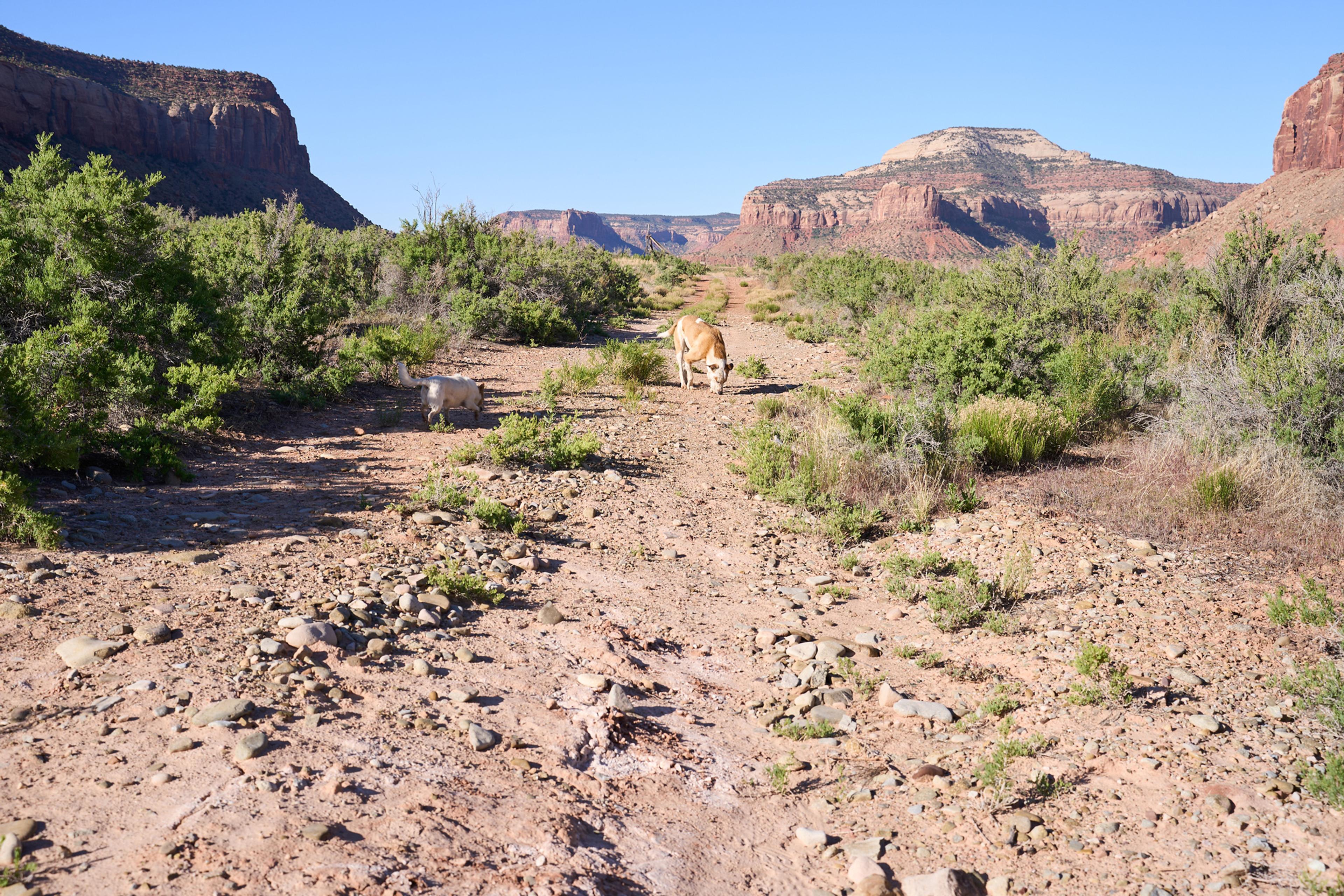
Every Father’s Day, Cortney Lemon and her father drive 60ish head of cattle from their 240 acres of irrigated alfalfa and timothy in Colorado’s remote southwest corner, up into the higher elevations of the Uncompahgre National Forest. There, until early October, the cows fatten up on mountain grasses as they wander among sagebrush and aspen and pine on two 1,000-acre allotments, permits for which came with the Lemons’ ranch when they purchased it some 30 years back. What Lemon refers to as the heritage of public lands grazing gives her pastures a chance to rebound from eight months of heavy use. It’s also a contentious practice that’s fixing to become even more fraught in the months ahead.
That’s because the Trump administration recently announced a plan to increase livestock grazing on public lands. Ostensibly, the aim is to bolster America’s beef industry — the size of the national herd is currently at a 65-year low — and it’s so far been cautiously celebrated by some ranching groups. (Counterpoint: This administration has promised, too, to lower beef prices by increasing purchases from Argentina.)
But Trump has also issued an “instruction memorandum,” deactivating what critics say were already too-scant environmental protections for these lands, overseen by too few land managers. He also pushed to boost mining, logging, and oil extraction. All this has left researchers, environmentalists, and park enthusiasts fearful that these collectively held resources will soon become degraded, taking their myriad benefits along with them — including for ranchers themselves.
“It’s exactly the wrong way to go,” said J. Boone Kauffman, conservation ecologist at Oregon State University and lead author of a 2023 paper on the negative impacts of grazing on semi-arid Western public lands. He had a lot to say about the reasons why: “We’re exacerbating the impacts of climate change. You’re going to see increased desertification. You’re going to see … warmer, drier conditions” — in fact, Lemon’s part of the world is currently experiencing unprecedented snow drought. “Even with increasing carbon in the atmosphere, you’re going to see decreased forage quality, less protein in the grasses [that] will hasten the decline of the productivity of these lands, and we will lose wildlife species and native plants and water quality. It’s all just moving down to a dead end where there’s no future.” Does anyone win in this scenario?
A Brief History of Public Lands Grazing
In 1862, Abraham Lincoln began giving acreage on the Western range to our homesteading forebears if they promised to cultivate it. Unfamiliar with the sere and vulnerable terrain, they brought in sheep and cattle that eventually wore down the land and depleted limited water resources. In response, Congress in 1934 passed the Taylor Grazing Act. Ranchers who owned “base property” that was ample and fertile enough to support herds and flocks for part of the year could now apply for permits (many issued in perpetuity and linked to those properties) to graze their animals on public lands the rest of the year.
Annual fees were partially earmarked for range improvement to be overseen by what’s now known as the Bureau of Land Management (BLM) — although the U.S. Forest Service (USFS) provides permits and environmental oversight as well. BLM offers 18,000 permits and leases for a total of 155 million grazed acres; USFS has a little over 6,100 active permits for 93 million grazed acres. In Western states, about 87 percent of public lands are grazed, estimates Kauffman, producing nearly 2 percent of U.S. beef.
Now as then, fees for public lands grazing are significantly lower than market rate for grazing on private land. This is an enormous bone of contention among critics, who argue that these fees nowhere near cover the cost of administering the program, which means it was subsidized by taxpayers to the tune of some $1.5 billion in 2024.
“Our ranch relies on public lands — we have to get our cows off the fields in order to put up hay.“
“The taxpayer is getting bilked,” according to Erik Molvar, executive director nonprofit Western Watersheds Project, which advocates for reduced grazing on public lands to better support the likes of wild horses, sage grouse, and wolves. Meanwhile, he said, “We have these regulations that are supposed to require the agencies to monitor all of the grazing leases and … take corrective action” to improve them before the next grazing season begins. “That almost never happens,” he said, and likely won’t anytime soon now that federal agencies have been gutted by DOGE.
As a result, he said, many grazing allotments are “failing basic land health standards.” Part of the reason is that swaths of the West are not well-suited to livestock — the land’s too dry, the soil’s too shallow and nutrient poor, the forage is too scant. Over-grazing is also rampant, said Molvar, pointing out that BLM allows permittees to graze off 50 to 65 percent of vegetation, where rangeland managers recommend allocating 25 to 30 percent of forage to livestock on private lands.
Darby Smith is a fifth generation rancher in Southwestern Montana’s Boulder Valley. She and her father run a medium-size cow-calf operation that has BLM and USFS permits in and around the Elkhorn Mountains and Beaverhead-Deerlodge National Forest. Smith says her family is “extremely grateful to have access to public lands,” which are essential to their business. She also agrees that land monitoring is essential, and knows that her USFS manager is short-staffed, meaning there’s likely to be less oversight.
In the past, “Forest Service has worked really closely with us to make sure grazing is done properly, that any weed concerns are taken care of,” she said. Now, at a time when “we’re up against a drought … that half of the partnership is up in the air.” Without monitoring, she doesn’t see how expanding grazing on public lands is viable. “You’d have to put people in charge who know the land and know what they’re doing, not just throw a bunch of cows on land that hasn’t been grazed before and expect it to turn out okay,” she said.
Winners and Losers
Lemon ranches in a part of the country where the ecology better supports well-managed cattle. Despite the Trump administration’s promise of expanded grazing, she still mulls over what would happen if she lost her existing grazing permits. She said that would force her to find lease land that’s becoming ever scarcer and more expensive as wealthy transplants buy up acreage. Smith ranches on semi-arid land and although her father purchased an additional private parcel about a decade ago, where some of the herd could graze, “Our ranch relies on public lands — we have to get our cows off the fields in order to put up hay. There’s some places that we could lease, but every other ranch would be trying to get those leases too. That would put a lot of pressure on our neighbors, and I don’t think everyone would survive,” she said.
That’s a reality many ranchers now contend with, said Tessa Wittman, a conservation scientist who worked for BLM until a year ago. She sees Western land becoming more and more fragmented as non-ranchers purchase once-viable private grazing parcels at huge expense, build 40-acre ranchettes on them, and put up fences to keep out cattle; Smith says they’re also depleting scarce water resources as they drill deep down into aquifers. This pattern is a pending disaster for small- and mid-scale ranchers from an access and affordability perspective, which expanded public grazing will not fix: “It isn’t going to magically create a viable livestock market, affordable private lands, and enough ranchers that actually want to do the work,” Wittman said.
From her perspective, this fragmentation is one of the real villains in the public lands scenario, thwarting both conservation efforts and attempts to increase home-grown beef. “There is public land available that could produce enough forage for a ranch to come in, but there’s no viable private land because it’s all become too expensive for ranchers. So the question is, how do we keep ranchers in business?” Wittman said. “It doesn’t matter how much public land you have for grazing if you don’t have the ranchers who have the private land to sustain it.”
For Kauffman, the more relevant question is where grazing could expand to, with so much land already devoted to the enterprise. He’s concerned that refuge areas, like Hart Mountain National Animal Refuge in Oregon, might be targeted. “It’s a huge area, 200,000-plus acres, that has not been grazed now for 25 years,” he said. “If that were to be re-grazed, it would be just a tragedy beyond imagination, because it is in such a great ecological condition.” Both Wittman and Molvar worry that “expansion” means something along the lines of increased stocking rates on land that can’t take anymore. “If you’re a grazing permittee and you can barely keep your herd alive on the stocking rates you’re allowed, what does doubling that do for you? Not much,” Molvar said.
“My dad always says that ranchers are an indicator species — if you see ranches around, those connect the public lands.”
Unlike Molvar, Wittman believes that public lands grazing can be compatible with conservation and climate-mitigation goals — she’s worked with ranchers she says are excellent land stewards. Kauffman allows that on sturdier terrain, like the Great Plains, this dual aim might be achievable. Said Wittman, “I think what we have in place — the systems, the policies and the financial support — can absolutely support a level of American productivity,” the need for which was laid bare by Covid’s food chain snafus. And Smith points out that ranches provide essential habitat. “My dad always says that ranchers are an indicator species — if you see ranches around, those connect the public lands,” she said. “We really see ourselves as part of a larger ecosystem that enables, not just cows, but other wild animals to move between different mountain ranges and have access to different ecosystems.”
But as ranchers and environmentalists bicker instead of coalescing around the decreased development both sides are fighting for, they’re providing cover for other, less deserving entities. A recent investigation by High Country News and ProPublica found that two-thirds of BLM and one-half of USFS grazing lands were controlled by a handful of very large, wealthy ranchers — like Fox News owner Rupert Murdoch, who does not need low-cost publicly subsidized lands to support his cattle hobby.
Wittman believes this reveals part of the true impetus for Trump’s grazing expansion plan — not “multi-generational family ranching production that maintains open space and conserves wildlife; that’s the dream,” she said. But we are “opening up public lands for whatever use [the administration] chooses. If you can get the policy through to open up some wilderness areas that were previously off limits to grazing, then maybe you can get some mining in there too, maybe you get logging in there too.”