There’s been a push to restore whole and 2 percent milk to school meals ever since they were disallowed in 2012. That effort is about to pay off.
This November, in a rare act of singlemindedness, the U.S. Senate voted unanimously to pass a bill that would allow whole and 2 percent milk to be served in schools. On December 15, the legislation passed the House and now awaits a presidential signature. Now, nutritional guidelines that since 2012 have mandated that only fat-free and 1 percent milk be offered at school meals will soon be overridden. “Kids are gonna love it, it’s just gonna be fantastic for them,” said Tim Hawk, a vice president at Dairy Farmers of America (DFA), echoing a common pro-fattier-milk sentiment across the industry.

Having experienced a steady downward spiral of milk prices and small farm losses since the 1970s — concurrent with a large drop in milk consumption — dairy farmers take this potential return to “real” milk as a big win. Although they offer differing opinions on the ultimate benefit. Some see it as industry salvation — a way to get more money in farmers’ pockets. Others view it more as a corrective to a poor nutritional decision, enacted during the Obama administration, that they say has had adverse effects on children’s health. Both groups, though, feel victim to what one insider called a “rigged system,” in which a less tasty and desirable product (fat-free milk) turned public sentiment against them, contributing to dairy’s ongoing crisis.
Thanks to 13 years of low- and no-fat milk in the National School Lunch Program (NSLP), “We lost two generations of milk drinkers,” said Nelson Troutman, a fifth-generation, semi-retired dairyman in Berks County, Pennsylvania.
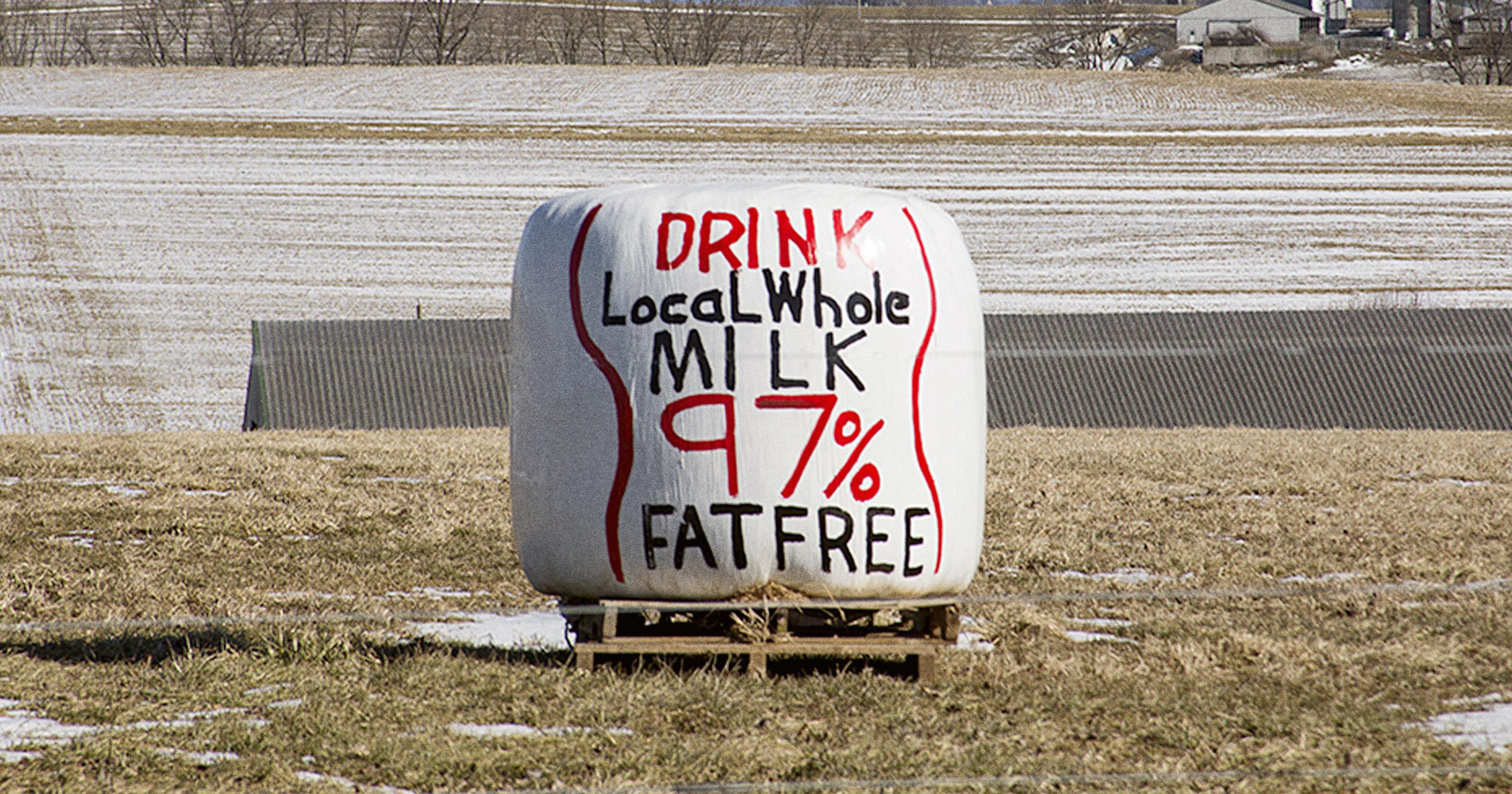
Back in 2019, Troutman kicked off a one-man grassroots campaign with hand-painted hay bales meant to drum up public fervor for whole milk. He and several other Northeast farmers now spearhead a nonprofit called 97 Milk, a reference to store-bought whole milk’s three-ish percent milkfat content. “So many people we’ve talked to think whole milk is 100 percent fat,” Troutman said. “Now come on! Ice cream is 8 to 15 percent butter fat ... but that’s what you see on the internet.” And what Troutman’s hay bales — which proclaim whole milk to be 97 percent fat-free — aim to counteract.
Troutman believes that by providing higher-fat milks in schools, demand for them will naturally rise and boost lethargic milk sales. “Long-term, when the kids start drinking good milk in schools, they’re going to want good milk at home,” he said. That “would help the farmer that’s producing the milk.”
“As a kid, my mom was entirely on the low-fat bandwagon; she bought ‘white water,’ is what we used to call it.”
Jay Hoyt grew up on a Northeastern dairy farm and has been driving a feed truck since 1972. In Washington County, New York, where he moved after graduating from college, “There [were] over 600 dairy farmers and now that it is 50 years later, there’s only like 35 or so left,” he said. He partly blames processors who reap profits while paying out low milk prices to farmers for this demise, and who make extra money by skimming the fat off whole milk and selling it for ice cream, butter, and cheese — extra money the farmer never sees.
Hoyt volunteers with Troutman’s 97 Milk campaign, spurred in part by a desire to help dairy farmers survive. However, “I’ve come to the conclusion I probably can’t save [any] farms,” he said. Instead, he’s now focused on “saving these kids from bad nutrition and maybe giving them a little more healthy product. Now I’m not trying to tell you that skim milk is bad nutrition. I’m just telling you that 50 percent of that milk goes in the garbage after the kid takes it at school.” (One research estimate puts milk waste at 45 million gallons per year.) “That may count — as far as the government’s concerned — as nutrition, but at the end of the line, there is no nutrition in what goes in the garbage.”
Shane St. Cyr is a co-owner of Adirondack Farms in Clinton County, New York, and a board member of the Northeast Dairy Producers Association — an organization he said felt “really great” about efforts to get whole milk back in schools. It’s “full of nutrients, full of vitamins and minerals that kids need, and it’s naturally made, it’s readily available, and it’s healthy.” Was he suggesting that lower-fat milks were not nutritious or healthy? “I’m not a nutritionist, so I can’t really speak to that,” he said. “I do know that I think there’s a lot of products out there that have much higher levels of things that are not healthy and not nutritious.”
Better nutrition is, in fact, a huge talking point across the whole-milk campaign, including among some cheerleaders of the Make America Healthy Again (MAHA) movement. They’ve argued that there’s no link between childhood obesity or other poor health outcomes and full-fat milk — the impetus for removing it from the NSLP in the first place. Recent studies have both seemingly backed up and contradicted this claim, and public health experts are similarly at odds on the matter.
Many balk at the idea of subjecting kids to any extra saturated fat when they’re already consuming too much, while influential Tufts University nutrition professor Dariush Mozaffarian has asserted that there’s no evidence that whole-fat dairy is “worse” than low-fat dairy.
Largely left out of the nutrition conversation as it relates to school meals: organic milk, which is produced without antibiotics and growth hormones, and pesticides in feed, and which has been shown to have higher levels of healthier fats. But as New York organic dairy farmer Samantha Kemnah pointed out, the rates that the USDA reimburses schools for food are already so low that nutrition directors don’t have the capacity to pay extra for organic.
“At the end of the line, there is no nutrition in what goes in the garbage.”
“The only [organic milk] initiatives that have gone anywhere have been grant-funded,” she said, alluding to a $1.75 million USDA grant issued in the spring of 2025 — arguably a pittance — meant to boost organic dairy sales to schools in 11 Northeastern states.
Still, Kemnah, like her conventional dairy colleagues, expressed support for getting fattier milks back in schools, and a nostalgic personal preference for them. “As a kid, my mom was entirely on the low-fat bandwagon; she bought ‘white water,’ is what we used to call it,” Kemnah said. “And then I went to a friend’s house where they bought whole milk and it was a revelation.” Like other dairy farmers interviewed here, she also expressed skepticism that the big players in the industry actually wanted to see this switch happen. “I would love to see whole milk in schools. Will the industry, which is behemoth, let that happen?” she mused.
In fact, DFA has come out in strong support of whole and 2 percent milk in schools, as have the Farm Bureau and other industry players. DFA’s Hawk said that his organization has been celebrating the recent Senate win and that they kept “working with legislators to move this through the House of Representatives for a vote so every child can have the access to the milk that they love and need.”
In true farmer spirit, Troutman remains dubious even amid industry enthusiasm. “They’re going to do whole milk, they claim. But see, they have the power to say, Oh, you got to take 2 percent milk, we don’t have whole milk because we’re low in processing. They do stuff like that.” And he believes that when they do sell whole milk, they’ll push extended shelf life, or ESL, milk, which he called “horrible.”
“With fresh milk, you have to take it [to a school] maybe twice a week,” Troutman said, “where, with the ESL, they can take a whole tractor trailer load there and set it on the dock and it [doesn’t] need to be refrigerated.” That means lower delivery costs.
Hawk, in response, spun ESL as a win. “Anything in whole milk, whether it’s ESL or whether it’s fresh, tastes better, feels better on the tongue, and those higher fat items just taste better to the human experience. We have a real pathway to having the right product and the right packaging delivered to the kids in any format and flavor.”
Should the whole milk in schools legislation garner a presidential signature, industry insiders expect that whole milk could make it to school lunch trays in the New Year.