In the wake of headlines about the “Oat Mafia” attempting to disrupt America’s oat infrastructure, one writer shares some lessons from the recent past.
For the first time in decades, the market is changing for the humble oat. Long overlooked in favor of more profitable and prolific row crops like corn and soybeans, demand for oats is growing, thanks in part to the popularity of oat milk. In Minnesota, Green Acres Milling is building a new oat mill, the U.S.’s first new mill in decades. It’s the brainchild of a cadre of upper Midwest farmers colloquially known as the “Oat Mafia.”
As Aimee Rawlins reported, adding oats to Midwestern farmers’ corn-and-beans rotation can manage weeds, cut down on nitrate pollution, and cushion farmers against the whipsaw of volatile input prices. The benefits for farmers are obvious, but they are building their own mill because selling oats has been a struggle. Existing oat mills, which process raw oats into intermediate products used by food companies, currently get all the oats they need by importing them from Canada. Today, Americans’ overnight oats and granola mostly come from oats harvested on the Canadian prairies and cheaply shipped to U.S. mills by train or truck.
America’s oat mills didn’t always import millions of bushels of cheap, high-quality oats from Canada, however. My uncle, Thomas Manuel, ran a Minneapolis mill in the early 1970s that purchased all their oats from U.S. farmers. My dad, Kerry Manuel, followed his brother into the grain business and worked 30 years as an oats broker, connecting people who had oats with companies that needed them. He played a key role the last time the oat market changed dramatically. Responding to agricultural policies in the U.S. and Canada, my dad and others created a supply chain to replace oats that American farmers quit growing with oats from Canada.
Time will tell whether changes in today’s oat market are long-lasting or ephemeral. But farmers hoping to break into — or break apart — the current supply chain would be wise to understand why the market changed 40 years ago and why the supply chain has proven so resilient.
*
Like the saying about how you go bankrupt — slowly, then all at once — the decline of oats in the United States began with gradual changes that transformed American farms during the 20th century and then accelerated quickly in the 1980s due to agricultural policy.
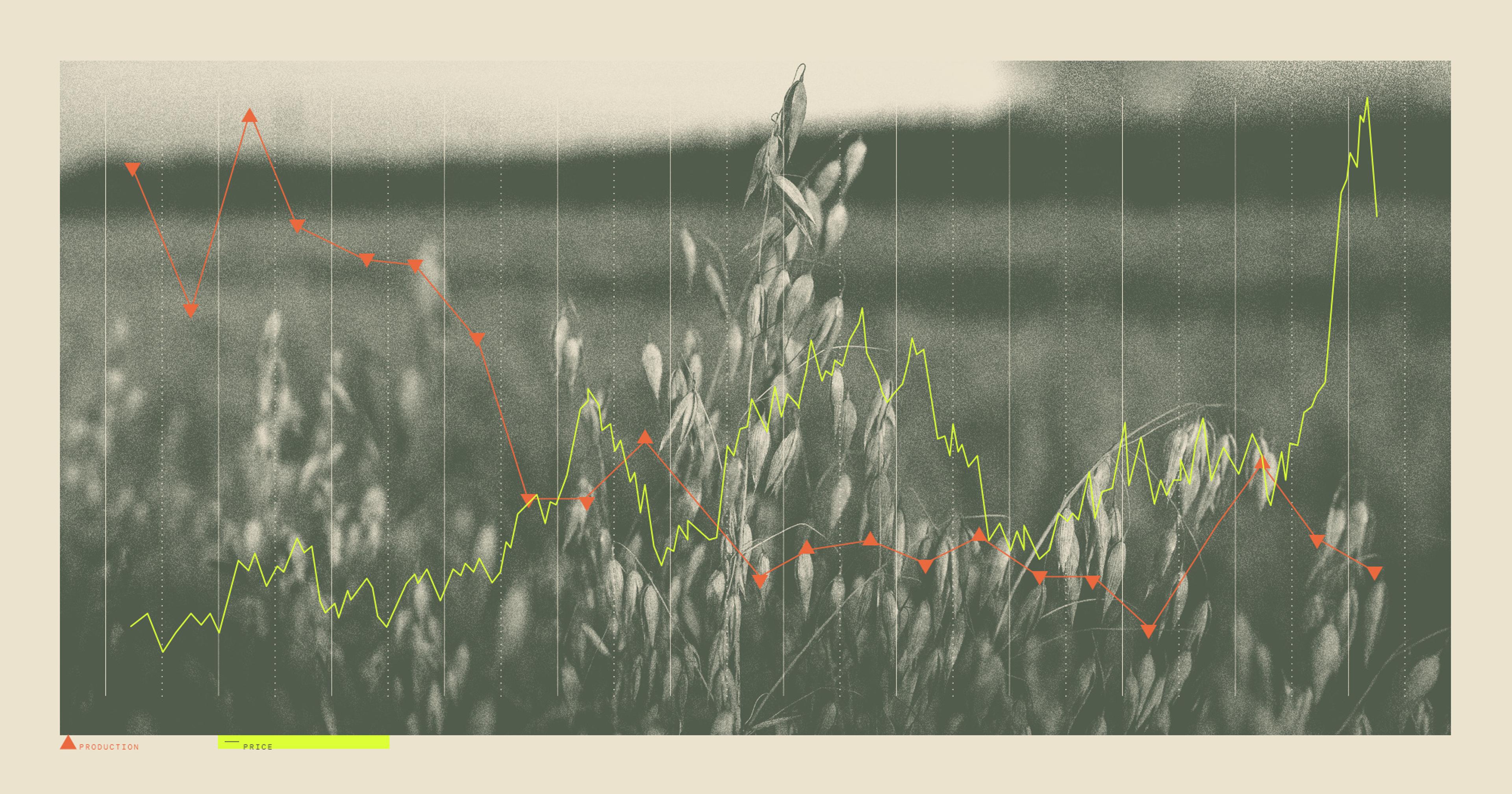
After 1950, oat acreage began a decades-long slide as trucks and tractors replaced farm animals. Better herbicides meant farmers didn’t need oats in the rotation for weed control. Most importantly, farmers could make more money growing corn, wheat, or soybeans. A 1990 USDA report summarized the shift: “Soybeans and corn have replaced oats throughout much of the Corn Belt, reflecting both the greater profit potential for soybeans and corn and a shift from livestock to cash grain farming.”
Federal agricultural policy accelerated oats’ long decline. Oats “were always an afterthought” in agricultural policy compared to “the big players — corn, wheat, and cotton,” Jonathan Coppess told me. Coppess is director of the Gardner Agriculture Policy Program at the University of Illinois and author of The Fault Lines of Farm Policy: A Legislative and Political History of the Farm Bill. Agricultural policies created strong incentives for farmers to shift fields from oats to other crops.
After 1950, oat acreage began a decades-long slide as trucks and tractors replaced farm animals. Better herbicides meant farmers didn’t need oats in the rotation for weed control.
The emergency feed grants of the 1960s were “basically paying farmers to take oats out of production,” Coppess said. Expansion during the 1970s — the era when Secretary of Agriculture Earl Butz told farmers to “get big or get out” — was followed by collapse in the 1980s. “Once you get to the 80s,” Coppess said, “it’s locked in at that point. We just cannibalize within agriculture and narrow it more and more to the major crops.” Oats were not a major crop.
Payment-in-kind programs and the 1985 Farm Bill were the nail in the coffin for U.S. oat acreage. That year’s Farm Bill included the Conservation Reserve Program, which paid farmers to take marginal acres out of production. Often, the idled acres were those that had been planted with oats. The cumulative effect of these policies erased oats from Midwestern farms. Each year from 1950 to 1987, the acreage U.S. farmers collectively planted in oats declined by an average of 712,763 acres per year.
“The U.S. Farm Bill basically killed U.S. oat production,” said Randy Strychar, an oat industry analyst. “The loan rates were never favorable for oats. It was a small crop that had no real significant lobby group.”
*
Yet food companies like Quaker and General Mills still needed oats. They found them in Canada. Bill Wilton, a Manitoba oat farmer, remembers when the American oat millers arrived in the early 1980s: “They came to Canada and they were really surprised and pleased with the quality and the volume of oats they found.”
Oats hate heat and thrived in Canada’s cooler climate. Canada’s “oat growing regions basically are north of a line between Winnipeg and Calgary,” Wilton said. “There’s some terrific oat crops growing in the Peace River region of Alberta, which is getting very, very far north.” It’s a landscape that stretches from the flat Red River valley of southern Manitoba to the rolling hills and grasslands of Saskatchewan and Alberta.
Before the 1980s, Wilton said, oats were “a very minor crop” for Canadian farmers. In that era, all grain harvested on Canada’s prairies was marketed by the Canadian Wheat Board. “The Wheat Board didn’t make much of an effort to promote and sell oats,” Wilton said. “They were true to their name. They were in the wheat and barley business.”
“They came to Canada and they were really surprised and pleased with the quality and the volume of oats they found.”
Strychar was born in the United States but moved to Canada to play hockey. By the 1980s, he had a front-row seat for the changing geography of the North American oats market while working for a branch of the Wheat Board. “Canadian farms are very nimble,” Strychar said. With the decline in U.S. oat acreage, Canadian farmers “just started growing more oats because they could sell volume.” Demand for oats increased in the 1980s when researchers announced that beta glucan, a type of fiber in oats, can lower cholesterol.
While U.S. agricultural policies squeezed oats out of American fields, Canadian policies opened the door for farmers to grow more oats for their neighbors to the South. First, Canada and the United States signed a historic free trade agreement in 1988. “When that came in,” Strychar said, “all the tariffs dropped and that meant Canada could now export raw oats or oat products to the United States quite freely.” Second, in 1989 the Canadian Wheat Board shifted control of oats from the government to the free market, an opening move in Canadian agriculture’s shift from government control to market-oriented policies.
*
Connecting Canada’s oat supply with U.S. mills was where my dad entered the story. In the early 1980s, he was trading barley for a small Minneapolis firm and saw how U.S. farm programs were driving oat acreage down. “You knew you were going to keep losing acreage, the natural place to go was Canada,” he said. There was a fierce scramble among traders to make money bringing Canadian oats into the U.S. “I ran my competitors out of business by outworking them,” my dad said (perhaps still trying to impart lessons to his middle-aged son). After the trading day ended, traders would head to a bar near the Minneapolis Grain Exchange and trade until 11:00 pm. “Huge egos,” my dad said, “they’d get a few beers in them and they’d buy a million bushels.”
The logistics of importing oats were usually less exciting, though. Oats from Manitoba were shipped to the upper Midwest by truck, since the trucks could backhaul fertilizer to Canada. Existing Canadian rail lines hauled oats from Saskatchewan and Alberta.
“I ran my competitors out of business by outworking them,” my dad said (perhaps still trying to impart lessons to his middle-aged son).
In a business that measured volume in millions of tons, squeezing even a few cents out of the supply chain could be extremely profitable. My dad, a gifted mechanic, excelled at finding creative ways to move oats cheaper than the other guy. For example, Canadian rail lines could deliver oats cheaply to Thunder Bay, Ontario, but rail freight across the border into the U.S. was expensive. My dad realized that instead of paying the high rail rates past Thunder Bay, oats could instead be loaded into a Great Lakes freighter designed to haul iron ore pellets (like the ill-fated Edmund Fitzgerald). Lake freighters typically unloaded their cargo in Thunder Bay and had to sail empty to pick up more iron ore on the U.S. side of the border. If you could fill them with oats in Thunder Bay, deliver the oats to Duluth, Minnesota, and then load the oats on U.S. rail lines, you could substantially cut shipping costs.
The problem was that Duluth’s elevators were built as a one-way spigot to ship grain out. Moving grain from a freighter into the elevator required a McGyver-esque solution. The grain company cut a hole in the side of the massive elevator bin so the lake freighters could pour oats into them, reversing the flow of grain from export to import. These kinds of fixes were how my dad made his living, and it’s how a supply chain was built.
*
I grew up blissfully unaware that my dad’s shabby office next to a bail bondsman was reshaping an agricultural supply chain. The system my dad and many others built to ship Canadian oats to U.S. mills has proven resilient because it’s worked well for American consumers, North American millers, and Canadian farmers. “The supply chains, they’re in place. They’re going to be hard to break on any scale,” Strychar said. “It’s like water starts flowing down the hill, you can’t stop it.”
Everyone I talked to for this article had different opinions about the supply chain they had built. Reflecting many Canadian farmers’ views, Wilton said, “it’s a classic case of what really can be done if everybody starts to pull on the wagon.” Strychar sees it as the unintended consequences that flowed from agricultural policy: “Canada’s kind of been portrayed as the bad guys and they’re not. It isn’t anything that was done to punish anybody. There’s just a whole series of events.” My dad has been retired for years and is happy to spend his time thinking about motorcycles and fishing rather than oats.
Perhaps a new generation of farmers can remake the oat supply chain to prioritize U.S. soil health and Corn Belt communities. But that will require breaking a chain that now stretches from Midwestern mills to northern Canadian fields; a chain my dad, and many others, made over a generation.