
Tomato ripening rooms reveal the growing costs of the produce industry’s massive consolidation.
Just north of the border in Texas, there are town-sized warehouses filled with sealed rooms, designed to transform tomatoes from green to red. An invisible gas, ethylene, is carefully meted into these rooms, where imported Mexican tomatoes ripen on a schedule set by logistics operators rather than by the sun. If you are an American adult, nearly every tomato you have eaten in winter was ripened this way.
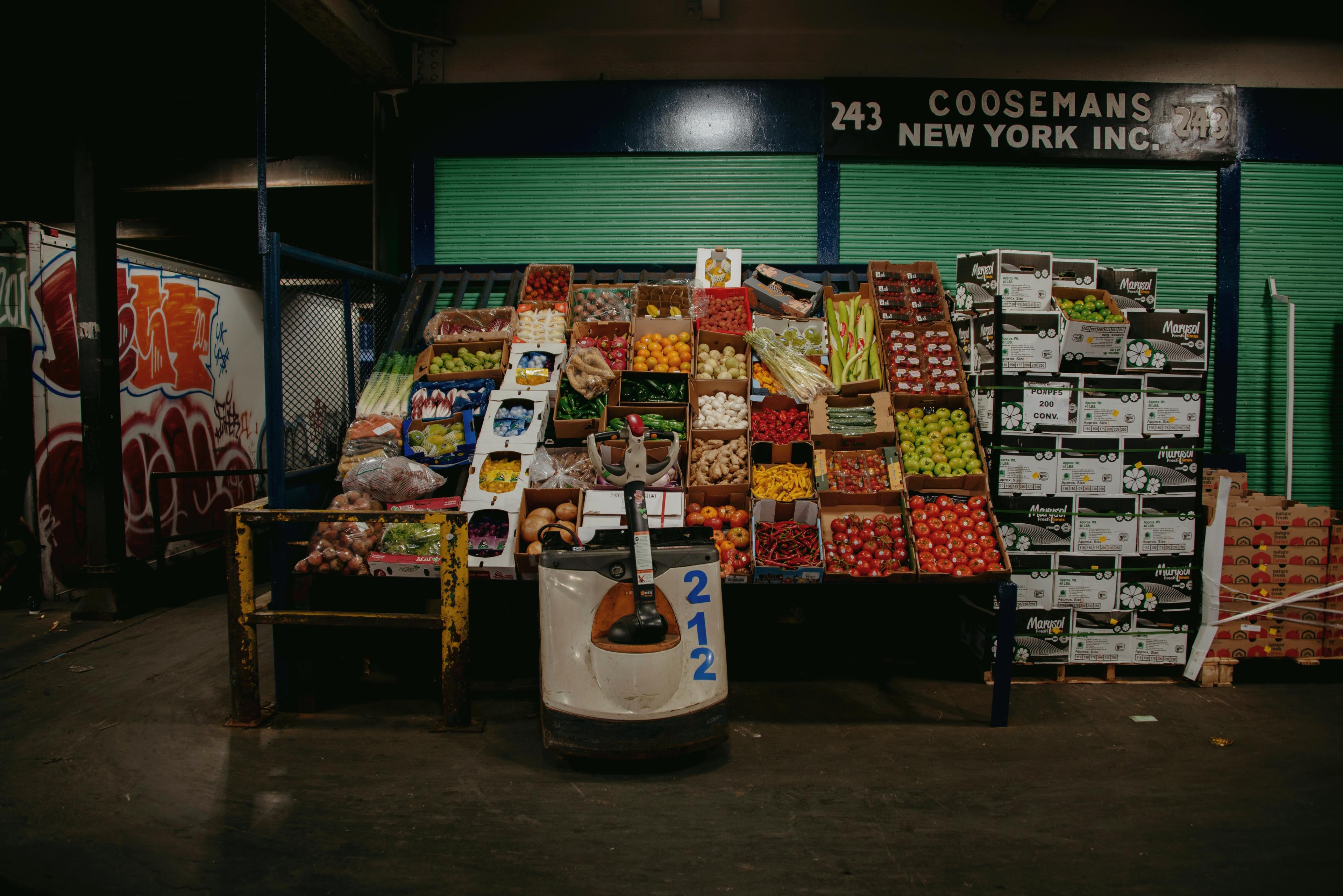
Ripening rooms have been around since the 1980s, but they’ve migrated over time. Tracking the location of those rooms closely tells the story of how the American produce industry consolidated over the last few decades. Robust terminal markets with dozens of smaller companies shared the expensive infrastructure in their early days, but as large grocery and wholesale chains grew, they built their own massive gassing rooms at central facilities and at the border. As large companies grew more dominant and secured their tomato supplies, the smaller buyers lost access to both product and infrastructure, with many going out of business.
Who owns the rooms today shows who the market is ripe for, and for whom it has grown rotten. Understanding why requires a brief look at how tomatoes turn red.
Ripening Off the Vine
Tomatoes are climacteric fruits, like bananas, avocados, and mangos, which means they can be harvested unripe and complete the process later. Ethylene sends the hormonal signal to ripen. When that process happens naturally, cells near its seeds start producing the gas and it diffuses outward through the fruit. Each cell the gas reaches begins its own production, and the cascade softens the flesh and the tomato turns red from the inside out. That allows the fruit to be picked much greener, shipped far, and then ripened when they’re close to their eater.
To do it artificially isn’t complicated, but it is expensive. Ethylene floods the room at carefully calibrated amounts, and the operator compresses what might take weeks into five days. Sensors log temperature, humidity, and gas concentrations around the clock. The tomato turns red from the outside in.
Food scientists have known since 1901 that ethylene caused certain plants to ripen quickly, after a Russian botanist discovered that lamps off-gassing the substance were ripening pea plants. They also discovered ethylene has the tendency to violently explode at high volumes; its adoption by the produce industry was not immediate. Then in the 1970s, a banana distributor found out that the safer and cheaper option was to generate small volumes of the gas in the rooms where you needed it.
If you’ve noticed backyard tomatoes taste better than grocery store tomatoes, ethylene ripening is the biggest reason.
If you’ve noticed backyard tomatoes taste better than grocery store tomatoes, you’re not alone, and ethylene ripening is the biggest reason. In 1995, food scientists at the University of Georgia ran sensory panels on tomatoes with controlled levels of sugar and acid. They found that the volatile organic compounds that made a tomato’s flavor more intense came from more time ripening on the vine.
Consumers generally prefer these flavors, which is why greenhouse vine-ripened snacking and cherry tomatoes like those from NatureSweet are the fastest-growing segment of the industry. Other companies are breeding new varieties to maximize quality. However, most of the classic slicers and Romas—the most in-demand tomatoes—are harvested green and imported. They used to be grown close to consumers, but time and business has changed.
Consolidation Creeps In
Jamie Gonzalez spent decades at the San Antonio Produce Terminal Market, watching ripening shift over the 40 years she’s lived and worked there. The terminal was built in 1951 as the largest wholesale market at the time outside Los Angeles. When she started in the industry in the early 1990s, its cold storage, truck docks, offices, and sale houses contained about 100 distributors, truckers, brokers, and repackers.
The companies ranged from small, single-truck operations to the large “five families” that invested in the backbone of the market. Those families built the ripening rooms; other companies could rent the rooms and contract services from them.
“The cost to have ripening infrastructure in your facility starts at about half a million dollars,” said Gonzalez, who is now director of development and community programming at wholesaler River City Produce. “To have and maintain it can be prohibitive.”
“The cost to have ripening infrastructure in your facility starts at about half a million dollars. To have and maintain it can be prohibitive.”
When H-E-B, the dominant grocer in the region, stopped buying produce from the terminal market in the mid-1990s, followed quickly by Walmart, Costco, and other large retailers, the volume that justified even modest gassing operations began to drain away. By the mid-2000s, only three companies in the produce terminal still had gassing infrastructure, and today there are only two. The terminal rapidly contracted. “For every company that survived,” Gonzalez said, “there were five or six companies that didn’t.”
The same contraction has played out in cities across the country. Pittsburgh’s Produce Terminal, built in 1926 and once stretching five city blocks in the Strip District, stopped operating as a produce facility by the mid-2000s. The USDA now lists San Francisco’s produce terminal as discontinued. Boston’s terminal closed in 2021 and became an Amazon distribution center.
The produce those terminals once handled did not disappear. It moved south.
Enter Mexico
In 2000, the United States grew the majority of its own tomatoes. By 2021, domestic production had fallen to 35%. Imports, more than 90 percent from Mexico, now supply the rest. And most of those Mexican imports come through a narrow stretch of Texas border at the Laredo Customs District.
As production moved south, the ripening function had to happen somewhere between the border and the store. Gonzalez noticed it from San Antonio. “We see a lot of produce stop at that border for ripening,” she said. “That’s real consolidation. The storage infrastructure is greater, the labor is cheaper.” Once ripened, the fruit has 8-10 days of shelf life, which provides ample time after the 2-3 days of travel time from the border.
Mission Produce’s Laredo facility is the most visible example. Inside a 262,000-square-foot building a few hundred yards from the Rio Grande, Mission Produce operates 10 sealed ripening rooms, each capable of holding 42 pallets of fruit, where they carefully dole out ethylene gas to bring bright green fruit to their first blush of pink. Meanwhile GAB Operations, one of Mexico’s largest organic tomato producers, built its own Laredo distribution center with dedicated ripening rooms. And C.H. Robinson, the world’s largest freight broker, opened a $33 million, 142,600-square-foot cold storage and ripening facility in nearby Pharr in May 2026.
“On a certain level, [ripening] increases food security by increasing the consistent supply. But consolidation of all of this infrastructure also makes us less resilient.”
Large operations even have a way to stop ripening in its tracks entirely until they’re ready to move the product. SmartFresh is another gas that binds to the ethylene receptors on climacteric fruits and can keep them green for more than a month until the distributor is ready to ripen them. Warehouses have to be very sophisticated to monitor and utilize the push and pull of ripening gases with precision.
Gonzalez says, “The reason ripening exists is for longevity. That allows more people to get the food. On a certain level, it increases food security by increasing the consistent supply. But consolidation of all of this infrastructure also makes us less resilient.”
The events of the past few years have illustrated what that concentration costs when something goes wrong.
Our Brittle Supply Chain
In April 2022, Texas Governor Greg Abbott ordered additional state safety inspections of commercial vehicles—trucks that had already cleared federal customs. State troopers were ordered to check brake lights, windshield wipers, and tire tread on refrigerated trailers. Wait times at the customs main bridge in Laredo, with trucks filled with green tomatoes waiting to reach their ripening rooms, started to degrade in 120-degree temperatures. Produce that had days of shelf life left was burning through it in a parking lot. The Fresh Produce Association of the Americas estimated losses to growers and distributors at more than $240 million over 10 days, before Abbott suspended the order under pressure from the produce industry.
Eighteen months earlier, Winter Storm Uri had exposed a different layer of the same vulnerability. When Gulf Coast petrochemical plants froze in February 2021, approximately 70% of U.S. ethylene production capacity went offline. The gas that fills the ripening rooms was no longer available. At the same time, the highway was impassable, cold storage facilities lost power, and the corridor that moves a third of the country’s tomatoes was paralyzed.
Large grocers like H-E-B have built genuine disaster resilience. When Harvey flooded the Gulf Coast in 2017, H-E-B had water trucks in Beaumont before FEMA could reach the city, a response that became a symbol of what private logistics infrastructure can do. That said, during Uri even H-E-B experienced what it called “severe disruption” to its supply chain.
Still, large grocers were the first to restock. The buyers who usually feel these disruptions first and longest are the ones with the least leverage in the consolidated system: school districts, independent restaurants, rural communities, and the institutions that source what’s left through terminal markets rather than through the private supply chains that large retailers built for themselves.
“A more secure system might ... [make] sure different groups have access to infrastructure like trucking, warehouses, sales, and ripening rooms. Over time, consolidation is going to hurt people.”
Since 1982, independent grocers‘ share of the national grocery market has fallen from 53% to 22%, according to the Institute for Local Self-Reliance’s analysis of U.S. Census data. Four companies now control more than two-thirds of American grocery sales: Walmart, Kroger, Costco, and Albertsons. As those companies scaled, they built their own ripening infrastructure into their distribution centers and stopped buying through terminal markets. Ripening moved to massive facilities at their headquarters and along the border.
For food security, the produce industry’s consolidation means that when a single disruption hits the supply chain, it can hit everyone at once. In the more distributed system that existed before the 1990s, a city’s produce moved through dozens of independent operators who sourced from different regions, different farms, different corridors. Some had Florida product, some California, some Texas-grown, some Mexican imports through different crossings. A disruption in one supply chain meant one operator had a problem, but others were unaffected and could absorb redirected demand.
The buyers absorbing these shocks without alternatives are the ones still using terminal markets which the consolidated system was not designed to serve. When most of the ripening rooms at the San Antonio terminal went quiet, those buyers lost access to produce at a stage and price that worked for 10 pallets on a Tuesday, sourced from a person they knew across a dock. What replaced it was built for the volume of H-E-B and the logistics of Walmart. While it increased available food, it decreased options.
Gonzalez has watched it all from inside. “The ability to feed people at scale is necessary,” she said. “But a more secure system might want to see better relationships between small and mid-size and large operations, filling in the gaps better. Making sure different groups have access to infrastructure like trucking, warehouses, sales, and ripening rooms. Over time, consolidation is going to hurt people.”