There’s much we can learn from the ancient Pueblans‘ desert farming techniques. Chief among these lessons? Be ready to adapt.
Eleven hundred years ago, a thin man with a handsomely chiseled face thrust a pointed digging stick into the ground and dug a small hole, about 12 inches deep. He hoped to find moist soil left by the spring snowmelt beneath the now-dry surface. Kneeling, he scooped up a handful to check for water. Satisfied, he dropped 10 or 12 dark blue corn seeds into the hole.

Deeply spiritual, he likely chanted prayers while planting the corn.
The man then gently mounded earth over the hole, stood up, took two paces in a straight line along his row, and repeated the process. By planting a dozen seeds together, the corn would grow into a tight cluster of stalks that sheltered one another from gusts of wind and provided shade, helping the plants retain precious moisture.
This essay explores how these farming practices, developed by ancestral Puebloans over centuries, are proving valuable today—more than a thousand years later—as Pueblo farmers adapt to extreme drought conditions.
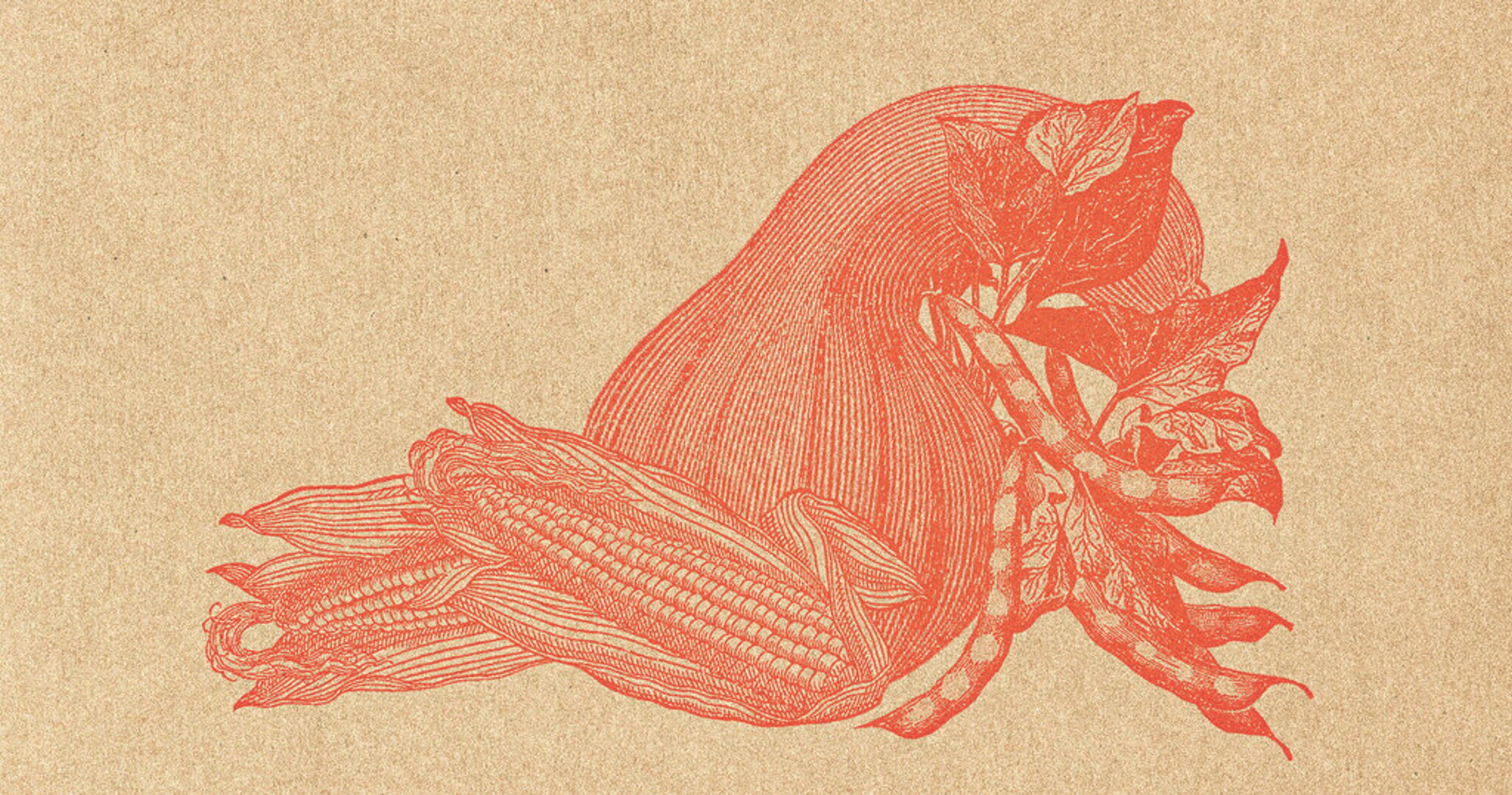
For our ancestral farmer, once the corn had sprouted, he would return to plant beans and squash seeds in the soft mound surrounding the corn. Planted together, they formed an ingenious companion-planting system known as the Three Sisters. In the Mesa Verde pueblo where he lived, Puebloans favored hearty winter squash—similar to a modern pumpkin—and a deep maroon bean speckled with white.
The corn stalks provided a trellis for climbing bean vines. The beans provided protein for the family. Spreading across the ground, the squash shaded the soil, helping it retain life-giving moisture beneath the harsh sun and wind. Over centuries, Puebloan farmers had developed varieties of corn, beans, and squash that were well-adapted to the region’s dry conditions. They could grow in low-moisture soil, producing a harvest before the ground dried completely.
The farmer was practicing dry farming, a tradition the ancestral Puebloans began developing in the Mesa Verde region around A.D. 550. By about A.D. 890, as recurring drought and increasingly depleted farmland challenged crop production, they began building check dams to create planting beds for corn—an adaptation to the changing conditions they faced.
The farmer was practicing dry farming, a tradition the ancestral Puebloans began developing in the Mesa Verde region around A.D. 550.
A check dam is simply a row of stones placed from bank to bank across a seasonal streambed. During snowmelt or summer rains, the loosely stacked stones slowed the flow of water, giving it more time to soak into the soil and provide moisture for that season’s Three Sisters crops.
Moving slowly, the water also deposited nutrient-rich silt collected during its journey. As the silt accumulated, it gradually formed a flat, level planting area on top of the rocky streambed. Each new season’s rains brought another layer of nutrient-rich silt, renewing the soil. He likely tended dozens of check dam planting beds, stair-stepping down different streambeds—enough to feed his family.
We will never know the man’s name, but he helped refine a dry farming tradition that would be passed from one generation to the next through more than 50 generations of Pueblo farmers.
Living Knowledge Is an Inheritance
Now, 1,100 years later, many Pueblo people continue to preserve and practice these revered farming traditions.
In my work helping communities adapt to a changing climate, I’ve become interested in what long-standing, traditional farming practices can teach us about adaptation. I reached out to two Puebloan farmers in a part of the U.S. already feeling the bite of a changing climate. The first was Michael Kotutwa Johnson, a Hopi farmer and assistant specialist for the Indigenous Resiliency Center at the University of Arizona. For Johnson, farming isn’t a profession he chose. It’s the life he inherited.
“We go back eons when it comes to farming,” he told me. “So I’ve been farming since I’ve been a little kid ... It’s more of a subsistence type of farming that’s tied directly to our culture.” Today, Johnson continues to practice traditional dry farming on the Hopi Reservation in northeastern Arizona while teaching and working with Indigenous communities across the Southwest through the University of Arizona’s agricultural extension program.
During our conversation, Johnson impressed upon me the importance of place-based heirloom seeds—varieties that have adapted over thousands of years to their local climate. As he put it, “Our seeds are probably the most important thing because you have 3,000 years of growing these seeds in a dry area, and they’ve adapted to grow with less water. Why reinvent the wheel when you already have the seeds and crops that have been grown there for thousands of years?”
Asked about his favorite traditional Hopi farming practices, Johnson replied, “My thing is the spacing. We have six-foot rows.” The wide spacing allows each clump of corn to draw moisture from a larger area of soil. Like his ancestors, he practices non-irrigated dry farming and plants his corn between 6 and 18 inches deep, depending on spring soil moisture. He puts 10 to 12 seeds in each hole. “It’s just planting in clumps, because that allows those plants to survive in this type of heat because they shade each other.”
“Our seeds are probably the most important thing because you have 3,000 years of growing these seeds in a dry area, and they’ve adapted to grow with less water.“
He also grows beans and squash alongside his corn, continuing the Three Sisters planting tradition. As our conversation continued, I asked, “For somebody who isn’t Hopi, what would you want them to understand about the cultural importance of Hopi agriculture?” He replied, “It’s more of a faith-based type of agriculture because it’s integrated within our religious beliefs. It’s not so much the process of agriculture but the why we’re doing it—because it focuses on our values. It’s holding on to those things that people seem to have forgotten nowadays, like hard work and sharing. Those kinds of things are important to me and to other Hopi people.”
“We’ve been in this area for such a long time that all of our ceremonies and beliefs revolve around precipitation—bringing winter moisture and the summer monsoon rains,” he added.
I asked what farmers are experiencing today that they weren’t 20 or 30 years ago. He said, “I think the growing season’s a little shorter than it used to be because it’s a lot hotter. And we haven’t been getting nearly the amount of snowfall we had been, say, 20 years ago. It makes it very hard for the soil to stay moist until we get to the monsoon rains because dry farmers don’t irrigate.”
Despite many differences, Johnson doesn’t see traditional and conventional agriculture as opposing worlds. “I will never, ever say anything negative about the American farmer because he’s a person, he has a family, and they deserve the best.” Whenever Johnson travels, he enjoys sitting down with farmers because, regardless of whether they practice traditional or conventional agriculture, “their number one thing is to make sure they take care of their families.”
Johnson does believe water will become one of their biggest challenges. As an example, he said a Midwestern farmer will have to begin asking, “What crops are drought-tolerant, and which ones could survive with less water?”
Despite many differences, Johnson doesn’t see traditional and conventional agriculture as opposing worlds.
I asked what he thought was most important to Indigenous farmers today. “The first is they want to improve the health of their people. The second is they want more of their young people going into agriculture.” He added, “It’s having a healthy food system, then you have healthy people.” Just as important to him is helping young people reconnect with “the deep, deep agricultural tradition they used to have.”
“One of my main initiatives is something I call ‘One Seed, One Child.’ Elementary school children from the Tucson United Way program receive a seed, a cup of soil, and water on their first day. “It doesn’t matter if it grows into a big plant as long as they’re planting—because there’s tremendous value in that.” For Johnson, it’s about “planting in a community for a community.”
The ancestral Mesa Verde farmers experimented and developed check dams and other innovations that became solutions to reduced crop production caused by environmental changes in their landscape. Experimentation and innovation became central to the Pueblo approach to adaptation.
One modern-day Puebloan is having to adapt to changing climate conditions as well. Roger Fragua, executive director of the Flower Hill Institute, an Indigenous-led nonprofit working on agriculture and climate resilience, works closely with Pueblo farmers in New Mexico. He believes Pueblo communities are running out of time to adapt.
The Future Is Suddenly Here
Years ago, Flower Hill began experimenting with soil restoration, drip irrigation, and planting cover crops because they anticipated that hotter, drier conditions would eventually arrive. They expected these conditions to affect the next generation—not today, not now. Instead, in a recent conversation, he told me, “We didn’t predict we’d be here now. We thought we’d be here sometime in the future. But ... here we are, Tim.”
The river that provided water through the growing season in Jemez Pueblo ran dry in May. “I didn’t think I would see that,” he said. “I thought my son was going to have to wrestle with that … Our river usually starts to run low—but not dry—in August, just in time for the monsoon rains.”
For Fragua, the urgency is clear. “We’ve got to find ways to move the dial faster, with more people, sooner ... because of the temperatures, because of the climate,” he said. “We’re running out of time. I mean, the 104-degree temperatures, and my river running dry?”
“People have told me, almost in a critical way, ‘Why don’t you just plant corn and chile like the rest of us?’”
Roger and his colleagues at Flower Hill looked at their changing landscape and built shade structures, experimented with drip irrigation, and planted cover crops. These weren’t ancestral Pueblo farming practices, but they reflected the same tradition of ingenuity and adaptation.
Not everyone has supported those changes. “People have told me, almost in a critical way, ‘Why don’t you just plant corn and chile like the rest of us?’” Fragua sees Flower Hill’s experiments differently. “Somebody has to splinter off and go explore these new ideas ... We don’t always succeed. Not everything we’ve tried has had success, but we’ve learned. And that’s success—what we’re learning.” For him, the goal isn’t simply to experiment. It’s to let the community learn what works. “We are helping the community through experience and knowledge.”
What today’s farmers can learn from the ancestral Puebloans isn’t simply their farming techniques. It’s also the Pueblo approach to adaptation. The ancestral Puebloans looked at their changing landscape and adapted by building check dams. Michael Kotutwa Johnson carries forward the dry farming traditions he inherited from his ancestors. And Roger Fragua is carrying forward that tradition of adaptation by experimenting with new ways to farm in today’s changing climate. It’s the Pueblo way.