Oat farming has declined in the U.S. in recent decades — but a growing group of more than 100 Midwestern farmers is trying to bring it back.
Oats are an undersung hero when it comes to sustainable farming. Planted early in the season, they suck up nitrogen that might otherwise leach into groundwater. They’re often paired with red clover, which protects soil from erosion and fixes nitrogen for the other crops. And when added to a corn-soy rotation, oats help break pest cycles, reduce disease pressure, and curb resistant weeds.


They’ve declined in the U.S. in recent decades, but as demand for oat milk rises, it seems natural to assume that the need — and the potential for profit — is there. That was part of Martin Larsen’s hope when he started growing oats in 2018.
But that’s where things get a little stickier. Despite Quaker Oats and General Mills both being headquartered in the Midwest, they overwhelmingly source their oats from Canada. Even after Larsen, a fifth-generation farmer in Minnesota, brought some neighboring farmers on board, the entrenched supply chain proved nearly impossible to break into.
The farmers had issues getting their oats milled and difficulties finding buyers. But Larsen and his fellow farmers weren’t deterred. Instead, they coined a name for their group: the Oat Mafia. They decided to create a supply chain — and, eventually, a mill — of their own.
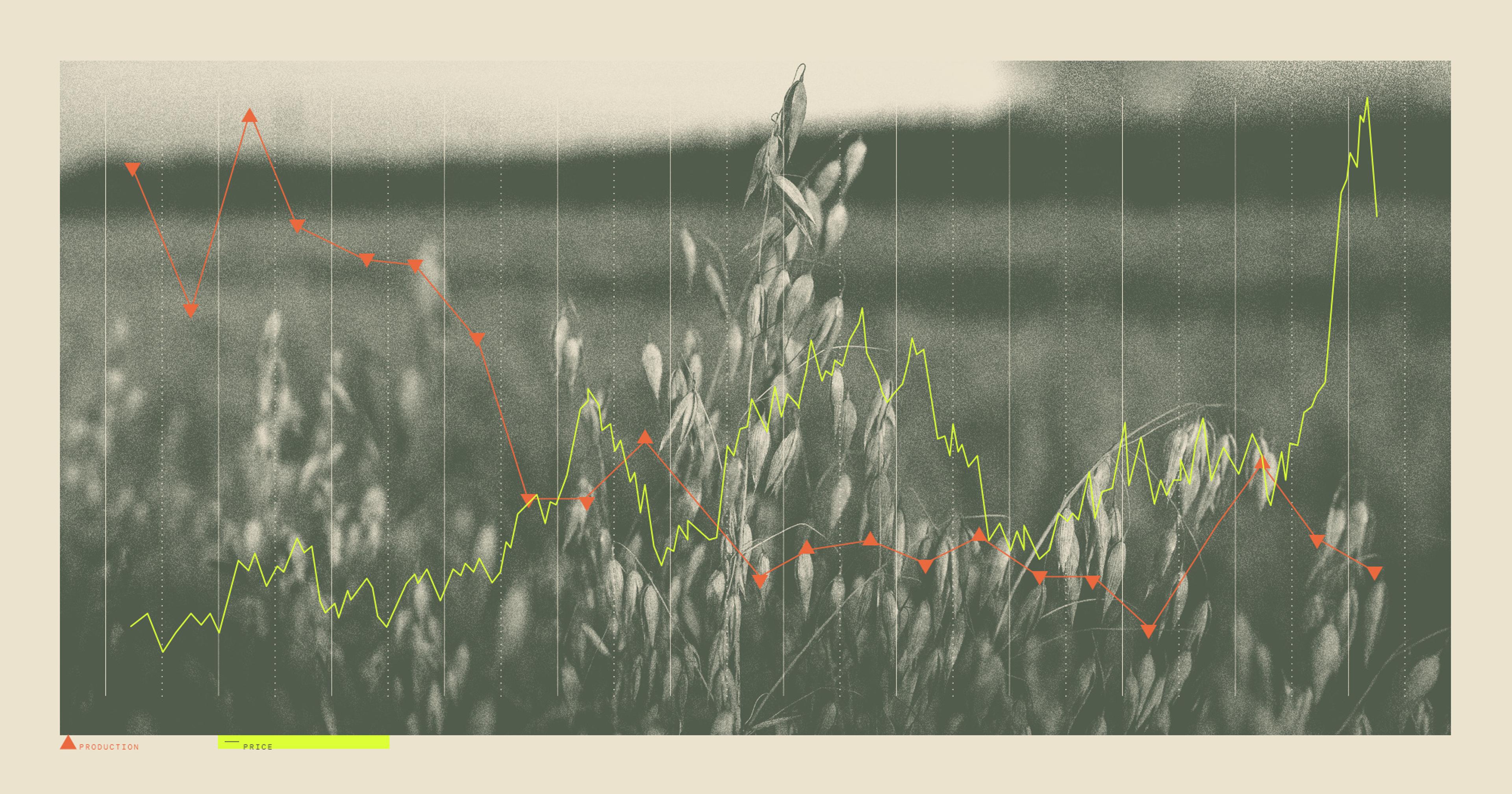
Today, the Oat Mafia has around 125 farmers with 50,000 acres of tillable land and about 6,000 acres of oats, said Larsen, who started with just seven acres and now grows 500. It’s an admittedly small number. In 1950, Illinois, Iowa, Minnesota, and Wisconsin produced more than 18 million acres of oats. By 2024, there were just 294,000 acres, most of which are grown for feed.
Much of the decline was due to the consolidation around corn and soybeans, which are heavily incentivized. Federal crop insurance subsidies cover roughly 60% of premiums for corn and soybeans, while government support for biofuel infrastructure created a guaranteed market for corn ethanol. This can make it challenging to introduce a third crop into rotation.
“Farming is all about managing risk,” said Kevin Smith, professor of plant breeding and genetics at the University of Minnesota. “And if you have the choice behind growing something where you have much less risk, I can understand why farmers would gravitate toward that.”
Despite Quaker Oats and General Mills both being headquartered in the Midwest, they overwhelmingly source their oats from Canada.
Larsen, who also works part-time for Olmsted County’s Soil and Water Conservation District, quickly saw how widespread the benefits were, even beyond the environment and risk mitigation. His corn seed is cheaper because it doesn’t need to have as many disease-resistant traits, and Larsen said he saves about $40 to $50 an acre in nitrogen because he plants red clover.
With the Oat Mafia, he aims to be a resource for other farmers who aren’t sure where to start, offering advice on everything from what varieties to plant and how many oats per acre, to how much fertilizer to use and how to combine them. “Think of starting out at nearly ground zero and building out from there,” he said.
Shea-Lynn Ramthun is one of the growers he works with. A sixth generation farmer — her ancestors homesteaded on the land before Minnesota was even a state — her family grew oats for years as feed. “My grandpa really believed in what oats do for soil health,” she said. “So we always kept a very small amount of the acres in oats, and we would feed our weaned calves or have it for the horses.”
But about five years ago, she attended an event at the Land Stewardship Project and heard Larsen talk about growing food-grade oats. “And I was like, ‘Wait, you can do that?’ Because it’s just not something you saw.”
“Farming is all about managing risk. And if you have the choice behind growing something where you have much less risk, I can understand why farmers would gravitate toward that.”
Ramthun connected with Larsen and started adding more oats into her rotation; today, she grows them on about 60 acres (out of 140 acres of tillable land). She too grows red clover as a cover crop and extols its benefits. As an added bonus, she uses the clover for feed. “Come August, my pastures are getting tired, and I’ve gone through them all. Now I’m turning my cattle out on really high-quality forage, and they can stay out there for a lot longer.”
While Ramthun said you could probably make almost any type of oat appropriate for food if you “massaged it enough,” the workload is much easier if farmers start with certain varieties.
“The two most important things are high grain protein and high test weight,” said Smith, who runs breeding experiments with oat, barley, and silflower in his lab at the University of Minnesota. “[Those] particularly affect the value as a food crop.” Attributes like grain plumpness and fiber content are also important factors, he noted.
There are also certain traits that make it easier for farmers to grow food-grade oats — specifically shorter plants and strong lodging resistance, meaning the plants are less likely to bend, break, or tip over at the roots during heavy rain or high winds.
Smith’s lab has been working on developing varieties with these qualities for nearly a decade. Last month, they released one called MN-Amber.
Oatly is “supportive” of the growing movement in the U.S. and “would love to find more opportunities to engage in the future.”
The University of Minnesota has had an oat breeding program for more than 100 years, but it was dormant for a bit after the previous head retired. Part of what spurred its relaunch was a grant from PepsiCo (the parent company of Quaker Oats), which Smith said lasted for about five years. “They had an interest in helping support public plant breeding for oats,” he said. “It was very helpful in restarting the program.” (PepsiCo did not respond to a request for comment.)
This renewed interest also coincides with a growing demand for oat milk. In 2021, oat milk sales hit $350 million in the U.S.; in 2025, that grew to $860 million; it’s projected to reach $1.74 billion in 2031.
In 2022, Larsen and 12 other farmers sold 950 acres of oats to Oatly. But that contract was part of a pilot program and didn’t renew for another year. While Oatly still sources the majority of its oats from Canada, the company said it is “supportive” of the growing movement in the U.S. and “would love to find more opportunities to engage in the future.”
***
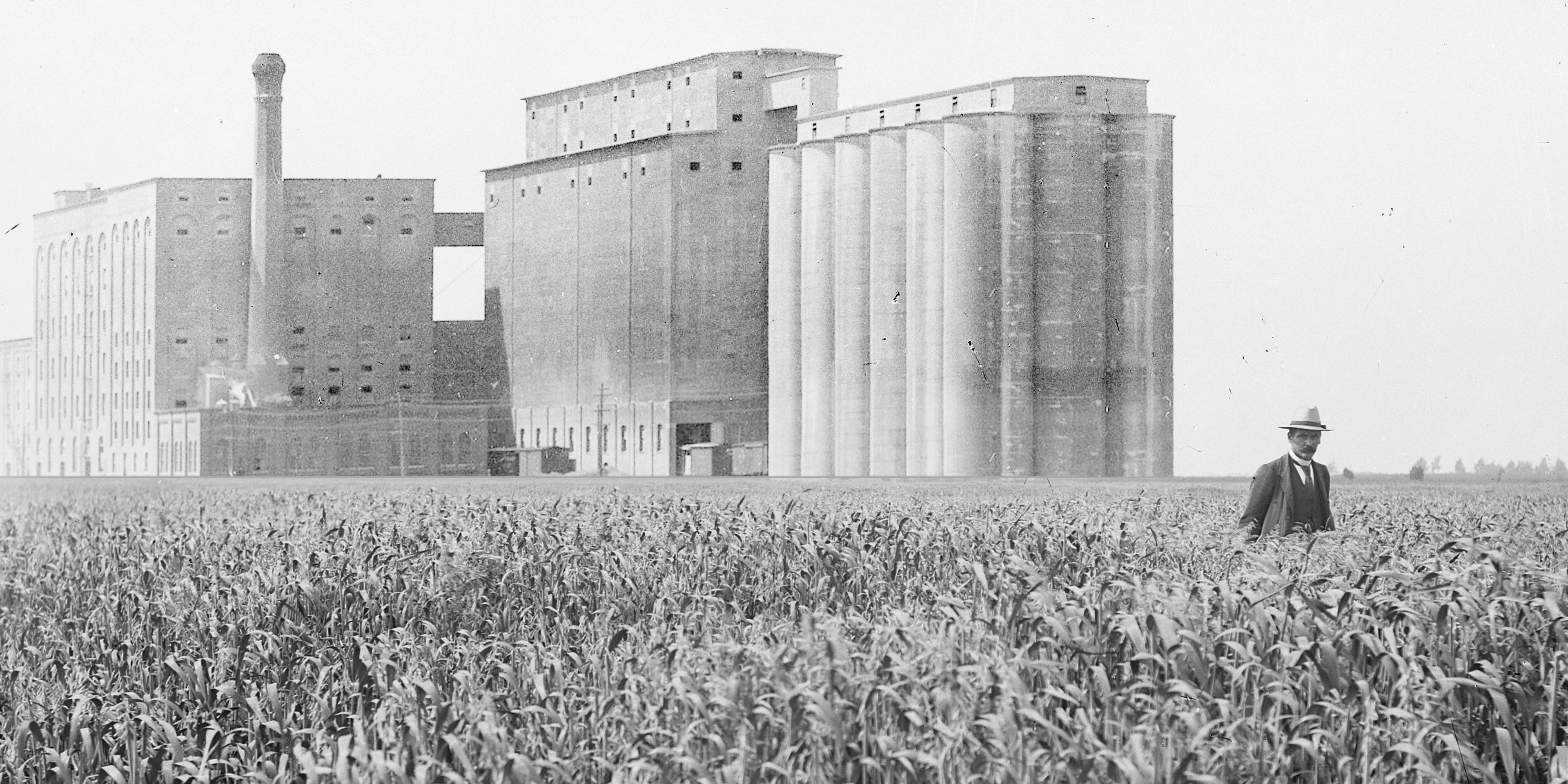
As the Oat Mafia grew, one of the major sticking points was where to mill their oats. For independent growers in the Upper Midwest, there aren’t a ton of options. And when their relationship with a key miller ended in 2024, they knew they needed a more sustainable solution.
“That left a lot of farmers holding on to their oats,” said Ramthun, who started working for the Land Stewardship Project a few years ago. “And so then it was a lot of organizing, [trying to figure out] what do we do now, and what are our options?”
The answer came in the form of Landon Plagge, another Oat Mafia farmer in Iowa. “He’s like, ‘We should just build our own mill,’” Ramthun said.
Green Acres Milling in Albert Lea, Minnesota, is currently under construction and is scheduled to open in time for oat harvest in August. Plagge, who did not respond to a request for comment, received a $1.5 million grant from USDA for the mill; the city of Albert Lea is also providing tax incentives for the 135,000-square-foot facility. About $20 million was also invested locally, through farmers who plan to sell their oats to the mill. (Larsen said there are about 135 investors, roughly half of whom are Oat Mafia members. He said the minimum investment was $25,000, and “there were a wide range of amounts.”)
When their relationship with a key miller ended in 2024, the Oat Mafia knew they needed a more sustainable solution.
“The investment gives you the ability to sell to the mill on an acreage base,” said Larsen, who didn’t fully vest all 500 acres of his oats. “The amount that you invest is based on the acres you would like to sell to the mill, so 100 acres or 200 acres or 500 acres [and] you will get a fair price for [your oats].”
Ramthun, who’s also an investor in Green Acres, said all the oats sold to the mill will be grown using regenerative practices. They’ll also be traceable, which farmers hope will be a selling point for companies who want to highlight where their products originate.
“From the farmers‘ aspect, we’re getting a good price,” said Larsen. “For a consumer packaged goods company, they’re getting sourced, traced oats from a farmer-led project from Southeast Minnesota.”
Green Acres Milling in Albert Lea, Minnesota, is currently under construction and is scheduled to open in time for oat harvest in August.
Seven Sundays, an environmentally focused cereal company based in Minnesota, said it intends to source from Green Acres once the mill opens. (Exact details of the arrangement are still under discussion.) The company already sources sunflowers from Ramthun and other Oat Mafia farmers.
As a corn farmer, Larsen acknowledges the environmental issues with growing that crop. But longstanding policies and ingrained ways of doing business had made it hard to even think of changing. “It’s such a good example of, ‘Well, it should have been easy to switch to a better, easier, more environmentally friendly crop.’ It shouldn’t have been this hard. We shouldn’t have had to build our own mill to make it work.”
***
Oats are a cold weather crop, which is one of the reasons that Canada has been a more attractive environment. It could seem like an odd time to double down on the crop as Midwest summers get hotter and storms get more severe. Larsen acknowledges this but said the extreme weather has also caused issues for his corn and soybeans — and the impacts aren’t evenly distributed.
“2023 was a substantial drought. The oats just loved it. I had the best oats I ever grew,” he said. “I had the worst soybeans I ever grew in 2023 because of the drought. So it’s a risk management tool. There’s no great answer for trying to farm around this erratic weather and climate [shifts].”
In fact, Larsen sees oats as helping stave off some of the worst erosion. “I almost see it as a tool to protect your farm from it all washing away when you get short-duration, intense rainstorms.”
Recently, commodity prices for corn, soybeans, and other row crops have declined, and Ramthun said that’s actually proving to be a boost for oat farming. “When prices are where they’re at, it gives you the opportunity to think outside the box,” she said. “It’s easier for farmers to go, ‘Yeah, I should maybe try something different, because what do I have to lose?’” She said this is especially true with a younger generation, “but I’m also seeing the older farmers excited that they’re able to try something different.”
“When prices are where they’re at, it gives you the opportunity to think outside the box. It’s easier for farmers to go, ‘Yeah, I should maybe try something different.‘“
All of this is happening against the backdrop of Trump’s tariffs and uncertainty around agricultural funding. It’s reasonable to wonder whether this might push companies like PepsiCo and General Mills to look for domestic sourcing. (General Mills did not respond to a request for comment.) But Joe Janzen, a professor of agriculture and consumer economics at the University of Illinois, Urbana-Champagne, said that’s unlikely to happen — at least not yet.
“Certainly, tariffs can dramatically change the sourcing decision for some of these big companies,” he said. “But if we don’t know what that tariff regime is going to look like for the life of the infrastructure that we’re building, then it’s really hard to make a plan. If you believe the tariffs are going to be gone next month or next year, or even five years from now, then you don’t make those kinds of supply chain infrastructure investments.”
But Larsen is still hopeful that they’ll be able to get bigger buyers on board — even though it wouldn’t necessarily make a difference for him and other Oat Mafia members who have invested in Green Acres Mill and thus have a guaranteed buyer.
“To fight back against consolidation, to actually make headway for nitrate contamination and groundwater, we need those companies to engage with us,” he said. “They are part of the answer. We absolutely have to have those buyers to make the landscape change.”