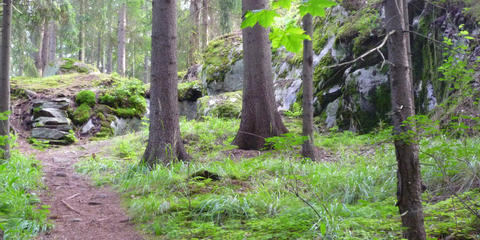
The Healthy Forests Reserve Program (HFRP) helps landowners restore, enhance and protect forestland resources on private lands through easements and financial assistance. HRFP aids the recovery of endangered and threatened species under the Endangered Species Act, improves plant and animal biodiversity and enhances carbon sequestration.
Benefits:
HFRP provides landowners with 10-year restoration agreements and 30-year or permanent easements for specific conservation actions. For acreage owned by an American Indian tribe, there is an additional enrollment option of a 30-year contract. Some landowners may avoid regulatory restrictions under the Endangered Species Act by restoring or improving habitat on their land for a specified period of time.
Eligibility
HFRP applicants must provide proof of ownership, or an operator (tenant) must provide written concurrence from the landowner of tenancy for the period of the HFRP restoration agreement in order to be eligible. Land enrolled in HFRP easements must be privately owned or owned by Indian tribes and restore, enhance or measurably increase the recovery of threatened or endangered species, improve biological diversity or increase carbon storage.
Land enrolled in HFRP easements must be privately owned or owned by Indian tribes and restore, enhance or measurably increase the recovery of threatened or endangered species, improve biological diversity or increase carbon storage.
Details
Organization
Financial Instrument
Easement
Terms
Payments are set as a percentage of easement/contract value and of practice cost, not as a fixed dollar award. Four enrollment options (NRCS national HFRP fact sheet, February 2024):
• 10-year restoration cost-share agreement — "the landowner may receive 50 percent of the average cost of approved conservation practices."
• 30-year easement — "the landowner may receive 75 percent of the easement value of the enrolled land plus 75 percent of the average cost of approved conservation practices."
• 30-year contract, tribal acreage only — "75 percent of the contract value of the enrolled land plus 75 percent of the average cost of approved conservation practices."
• Permanent easement — "landowners may receive 100 percent of the easement value of the enrolled land plus 100 percent of the average cost of approved conservation practices."
No dollar floor or ceiling per landowner is published. Your number depends on the appraised easement value of your acres and on NRCS practice payment schedules, so the local NRCS office is the only place to get a real figure.
A non-cash term worth pricing in: landowners who agree, for a specified period, to restore or improve habitat for threatened or endangered species get regulatory certainty — "In exchange, they avoid future regulatory restrictions on the use of that land protected under the Endangered Species Act."
For every easement, contract and 10-year restoration agreement, "NRCS will develop an HFRP restoration plan" that you then have to follow.
Application Instructions
Apply at your local USDA Service Center, which you can find at https://www.farmers.gov/service-center-locator
Resources
Related Programs

Acequia and Community Ditch Fund (New Mexico)
New Mexico Department of Agriculture
- GrantWater ManagementConservationLegal & FinanceResearchNM

ACRE3 Agricultural Energy Efficiency
Colorado Department of Agriculture
- GrantCost ShareLoanAlternative EnergyConservationIrrigationStorageGreenhouseCOAny
ACRE3 Irrigation Hydropower Programs
Colorado Department of Agriculture
- GrantCost ShareLoanHydro PowerAlternative EnergyIrrigationConservationWater ManagementEquipmentCOAny

ADM re:generations
ADM
- Environmental MarketCarbon CreditsCarbon CaptureSoil HealthCover CropsClimate-SmartNationalCornSoybeansWheatCanolaPeanuts
Updated September 4, 2026
Image Credit: timo_w2s
Run this program? Email fundinglibrary@ambrook.com to request changes to this listing.
This information was gathered from public sources. Ambrook is not responsible for or able to affect the results of any financial programs listed, nor are they responsible for any incorrect information that is listed or is on the hyperlinked external sites. All information is subject to change.
Explore hundreds more programs on Ambrook.