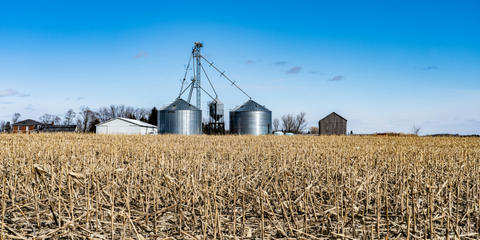
Marketing assistance loans provide producers interim financing at harvest time to meet cash flow needs without having to sell their commodities when market prices are typically at harvest-time lows.
Eligibility
Individual producers qualify — this is a farmer-facing loan, taken out at your county FSA office. FSA's own eligibility statement: "Eligible applicants include producers of designated commodities who meet conservation and wetland protection requirements and provide sufficient documentation of their commodities. Producers must comply with all program requirements to qualify for a loan."
The binding tests:
-
You must have grown or sheared an eligible commodity. FSA's published list: barley, canola, chickpeas (large and small), corn, cotton (upland and extra-long staple), crambe, dry peas, flaxseed, grain sorghum, honey, lentils, mohair, mustard seed, oats, peanuts, rapeseed, rice (long and medium grain), safflower seed, sesame seed, soybeans, sunflower seed, wheat, and graded and ungraded wool. Unshorn pelts and sugar are also carried under the commodity-loan umbrella.
-
You must still own the crop. "For a commodity to be eligible for a marketing assistance loan or a loan deficiency payment (LDP), the producer must have beneficial interest in the commodity in addition to other eligibility requirements." If you have already sold the crop or given up control of it, you cannot pledge it.
-
You must be in conservation compliance — highly erodible land and wetland protection provisions, certified through FSA.
-
You must document the commodity — quantity, quality and storage — because the crop itself is the collateral.
Crop quality decides which loan you get, not whether you qualify: "Recourse Marketing Assistance Loans are loans for which the commodity offered as collateral does not meet the quality eligibility requirements according to U.S. grading standards." Recourse loans must be repaid in cash and the commodity cannot be forfeited to CCC; commodities that meet grading standards get non-recourse loans and the forfeiture option.
Geography: national, no state restriction. Loans are available "beginning upon harvest or shearing," and "applications must be submitted by the final loan availability date for the commodity" — the deadline is per-commodity, so ask your county office.
Not published on these FSA pages: any dollar cap per producer, any farm-size or income limit, any acreage minimum, and any audience restriction (beginning, veteran, socially disadvantaged). Statute extends the program "through crop year 2031."
Details
Organization
Financial Instrument
Loan
Terms
This is short-term harvest financing, not a grant. You pledge your stored crop as collateral and FSA advances you the national loan rate per unit. FSA: marketing assistance loans "provide producers interim financing at harvest time to meet cash flow needs without having to sell their commodities when market prices are typically at harvest-time lows."
2026 National Average Loan Rates (per unit) published by FSA:
-
Wheat $3.72/bu; Corn $2.42/bu; Grain sorghum $2.42/bu; Barley $2.75/bu; Oats $2.20/bu; Soybeans $6.82/bu
-
Rice: long grain $13.21/cwt; medium/short $11.79/cwt
-
Oilseeds (canola, crambe, flaxseed, mustard, rapeseed, safflower, sesame, sunflower) $11.10/cwt
-
Dry peas $6.87/cwt; lentils $14.30/cwt; small chickpeas $11.00/cwt; large chickpeas $15.40/cwt
-
Graded wool $1.15/lb; non-graded wool $0.55/lb; mohair $5.00/lb; honey $1.50/lb
-
Upland and ELS cotton, peanuts and sugar: "To Be Announced"
County loan rates differ from these national averages, and premiums/discounts apply by quality grade.
How repayment works: most loans are non-recourse — "the commodity is pledged as loan collateral and producers have the option of delivering the pledged collateral to the Commodity Credit Corporation (CCC) in satisfaction of the repayment of the outstanding loan." You also get marketing-loan relief: "Market loan repayment provisions specify, under certain circumstances, that producers may repay loans at less than principal plus accrued interest and other charges." Instead of taking a loan you can elect a loan deficiency payment (LDP) — except for ELS cotton, where "LDP provisions do not apply and ELS cotton marketing assistance loans must be repaid at the loan rate plus interest."
Recourse loans (collateral that fails U.S. grading standards) "must be repaid at principal plus interest" and the commodity cannot be forfeited to CCC.
Not published on the FSA pages: the interest rate charged on commodity loans, the loan maturity period, service fees, and any dollar cap per producer. Eligibility requires beneficial interest in the commodity. Loan rates are reissued annually, so check the current-year PDF before budgeting.
Application Instructions
Apply at your county FSA office. There is no online application for a commodity loan.
The route, in FSA's own words: "To apply for Marketing Assistance Loans, producers must complete and submit a loan application to their local FSA office. The application process includes providing documentation of the eligible commodity, production records, and proof of compliance with program requirements. Detailed enrollment instructions and deadlines are available through the local FSA office."
A farmer looking for FSA's "Apply for a Loan" button should know it leads to the online farm-loan application, which is a different product line — commodity loans are not filed there. Go to the office.
Find your office. FSA's own "Find Your FSA Location" link: https://www.fsa.usda.gov/office-locator. To book a visit, the USDA Service Center locator is https://www.farmers.gov/working-with-us/service-center-locator.
Timing is per-commodity, not one national date. "Applications must be submitted by the final loan availability date for the commodity." FSA publishes no single program deadline — the final availability date differs by commodity, so ask your county office or check FSA's national deadlines page at https://www.fsa.usda.gov/news-events/national-deadlines. This is not rolling year-round intake: each commodity's window closes.
What to bring:
-
Documentation of the eligible commodity — the crop is the collateral, so quantity, quality and storage all have to be evidenced.
-
Production records.
-
Proof of compliance with program requirements. Eligibility runs through "conservation and wetland protection requirements," certified through FSA.
-
Proof you still own the crop. "For a commodity to be eligible for a marketing assistance loan or a loan deficiency payment (LDP), the producer must have beneficial interest in the commodity in addition to other eligibility requirements." Once you have sold it or given up control, it can no longer be pledged — so apply before you market the crop, not after.
Decide two things with the county office at the same time. First, loan or LDP: "in lieu of securing a MAL, producers may elect to receive an LDP" — the LDP is a payment instead of a loan, and it is not available for ELS cotton. Second, term: "MALs provide short-term loans with terms up to nine months," so the maturity date and your marketing plan should line up.
Who to ask. FSA routes application questions to the county office rather than a national line and publishes no farmer phone number for this program — use the locator above. For background before the visit, FSA links a "Marketing Assistance Loans and Loan Deficiency Payments" fact sheet and the 8-LP MAL and LDP Handbook from the program pages.
Resources
Weekly Commodity Rates
-
Pulse Crop LDP Rates (Excel)
-
Peanut LDP Rates (Excel)
-
Wool and Mohair LDP Rates (Excel)
-
Cotton LDP Rates (Excel)
-
Rice LDP Rates (Excel)
Related Programs

Acequia and Community Ditch Fund (New Mexico)
New Mexico Department of Agriculture
- GrantWater ManagementConservationLegal & FinanceResearchNM

ACRE3 Agricultural Energy Efficiency
Colorado Department of Agriculture
- GrantCost ShareLoanAlternative EnergyConservationIrrigationStorageGreenhouseCOAny
ACRE3 Irrigation Hydropower Programs
Colorado Department of Agriculture
- GrantCost ShareLoanHydro PowerAlternative EnergyIrrigationConservationWater ManagementEquipmentCOAny

ADM re:generations
ADM
- Environmental MarketCarbon CreditsCarbon CaptureSoil HealthCover CropsClimate-SmartNationalCornSoybeansWheatCanolaPeanuts
Updated September 4, 2026
Image Credit: chris robert
This information was gathered from public sources. Ambrook is not responsible for or able to affect the results of any financial programs listed, nor are they responsible for any incorrect information that is listed or is on the hyperlinked external sites. All information is subject to change.
Explore hundreds more programs on Ambrook.