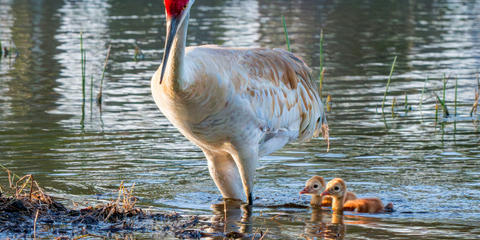
BirdReturns Sandhill Crane Program
The Migratory Bird Conservation Partnership
Closed September 11, 2026
BirdReturns has been working with farmers and landowners for 10 years to provide habitat for migratory shorebirds, cranes, waterfowl, and other waterbirds. This year, The Migratory Bird Conservation Partnership (MBCP), with funding and support from the California Department of Fish and Wildlife, will be using the BirdReturns Program to provide needed wintering habitat in the Sacramento Valley and Delta for the Greater Sandhill Crane, a California threatened subspecies. . Habitat provided through this program will also benefit a wide diversity of other waterbird species including waterfowl, shorebirds, and other wading birds.
The objective of the Sandhill Crane Program is to incentivize farmers to create new crane habitat to increase the resilience of the Central Valley’s population. Our goal is to complement existing habitat by providing additional foraging and roosting habitat. Individual growers may provide either foraging sites or roosting sites, or both in combination. (further details below)
Roosting sites provide sanctuary habitat for cranes and other waterbirds to congregate and spend the night safe from predators. Fields must be unhunted and flooded from 3-9 inches in depth for at least 8 weeks between October 1, 2024 and March 15, 2025.
Foraging sites provide locations for cranes to feed near their night roosts. These sites must be harvested grain fields that are left untilled and initially unflooded to maximize the amount of food for the birds.
On some fields, social attraction techniques that involve the use of decoys and broadcasting of crane vocalizations will be used to attract cranes. At these sites, access for setup and monitoring will be necessary. Participation in the social attraction aspect of the study is optional.
Eligibility
Open to individual farmers and landowners in the Sacramento Valley and Delta — you apply for your own fields, and eligibility turns almost entirely on where the field is, what was grown on it, and how big it is.
Where. "Sacramento Valley and the Sacramento-San Joaquin Delta—the primary wintering area of the Greater Sandhill Crane subspecies. Farmers can apply for sites located in Butte, Contra Costa, Colusa, Glenn, Placer, San Joaquin, Sacramento, Solano, Sutter, Yolo, and Yuba Counties, California."
Minimum acreage — there is a real floor, and it differs by habitat type:
-
Roost habitat, fall/winter: "Minimum of 30 acres, with enrollment capped at 250 acres per site/farm."
-
Forage habitat, fall/winter: "Minimum of 50 acres, with enrollment capped at 500 acres per site/farm."
-
Habitat complexes (roost + forage): "Minimum of 50 acres, with enrollment capped at 500 total acres per site/farm, including a maximum of 250 acres of roost habitat."
-
Roost only, winter/spring: "Minimum of 30 acres, with enrollment capped at 500 acres per site/farm."
"Minimum acreage requirements may be met by combining contiguous fields. Intervening levees are permitted."
What your fields must be:
-
Roost: "Post-harvest or fallow agricultural fields," open with no trees or vines, "a minimum width of 100 meters without continuous bands of large trees along the edge," and "reliable access to water for flooding maintenance" — they must be flooded to 3-9 inches by your start date and held there at least eight weeks.
-
Forage: "Acceptable crop types include unflooded harvested rice, corn (but not silage corn), or other fields (e.g., barley, wheat, oats, etc.) where grain was grown in 2026 that total at least 50 acres." Left untilled and unflooded for the first six weeks; no burning, baling, tilling or stomping.
Fields that are flatly ineligible:
-
"Fields enrolled in any annual incentive program (i.e., NRCS EQIP) that provides payment to conduct flooding during any overlapping time period." (Back-to-back enrollments are allowed.)
-
"Fields located within five miles of major airports, including Travis AFB, Beale AFB, and Sacramento International."
-
"Roost fields with trees along their borders are excluded."
-
"Forage fields are not eligible if they were idle in 2026 or flooded after the 2026 harvest." Likewise "Fields that were idle in 2026 will not be eligible."
Hunting rules bite on eligibility, not just scoring: "No hunting is allowable on roost fields or fields directly adjoining." On forage fields hunting is optional, but "applications that commit to forgoing hunting on forage fields will receive extra points."
This is competitive, not first-come: "The highest-scoring applications will be selected until the acreage goal is met and/or the budget is spent," against a $400,000 budget and a 4,300-acre goal, with priority to "applications in regions of known historic use by cranes." Earlier fall start dates rank higher; later winter/spring start dates rank higher. You may submit multiple applications, but initially only the highest-scoring one per property is accepted.
No income limit, years-of-experience requirement, ownership-versus-lease test, or beginning/veteran/socially-disadvantaged restriction is published. The 2026-27 application window is "August 24, 2026-September 11, 2026 @11:59pm," with award decisions September 25-29.
Details
Release Date
August 24, 2026
Deadline
September 11, 2026
Organization
Financial Instrument
Grant
Total Program Funding
$400,000
Payment Rate
$90.00–$95.00 per acre
Terms
Payment rate is tiered by enrollment season: $90 per acre for fall/winter enrollments (Options 1-4; start dates Oct 5, 12, 19 & Dec 7, 2026; roost, forage, or both) and $95 per acre for winter/spring enrollments (Options 5-7; start dates Jan 18, Feb 1 & Feb 8, 2027; roost habitat only with 2-week gradual drawdown). Habitat must be maintained for at least 8 weeks. Program budget $400,000; acreage goal 4,300 acres.
Application Instructions
To apply for the Sandhill Crane Winter Program, farmers must submit an application consisting of the acreage of foraging and/or roosting habitat they wish to provide. Farmers accepted in the program will all be paid the same fixed rates per acre for these different habitat types.
Related Programs

480-a Enrollment Incentive Program
New York City Watershed Agricultural Council
- GrantNY

Acequia and Community Ditch Fund (New Mexico)
New Mexico Department of Agriculture
- GrantWater ManagementConservationLegal & FinanceResearchNM
ACRE3 Agricultural Energy Efficiency
Colorado Department of Agriculture
- GrantCost ShareLoanAlternative EnergyConservationIrrigationStorageGreenhouseCOAny
ACRE3 Irrigation Hydropower Programs
Colorado Department of Agriculture
- GrantCost ShareLoanHydro PowerAlternative EnergyIrrigationConservationWater ManagementEquipmentCOAny
Updated September 23, 2026
Image Credit: Joseph Corl
Run this program? Email fundinglibrary@ambrook.com to request changes to this listing.
This information was gathered from public sources. Ambrook is not responsible for or able to affect the results of any financial programs listed, nor are they responsible for any incorrect information that is listed or is on the hyperlinked external sites. All information is subject to change.
Explore hundreds more programs on Ambrook.