All over Europe, angry farmers have been staging wild protests for months. Despite facing similar issues, their American counterparts have been awfully quiet.
This Perspective piece does not necessarily represent the views of Offrange or Ambrook, its parent company.
Growing up in the North, where my public education rarely touched on the agriculture industry, farming was background scenery: a flash of neat corn rows from a bus window, the idle steel of a tractor in a distant barnyard. It was a system that I — and many others outside the industry — never thought too hard about. For many, food simply appears at the grocery store, end of story. I moved South to study agriculture for purely practical reasons, drawn by the certainty of a market that would never vanish, hoping to fill the gap in my own education. I was rapidly exposed to a vital-yet-struggling pillar of the American economy.


Then came the smoke.
A rash of protests were being staged by European farmers, demonstrating against restrictive government policies and trade agreements that allowed cheap imports to undercut their prices. I saw these protests on a news clip, viewed from 4,500 miles away in Alabama. The sight of farmers burning tires and hurling produce fundamentally changed how I saw the industry I was now studying. These fires were a far cry from the controlled brush burns I’d come to know in Alabama, with the acrid chemical stench of desperation. As I saw the level of anger on the screen, I considered how many farmers were struggling here, too. I thought to myself, “Where’s the outrage?”
The smoke from Brussels feels like the opening flare, illuminating a deep squeeze that threatens to flatten European and American farmers alike. I would like to first dissect the fury in Europe — burning tires and blocked parliaments — to establish the global contours of this crisis. Then I’ll cross the 4,500-mile gap to the unsettling silence of Alabama, where farmers are quietly straining under the same pressures.
My investigation culminates in the $30 billion question: How long before the American farmer reaches their own breaking point? The answer may hinge on the fate of the long-delayed Farm Bill and the realization that the squeeze on both continents is much the same, separated only by a thin, temporary layer of political and financial support.
The Burning
December 18, 2025. Brussels, Belgium.
Eight thousand farmers. A thousand tractors. And fire everywhere.
These protests felt suffused with rage. Farmers were burning wooden coffins with the word “Agriculture” painted on the sides. Hurling potatoes at riot police like grenades. Dumping manure on Place du Luxembourg, directly in front of the Parliament building, where EU leaders were meeting inside to finalize the Mercosur trade agreement. It’s a deal that would open European markets to cheaper agricultural imports from South America, undercutting the very farmers choking the streets outside with smoke.
Pierre Vromann, 60, who raises cattle and grains near Waterloo, parked his tractor right out front to blockade the EU headquarters. The Mercosur deal would be “bad for farmers, bad for consumers, bad for citizens and bad for Europe,” Vromann told the Associated Press.
Approximately three weeks later, Paris experienced similar unrest. On January 8, hundreds of tractors immobilized traffic in the vicinity of the Arc de Triomphe and the Eiffel Tower. Then in Greece, agricultural producers maintained prolonged roadblocks. Yiannis Baritas, a cabbage farmer and father of five, articulated the prevailing sentiment to PBS News, stating that his community had reached a breaking point and was prepared to remain indefinitely to support their families.
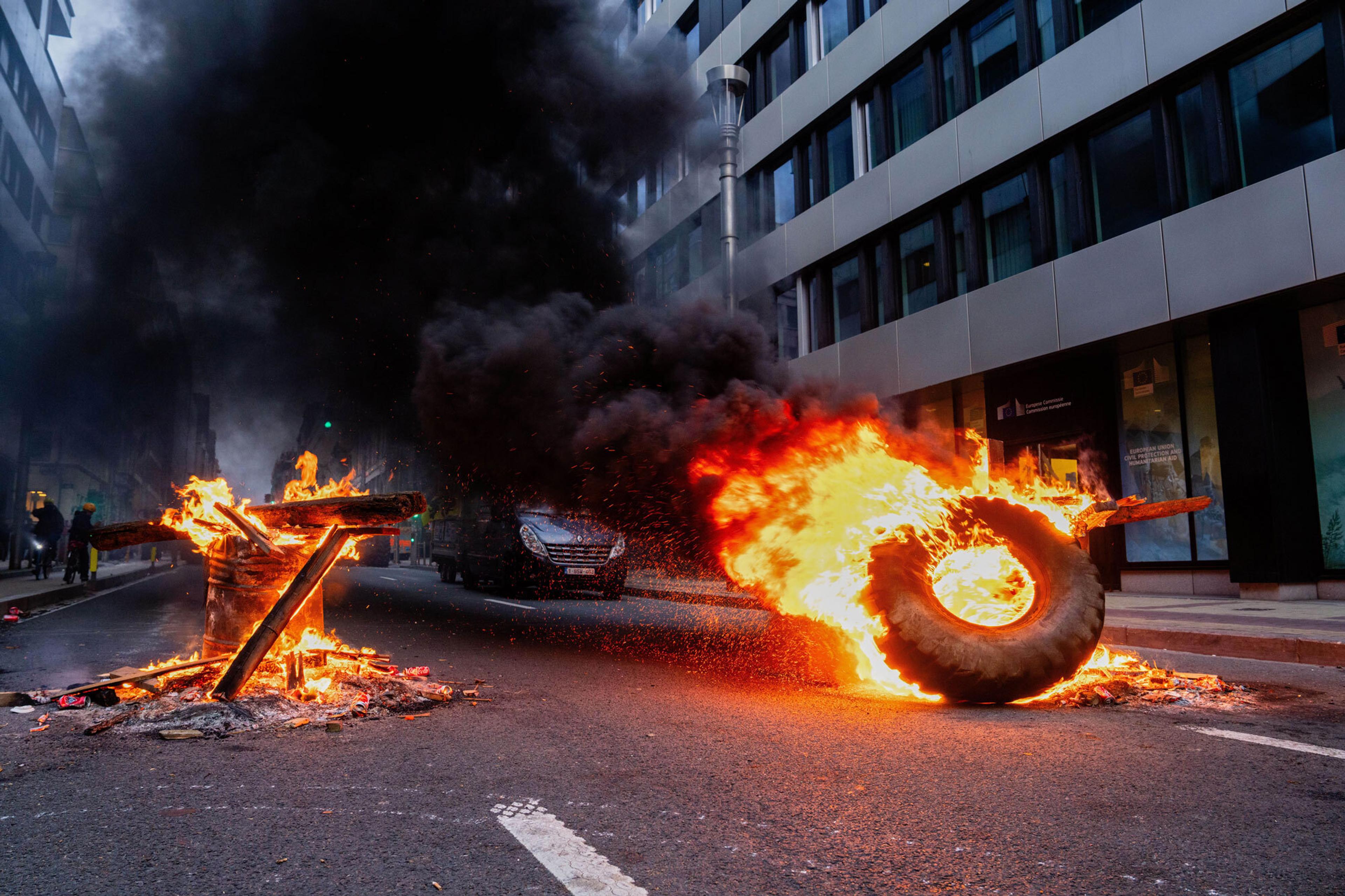
A burning tire moves across a road during a demonstration of European farmers outside a gathering of European leaders at the EU Summit in Brussels, Thursday, Dec. 18, 2025.
·(AP Photo/Marius Burgelman)
For a decade, European farming had been quietly dwindling. Between 2010 and 2020, the EU lost three million farms, nearly all of them small. Farms under five hectares (about 12.4 acres) shrank by 2.7 million while large operations expanded. The land didn’t vanish; it was absorbed by whoever could survive an imbalanced economic landscape.
As TIME magazine reported, eighty percent of the EU’s subsidies flowed to just 20 percent of farms, usually the biggest ones. Then the European Green Deal arrived, demanding farmers set aside productive land and cut fertilizer use while supermarket chains continued to squeeze their prices. Meanwhile, farmers in central Europe watched Ukrainian grain pour across their borders, undercutting prices they were already struggling to accept.
A sector told for years to do more with less had simply run out of resources. The protests had been building since 2019, in the Netherlands first, then Germany, then France, then nearly every European country with a tractor. By the time they reached Brussels, the demonstrations had acquired a notable rage.
As the European Parliament evacuated staff, protesters threw potatoes, beets, eggs, stones, bottles, and firecrackers. They set fire to trees in Place du Luxembourg and smashed windows of buildings and vehicles. Belgian farm union leader Florian Poncelet summed up the fury to Al Jazeera: “We’ve been protesting since 2024 in France, in Belgium, and elsewhere. We’d like to be finally listened to.”
The Silence
Meanwhile, 4,500 miles away in Alabama, where I’m studying agriculture at Auburn University, farmers were posting opinions on Facebook and other platforms.
American farmers had their own version of the same story, with specific data confirming the strain. Input costs surged after Russia’s 2022 invasion of Ukraine, driving the Green Markets North America Fertilizer Price Index to an all-time high of $1,270.40 in March 2022, according to the Federal Reserve Bank of St. Louis. Although prices have since pulled back, they remain volatile and significantly higher than pre-2021 levels; some nitrogen fertilizers saw monthly increases of 45% to 50% as recently as April 2026, according to reports from The Hill and the American Farm Bureau Federation (AFBF).
Meanwhile, land costs kept climbing: The average value of U.S. farm real estate increased by 7.4% in 2023 alone, driven by tight supply and non-farm investor interest, according to the USDA Economic Research Service (ERS). This has contributed to record debt, with total farm sector debt reaching approximately $540 billion in 2024 — its highest level in history in nominal terms, as forecasted by ERS.
Like their European counterparts, small and mid-size operators are typically “price takers” with little power to influence market prices. The USDA notes that net farm income often declines when input price increases outpace commodity price growth, even if gross income rises. The subsidy system offers little cushion for these farms, as critics like the Environmental Working Group (EWG) point out that the top 10% of recipients receive roughly 78% of all subsidy payments, primarily benefiting large commodity producers (corn, soy, wheat, cotton) rather than small diversified farms.
Yet no tractors descended on Washington. No burning tires. No manure on the Capitol steps. Just silence. The kind that feels heavier than it should.
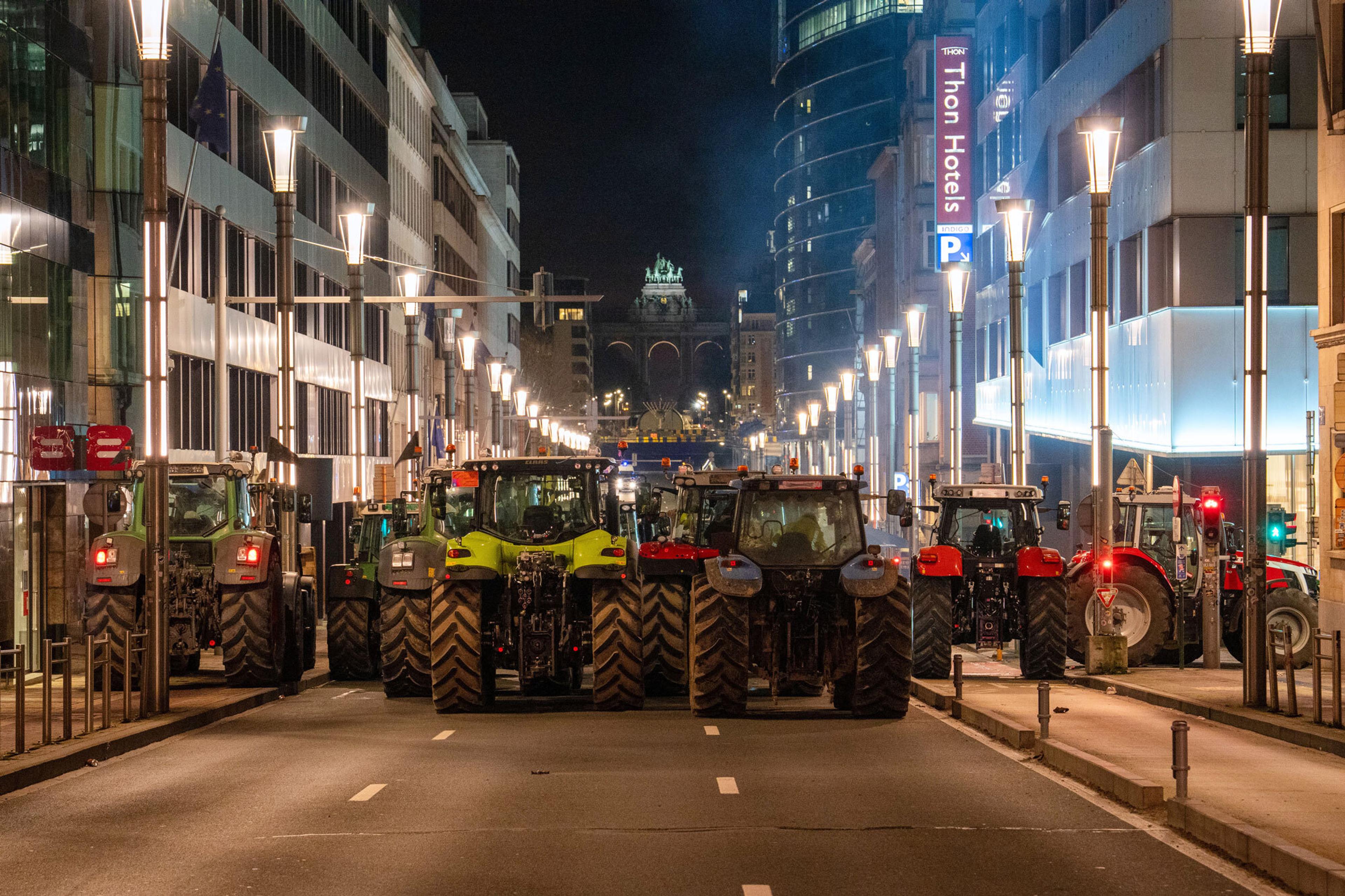
Farmers drive their tractors to block a main boulevard during a demonstration outside a gathering of European leaders at the EU Summit in Brussels, Thursday, Dec. 18, 2025.
·(AP Photo/Marius Burgelman)
“There haven’t been any tractorcade events or road blockades,” noted Whitney Shannon Heckel at the Delta Farm Press in September 2025. She documented the strange quiet between farmers, saying it’s easier to get angry online “than [fill] tractors with diesel to line up for a tractorcade.”
A report from the Alabama Farmers Federation (ALFA) further documented the severe financial strain on local producers. Adam Temple, a Houston County farmer, described the impossible math of modern farming. “No matter how hard I try to control costs, I can’t keep it under the cost of production,” Temple said. Despite investments in grain storage and irrigation designed to improve profitability, he noted he was still losing money.
Lance Whitehead, a 51-year-old farmer, grows cotton, corn, peanuts, and soybeans in Fayette and Pickens counties. Whitehead explained that stagnant commodity prices have left farmers with no margin for error. “The problem is our commodity prices are just too low,” Whitehead said in the ALFA report. “Even if we weren’t in a drought, we still couldn’t make enough yield to offset prices.”
The dire economic outlook has forced some to consider leaving the industry entirely. Mike Neal, 66, shared his backup plan: “If prices stay down much longer, I may retire and just run my trucks.”
Here’s the brutal math: Producing one acre of Alabama cotton costs $902.14. At 66 cents per pound and an average yield of 862 pounds per acre, farmers bring in $568.79. That’s roughly a $333 loss per acre. Multiply that across Alabama’s 394,685 cotton acres, and you get $131.57 million — just gone. Evaporated. That’s one state. One crop.
“No matter how hard I try to control costs, I can’t keep it under the cost of production.”
Alabama row crop farmers are projected to lose more than $236 million this year. Chapter 12 farm bankruptcies jumped 55% in 2024, then another 46% in 2025, reaching 315 filings nationwide — the highest in five years.
Stephen Censky, CEO of the American Soybean Association (ASA) and former deputy agriculture secretary under Trump, told Fortune magazine in September 2025, “It’s tough, and I can hear it in the stress in our members‘ voices.” Some of those farmers told the ASA that 2026 “could be their last year in farming.”
At least two Alabama poultry farmers told reporters their financial struggles have caused depression and suicidal thoughts. The Alabama Farmers Federation now runs a “Stronger Together” initiative connecting farmers with mental health resources.
So why weren’t American tractors rolling from Alabama — and the rest of the country — toward Washington?
The $30 Billion Question
That’s how much the American Relief Act of 2025 authorized in emergency support: $20.78 billion for disaster aid and $10 billion for economic assistance. It’s the difference between Brussels in flames and Alabama in silence. It’s the price of peace.
“It’s a financial lifeline for farmers facing the worst economic crisis since the 1980s,” Mitt Walker, national affairs director for the Alabama Farmers Federation, said in January 2026. Then Walker added something that should make everyone nervous: “But extensions aren’t a strategy. Without a permanent Farm Bill, we’re just kicking the can down the road.”
This massive federal outlay has purchased a fragile, temporary peace in the U.S., a stark contrast to the agricultural fury that has erupted across Europe. The same structural squeeze — driven by cheap imports, soaring fertilizer and diesel costs, and base prices that dropped over 10% in 11 nations between 2022 and 2023 — has forced policy change in Europe through sheer spectacle.
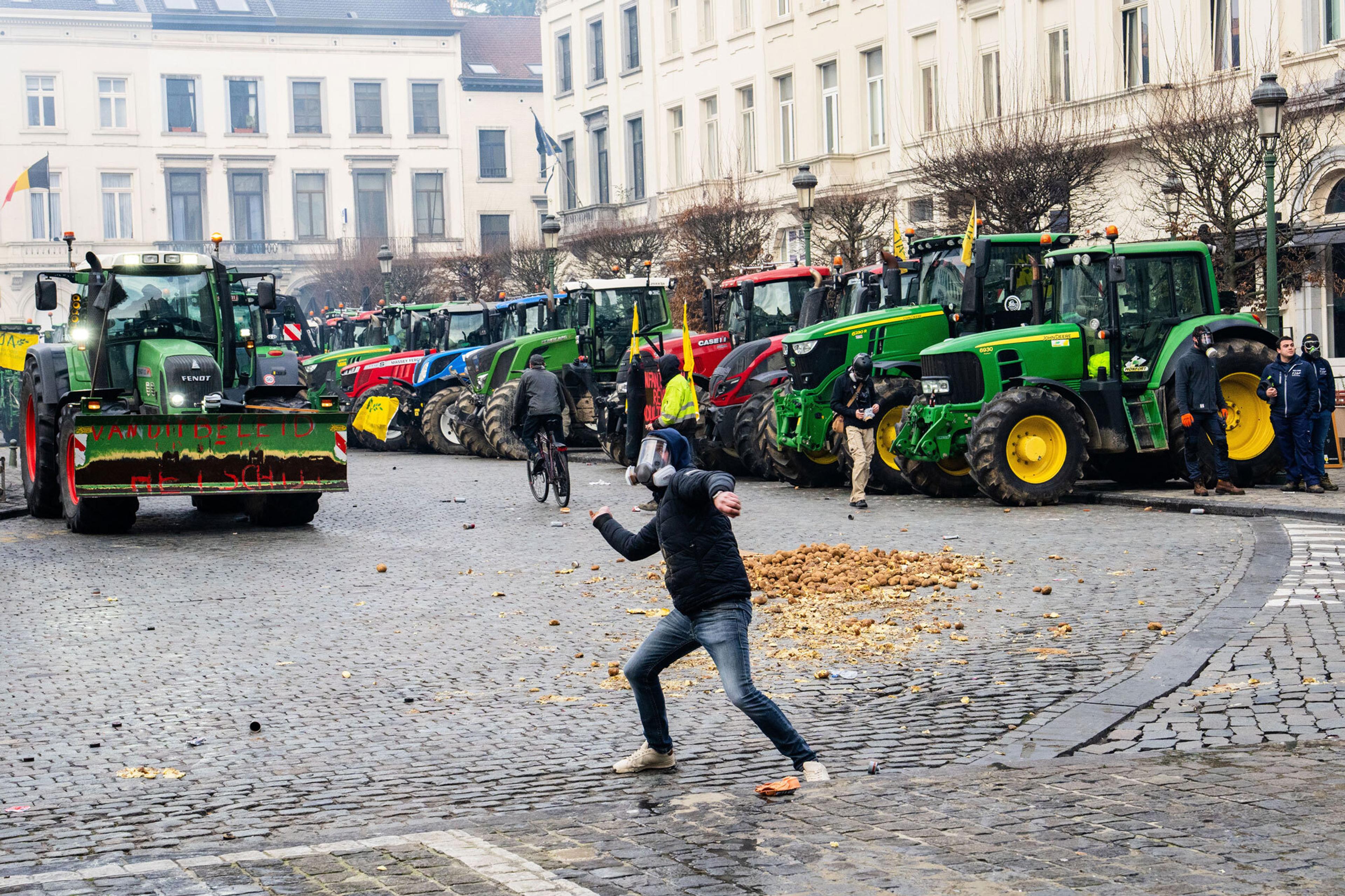
A farmer throws a potato during a demonstration of European farmers outside a gathering of European leaders at the EU Summit in Brussels, Thursday, Dec. 18, 2025.
·(AP Photo/Marius Burgelman)
In response to protests that involved dumping manure, hurling eggs at government buildings, and establishing dozens of road blockades across at least nine countries, European Union leaders in Brussels quickly backtracked on major environmental policies. This included scrapping plans to reduce agricultural emissions, pulling back a proposal to halve pesticide use across the block by 2030, and delaying requirements for farmers to leave parts of their land unused as part of the Green Deal. This political capitulation, directly attributed to the ferocity of the demonstrations, illustrates a fundamental difference in how policy responds to distress across the continents.
Joseph Glauber, former USDA chief economist and senior research fellow at the International Food Policy Research Institute, told Marketplace in February 2024, “France by comparison has a long tradition of active protests … I suspect that this does get the attention of policymakers.”
Translation: European farmers set things on fire because they needed to. While American farmers don’t. At least not yet.
The Ghost of 1979
American farmers haven’t always been this quiet — the current silence feels more like an outlier than a permanent shift. The 1970s and 1980s in the U.S. were marked by explosive rural activism that mirrors the current smoke in Brussels.
The activism peaked during the 1980s Farm Crisis, a period of devastation born from a “perfect storm” of high debt loads from the 1970s expansion and a sudden collapse in commodity prices. The breaking point arrived when interest rates peaked at a staggering 21% under Federal Reserve efforts to curb inflation. In response, groups like the American Agriculture Movement and the Iowa Farm Unity Coalition organized a resistance that went far beyond social media posts.
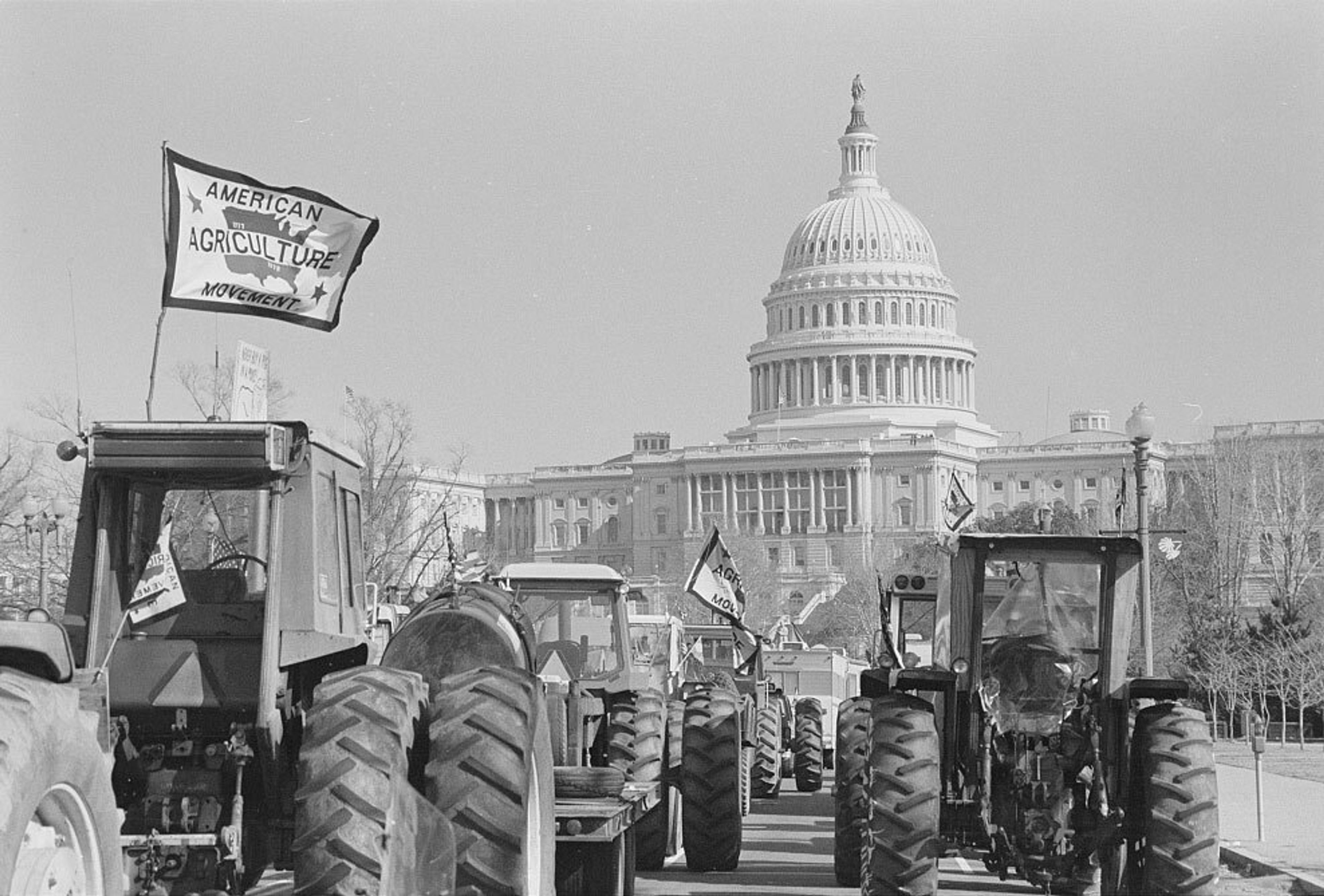
Tractors, one flying the flag of the American Agriculture Movement, on their way to the U.S. Capitol, Washington, D.C., during the "Tractorcade" protests of February 1979.
·Library of Congress
Tactics were aggressive: Thousands of tractors descended on Washington in 1979 for a weeks-long blockade of the National Mall. Throughout the 80s, farmers engaged in “no sale” actions, withholding grain from the market to force price increases, and blockaded farm foreclosures. Symbolism was potent; white crosses were planted in courthouse lawns to represent lost family farms, and the first Farm Aid concert in 1985 used music to broadcast rural desperation to a global audience.
That era’s fury only subsided when federal intervention finally pivoted toward debt restructuring and increased support levels. Today, the ghost of that activism remains in the Smithsonian, where a tractor from the 1979 tractorcade is preserved.
Everyone’s Waiting
To understand why American farmers haven’t yet reached their breaking point, we must look beyond the immediate financial lifeline and consider the underlying structural system. Max Runge, an extension professor in the College of Agricultural Economics and Rural Sociology at Auburn University, argues that the long-term functioning of the U.S. agriculture industry is fundamentally reliant on a foundation of community support and collective resource management by organizations like the Farm Bureau and state food programs.
This foundation is reinforced by the nation’s history, which was “founded on family farms and the preservation of the farmland.” In other words, American agriculture is a deeply social system that absorbs economic shock more effectively than a purely transactional market. However, this cultural and systemic resilience is currently being challenged by the massive federal emergency checks, the very ones that are keeping the system from collapsing under the global squeeze.
But culture doesn’t pay the bills. And Walker of the Alabama Farmers Federation, who tracks the trade numbers as closely as anyone, knows the gap between resilience and recovery. He’s cautiously optimistic about the federal government’s tariff strategy — but clear-eyed about the risk. “Historically, agricultural trade — we have always seen that as a bright spot on our nation’s trade balance,” Walker said on the Alabama AgCast podcast. “The alarming thing for agriculture is that, in the last three years, I believe, we’ve set new record highs for a trade deficit. So obviously, what we’ve been doing is not exactly working like it should.”
They’re failing because of fundamental gaps in state government programs and a chronic under-prioritization of agriculture as an industry.
Wheeler Foshee, associate professor of horticulture at Auburn University, has spent decades training the next generation of Alabama farmers. He sees the crisis from the ground up. It’s smaller farms, he argues, that are the essential building blocks of a stable food economy, and those are the ones disappearing first. He says he is cautiously optimistic about one thing: Farmers are getting smarter.
They’re learning more about the soil, the seasons, and the economics, and they’re recognizing that the numbers aren’t just failing to add up. They’re failing because of fundamental gaps in government programs and a chronic under-prioritization of agriculture as an industry. But that awareness only goes so far. As the reality sets in for students returning home to family farms on the edge, Foshee believes the burden will fall on the next generation to pick up where the last left the fields fallow.
Everyone’s waiting for the same thing: Either someone fixes the system, or the system’s going to break.
Where Do We Go From Here?
The question on everyone’s mind isn’t whether American agriculture faces the same pressures as Europe. We know it does. The data proves it. The farmers confirm it. The bankruptcies track it, and the mental health crisis reflects it. Leaving us with what we have today.
The Farm Bill is the foundational legislation that sets U.S. agricultural and food policy, typically renewed every five years. It has been running on extensions since 2023 because Congress has not passed a permanent replacement. The emergency checks authorized by the American Relief Act of 2025 have likely kept hundreds of thousands of family operations afloat — over 560,000 row crop farmers received more than $9.3 billion in assistance, with an additional $705 million going to over 220,000 ranchers.
But emergency checks are not farm policy. And without a permanent Farm Bill, the next drought, the next bad harvest, the next crisis, won’t have a safety net waiting — just another extension, and another prayer.
American checks are buying time, not a solution. Either way, the clock is ticking. The Farm Bill negotiations are ongoing, with debates over commodity support, conservation funding, and nutritional assistance programs adding layers of complexity to an already challenging legislative landscape. And somewhere in Alabama, on a farm losing $333.35 an acre, someone is doing the math, calculating not just their immediate losses but the long-term viability of their family’s legacy and livelihood.
The smoke from Brussels is clear, and the silence in Alabama speaks volumes. The real question isn’t whether the crisis will arrive, but whether policymakers and the public will choose to see it before the American farmer hits their breaking point. Will we wait for the sparks to catch here, too, or deal with the foundational cracks?