But they are a lifeline for small farms, and a vital source of community — maybe that’s enough.
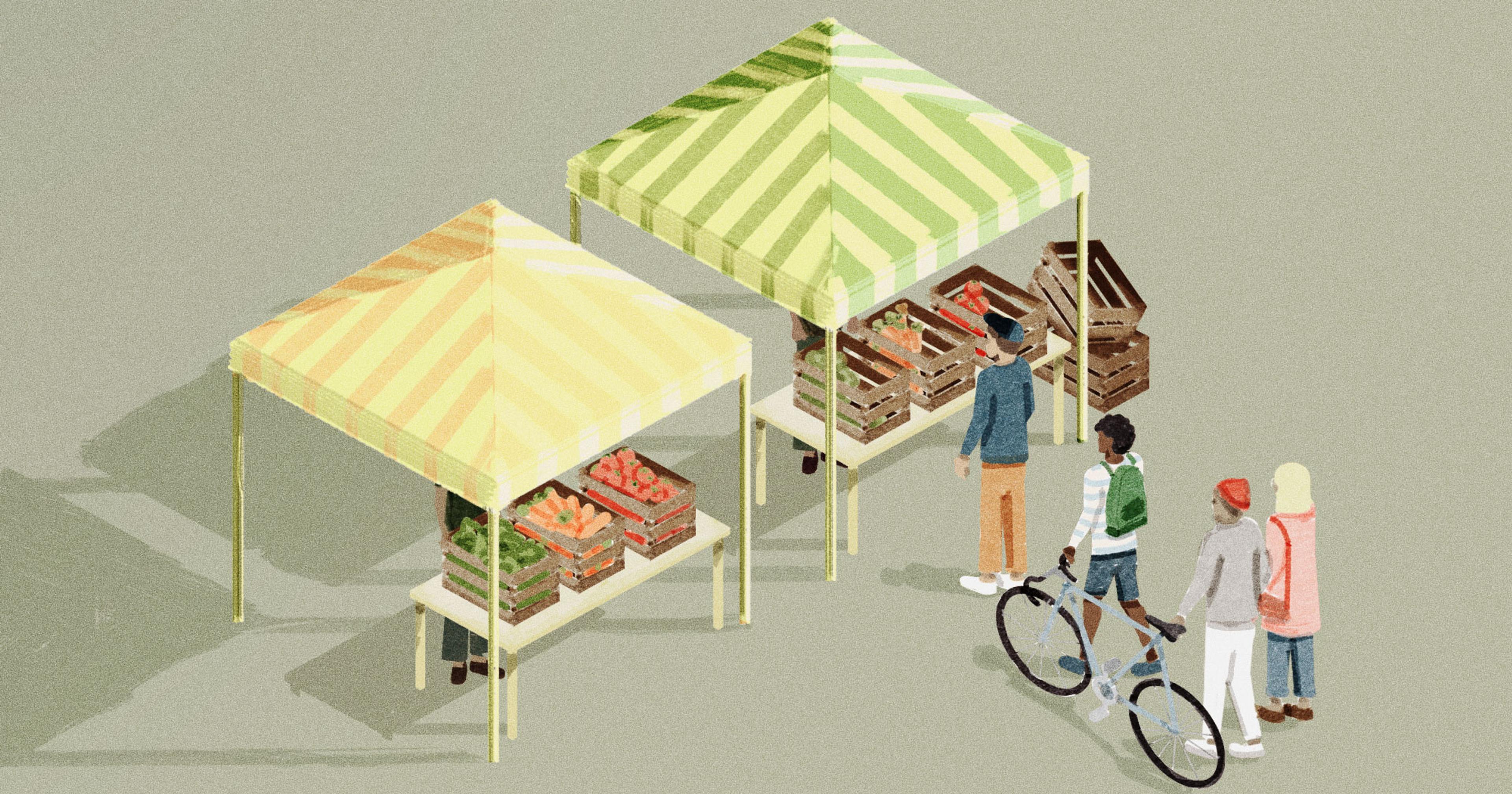
On any given Saturday here in the Pacific Northwest, the farmer’s market looks like a postcard of American agrarian nostalgia. Baskets of heirloom tomatoes glow like jewels. Children clutch Rainier cherries dripping with dew. A street performer strums a guitar under a tent that’s losing its battle with the wind. Shoppers drift from booth to booth with tote bags and good intentions, telling farmers how grateful they are for “local food” — a phrase that has become equal parts praise, aspiration, and political statement.
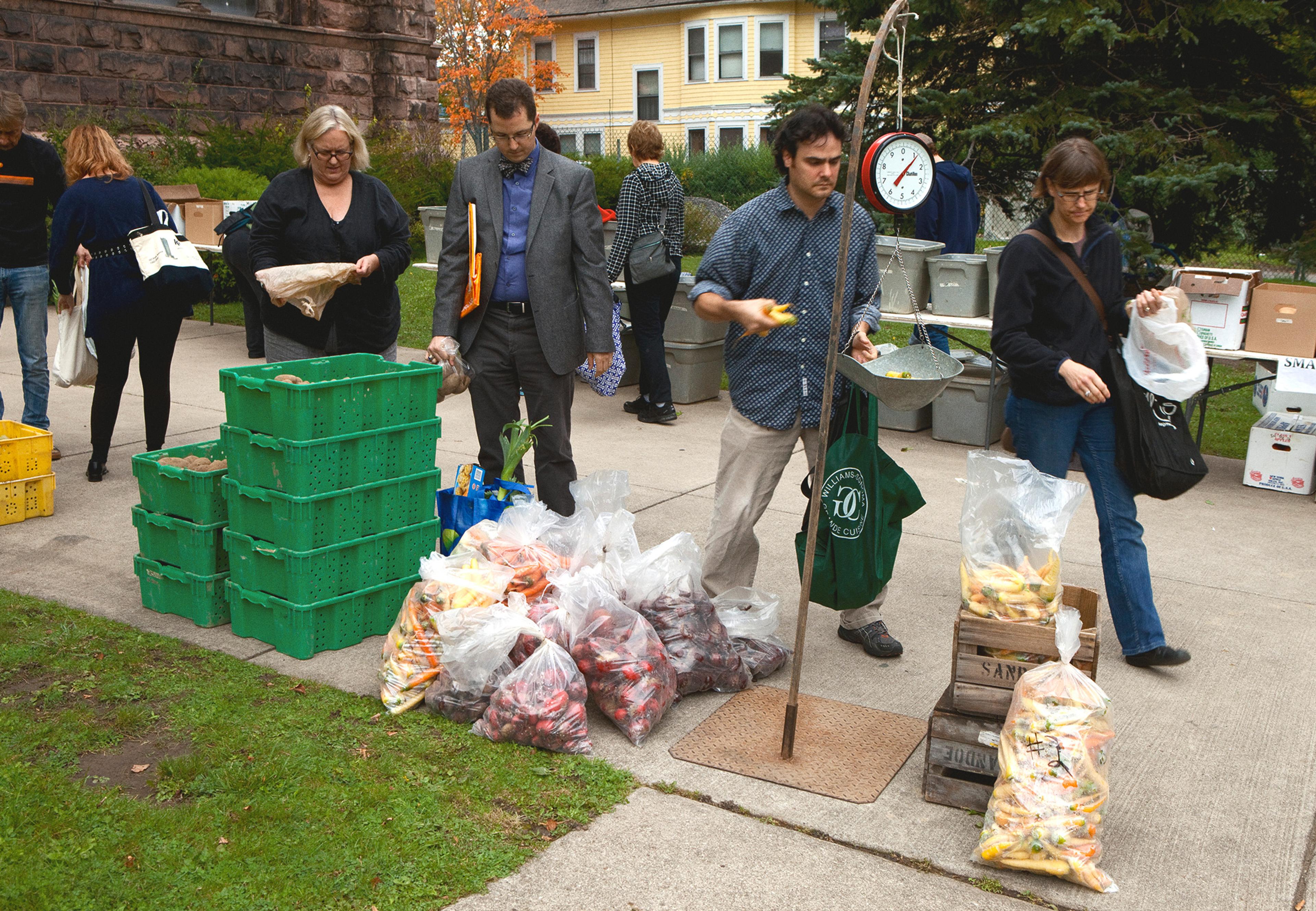

But behind the tables, the view can be different. The farmer who woke at 3:45 a.m. to pick, pack, and drive his product to the market is doing quiet math: stall fees, fuel costs, labor hours, the percentage of product that won’t sell.
The farmer’s market has become a symbol in today’s political and literal climate: celebrated, scrutinized, and often misunderstood. Some say it’s a feel-good outlet for consumers who want to believe they’re supporting a better food system. Others argue it’s one of the few remaining spaces where small family farms can still carve out a livelihood and potentially grow. The truth, as usual in agriculture, lives in the tension between those two ideas.
Like any self-respecting locavore who grew up in a food desert, I was over the moon when I moved to western Washington five years ago, surrounded by what seemed like an endless supply of farmer’s markets. But the more I shopped at, talked with, and wrote about these growers, the question kept surfacing: Do farmer’s markets genuinely strengthen local farming communities, or are they just a comforting story we like to tell ourselves—one that often overlooks the realities of farm labor, risk, and economics?
There’s no question that farmers‘ markets hold a special place in our hearts. Today, they account for a distinct-but-modest share of the nation’s overall food supply — roughly 3 to 8 percent by calories. While most households still rely on large supermarkets for more than 60 percent of what they eat, the role of direct-to-consumer markets is firmly established.
Even so, farmer’s markets remain essential for many small family farms, providing opportunities for these growers to shine. For small-scale producers — typically family-owned with a gross income under $350,000 — these markets provide the primary platform for direct-to-consumer sales. Rather than navigating complex global supply chains, these growers rely on the market as a vital source of income, allowing them to sell the majority of their products directly to the community.
Caleb Poppe of Sundowner Farm has been selling at the Olympia Farmers Market for three years, but his connection to the market began long before he ever imagined becoming a farmer. For years, he was a loyal shopper — buying produce, browsing craft stalls, and admiring the farmers who felt like “local celebrities.” That early admiration shaped how he saw the market community. Today, his stall is a vibrant display of carrots, chicories, greens, and heirloom tomatoes. He has also carved out a unique niche by growing Caraflex cabbage — a pointed, tender variety that no one else in the region currently produces.
Caleb approached farming with intention and patience, and his first two seasons were focused entirely on building a CSA program while he finished college. Easing into the market slowly by selling only on Fridays, he quickly expanded to the weekend, selling out each day.
They act as a living billboard, helping establish a level of community trust that is difficult to achieve through digital marketing alone.
Today, farmer’s markets remain his most important income stream. “Starting out with a CSA provided me with crucial early-season income, and it’s still a contributor to my success,” Caleb shared. Those upfront payments are invaluable before market sales pick up at the beginning of the season, but he feels farmer’s markets play an important role in supporting small and mid-sized farms. They act as a living billboard, helping smaller farms build a broader customer base and establish a level of community trust that is difficult to achieve through digital marketing alone.
“Let’s face it, farming can be lonely,” Caleb said. Unlike wholesale or CSA deliveries, selling face-to-face allows him to see people’s reactions, hear their comments, and share in their excitement over the food he’s worked so hard to produce. That interaction lets him educate customers, build trust, and feel part of a shared experience.
Next season, Caleb is preparing for significant growth. He plans to expand his production by taking on three additional acres and, for the first time, hiring two full-time employees. The move marks a major step forward — one that he says could only have come because of the market. With more land, more labor, and more responsibility, he sees the expansion as the next evolution of his farm and a commitment to the future he’s building.
When I asked Koji Pingry of Makanai Farm, a no-till farm north of Seattle, why he and his wife, Lizzie Jansen, pivoted from the restaurant industry to farming, he laughed, “That’s a question we were asking ourselves seven years ago, too.” He admits farming wasn’t their original plan. “I remember reading an article questioning whether farmer’s markets could ever truly sustain small-scale agriculture. The odds didn’t seem too promising.”
Still, driven by a shared belief in food’s power to connect people, Koji and Lizzie leaned into farming. Restaurants supported them financially while Lizzie worked on local farms and Koji finished college, and Koji found joy in the rhythm and camaraderie of the kitchen. Those same skills, he says, carry over to farming: “It has its own version of a dinner rush — just slower.”
Unlike wholesale or CSA deliveries, selling face-to-face allows him to see people’s reactions, hear their comments, and share in their excitement.
Like Caleb, Koji and Lizzie first launched a small CSA program, initially serving 30 members and eventually growing to over 100 — all on a single intensively managed acre. Their no-till approach was intentional, aimed at building soil health and nutrient density while pushing the limits of what small-scale land can produce.
“We avoided farmer’s markets at first,” said Koji. “Working with growers in the restaurant industry, I’d heard how grueling the model could be.” Loading and hauling produce, setting up a booth for a single day of sales, paying market fees, and hoping the numbers penciled out: At their scale, it didn’t seem worth it.
What finally changed their minds was community. For Koji and Lizzy, farmer’s markets have an undeniable cultural impact: They’re hubs for education, connection, and mutual support among growers. Their decision to join the market was also deeply personal.
For three decades, a Japanese farmer at Mair-Taki Farm — someone Koji grew up admiring and whose vegetables his mother revered — had anchored the market with some of the same Japanese vegetables Koji and Lizzy now grow. They often joked that they’d only take on a market stall if he ever retired. When he stepped away earlier than expected, he offered them his space, a gesture that felt like both an honor and an invitation to continue his legacy.
Koji and Lizzy are still newcomers to the farmer’s market world: This past season was their first. To make room for the shift, they cut their CSA membership in half — from 100 shares to 50 — and added a weekly Saturday market showing at the University District Farmers Market in Seattle. Surprisingly, the revenue they earned at the market balanced almost exactly the 50 CSA shares they gave up. This balance proved that while a CSA can sustain a farm’s start, the market provided the immediate scalability and brand awareness they needed to justify moving to a larger piece of land.
While the farmer’s market clearly seems to be working out for Caleb, Koji, and Lizzie, it’s not all beer and skittles. Still basking in the warm, soft glow of farmer’s market shopping, I read Sarah Mock’s two books, Farm (and Other F Words): The Rise and Fall of the Small Family Farm and Big Team Farms. Sarah gently, but firmly, brought me back to reality as she shared example after example of small farms that had transitioned away from selling directly to consumers at farmer’s markets for a variety of unsavory reasons:
Labor demand to work the market is hard for smaller growers to manage alone
Risk: unsold inventory, failed crops
Transportation costs
Emotional toll
Weather
The pain point that weighs most heavily on Caleb is the inherent exclusivity of farmer’s markets. Even with incentives like Washington’s SNAP/EBT match program, markets remain financially out of reach for many. “If I’m being honest,” said Caleb, “I can’t afford to buy the produce I sell, and it troubles me knowing that many people today face that same barrier.”
Pricing deepens that challenge. Farmers can’t legally coordinate prices, and each grower sets them independently based on costs. Caleb often charges some of the lowest prices at the market, partly because his overhead is lower and partly to remain accessible, but affordability has limits within a system that leaves farmers to navigate inequity on their own.
For Koji and Lizzie, those limits appear as sustainability rather than access. Early on, they learned that an estimated 70–80 percent of small-farm household income comes from off-farm work — a reality that continues to shape their decisions.
“We keep our living expenses low, and diversifying between the CSA, the market, and restaurant sales helps,” said Koji, “but we’re in our early 30s, and we still lease our land.” One of them taking an off-farm job is becoming part of their long-term plan — less out of defeat, Koji said, than out of realism. Supplemental income would relieve pressure and allow them to keep farming in line with their values.
While their CSA provides upfront stability and the market is currently strong, uncertainty remains week-to-week. Koji has seen that farmers who succeed long-term in market-driven models often own their land and farm three to eight acres — conditions that underscore how fragile sustainability can be without assets.
Sustaining small farms requires consistent customer turnout, fair pricing, and policies that prioritize farm viability.
Yet even with these contradictions and compromises, farmers keep showing up at the market, and shoppers like me keep returning to support them. For growers, these direct sales can mean survival. But more than that, a market is where a community decides whether its farmers truly matter.
Perhaps we should stop asking farmer’s markets to fix our broken food system. Markets do matter — but they are not a panacea. Their true impact depends on economic realities, community investment, and policy support, not just a locavore’s enthusiasm.
Farmer’s markets have the potential to bolster local agriculture, but only when the warm, community-focused narrative is matched by genuine support for the farmers themselves. The charm of open-air stalls and face-to-face connections can only go so far; sustaining small farms requires consistent customer turnout, fair pricing, and policies that prioritize farm viability. Without that deeper commitment, the feel-good story of shopping local risks becoming just that — a story, rather than a meaningful investment in the future of local food.