In Tucson, a vanished Mormon farming community lives on in a 1936 feed store that has outlasted the farms, the ranches, and the river that made them possible.
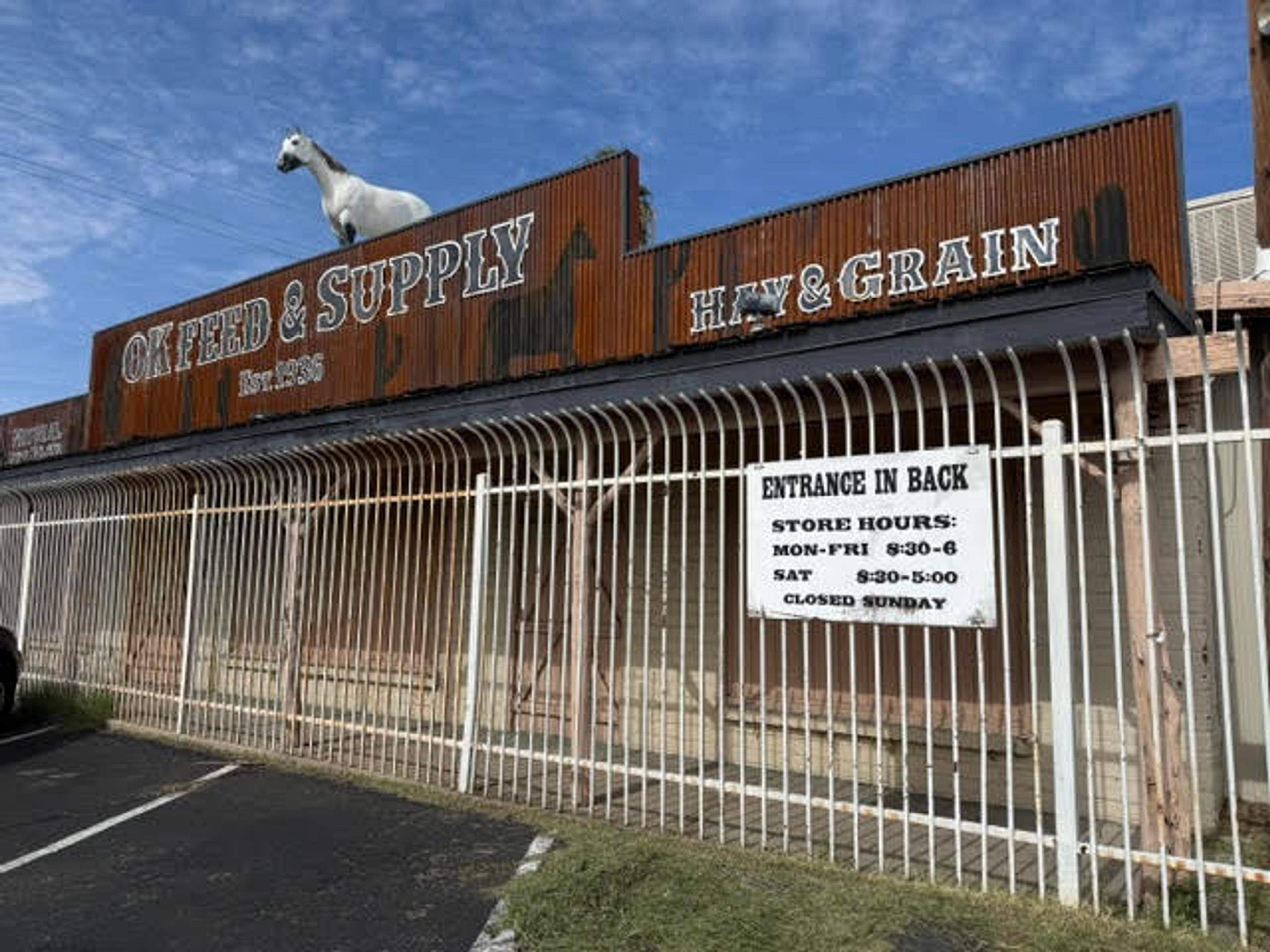
The cool air catches me the moment I step through the back door of OK Feed & Pet Supply — a sign on the gate reads ENTRANCE IN BACK. Hay is still stacked in the yard outside, the way it was when my parents first brought me here in the early 1980s. My dad used to load Tasha, our Weimaraner, into the back seat, her ears flapping out the window the whole way. Fort Lowell Road was mostly empty then, just the feed store standing out on the corner. We came for dog food. Flea medicine. Whatever else Tasha needed. I remember the sun on the bales, the smell of grain and dust. I don’t have many memories of my father in Tucson, but I have memories of us together at the store.

Even after my parents divorced when I was five, I continued to come with my mom and our Golden Retriever. When I had sons of my own, I brought them with our dogs, who nosed through the toy bins looking for something to destroy. I couldn’t walk out without making sure every dog had something — a bone, a toy, whatever they’d already found, plus their specialty food. After my sons were grown and the house went quiet, I came with Blazer, my grandpup, a Boston Terrier. Blazer rode in the front seat, window down, ears back in the wind. The second I opened the car door, he was out, nails on the pavement, pulling me through every aisle.
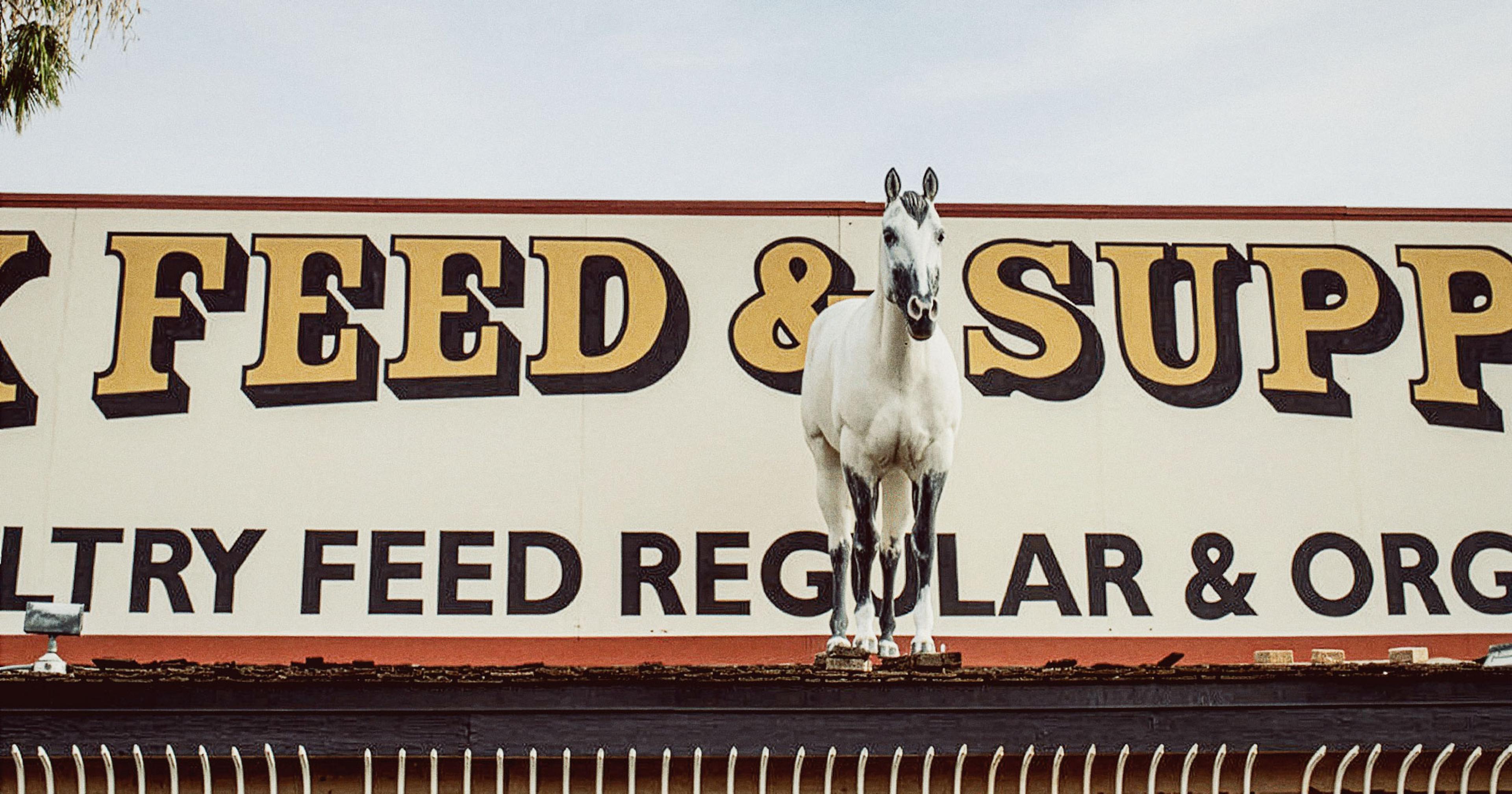
There is a fiberglass horse on the roof. His name is Smokey. He has kept watch over OK Feed in midtown Tucson since the 1980s. He has watched hay trucks back into the yard and customers load bales into their trunks. He has stood through monsoon seasons and summers that hit 118. He has been up there for most of my life. I remember looking up at him as a girl. My sons used to spot him from the car before we even pulled into the lot. Smokey has seen my parents together and then apart, my dogs one after another, the neighborhood turning over beneath him while the hay kept coming in.
*
Okay Feed was founded in 1936 by a man everyone called Bum. His real name was Orville Kelvin Post, but nobody used it. “Bum was what everybody called him,” says Michelle King, the store manager. “That’s just what he went by.” He opened a feed and supply store to serve the farmers and ranchers who worked this stretch of the Sonoran Desert. It was a hardware-type establishment that at one point even had a gas station.
The Post family didn’t just work there. They lived in an apartment attached to the building, on what is now the west side. The door and window are boarded up today, but inside the store, you can see where the ceiling drops and a thick wall juts out near the freezer, the seam where the family’s apartment began.
Bum Post was serving the tail end of a farming community that had been built in the desert by Mormon settlers less than four decades earlier. In 1899, the extended Bingham family began homesteading along the Rillito River, a waterway that once ran year-round but is now mostly dry, near the old military outpost of Fort Lowell. The surrounding area was settled by what historical sources call the Binghampton (sometimes spelled Binghamton) community of Mormons. Their patriarch’s father, Private Erastus Bingham, had passed through the Tucson Basin in December 1847 as part of the Mormon Battalion, and his descendants eventually returned to settle the land. They hired Yaqui laborers to dig an irrigation ditch from a creek two miles to the east, stored water in ponds large enough for boats, planted orchards, and ran dairies.
Tamara MC
Beginning around 1909, Mormon refugees fleeing revolution in Mexico’s colonies arrived, and by the early 1920s, the population probably exceeded 300. Then the water table dropped, the Depression hit, and the farms gave way to horse ranches. By the time Bum Post opened his doors, the hinge between one economy and the next was already swinging.
If you drive through the old Binghampton area today, you will pass a craft beer bar, a chocolate factory, a bike shop that sells espresso, and a cactus nursery right next to the feed store. Fort Lowell Road is lined with furniture showrooms and restaurants. There is little to suggest what this neighborhood once was.
But traces remain if you know where to look. The Binghampton Cemetery, just behind the store, dates to 1899. It now holds more than 1,500 interments, and still accepts burials. The chapel that Binghampton residents began constructing in 1927 was dedicated in 1935 and is still used by members of the local congregation. Nephi Bingham’s original home later became the Castro Place because Raul Castro, who would become Arizona’s governor, once lived there. It is now part of a Montessori school. In 2008, the Daughters of Utah Pioneers erected a historical marker commemorating the settlement.
*
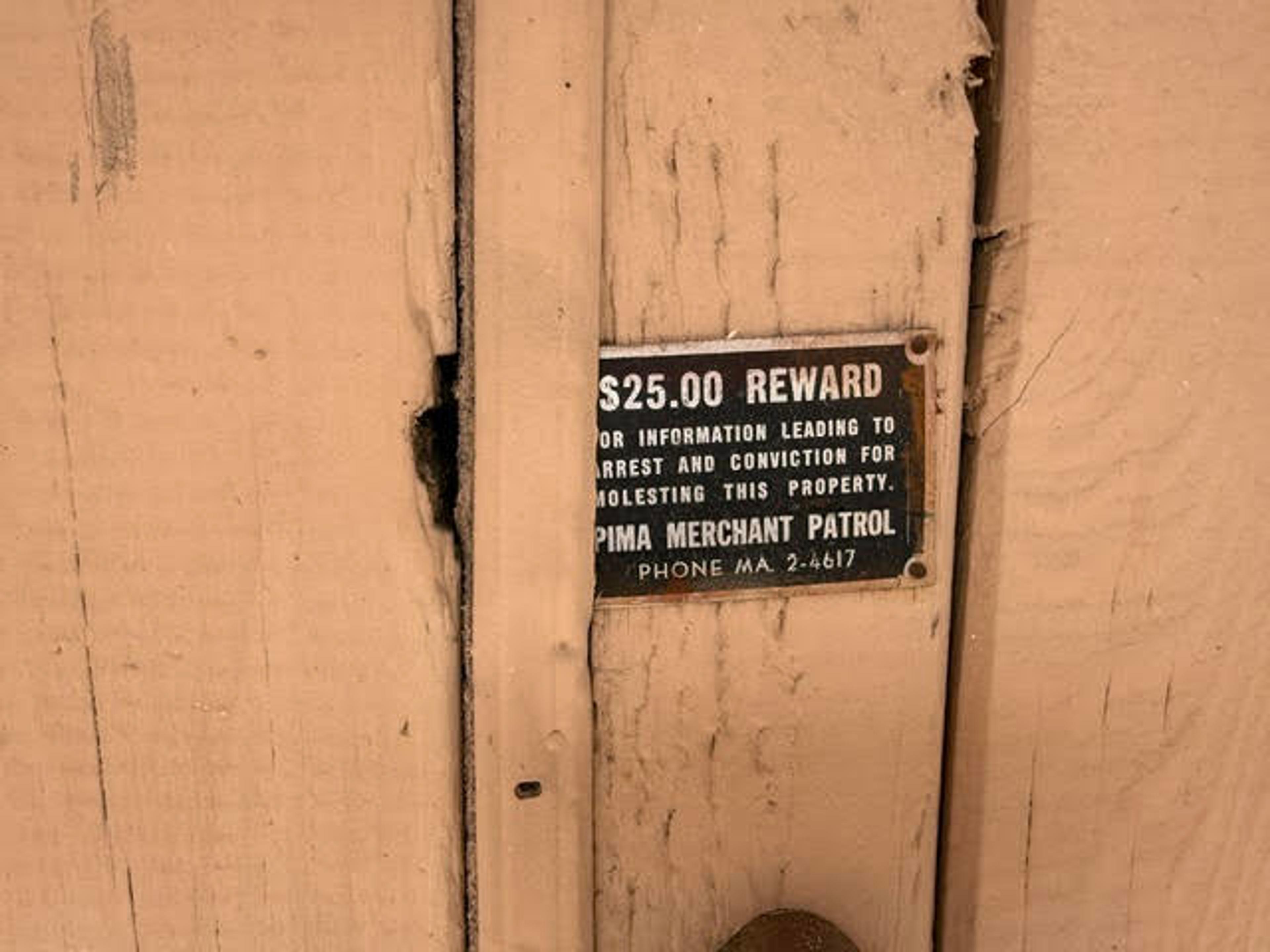
Old photographs, still held by the company, show Bum leaning against the posts out front, the same posts that still bear the original phone number plaques today. The number was just four digits then: 5012. As the phone system expanded, it became 50122, then 325-0122. The current number, 520-325-0122, still carries that original core. Beside the phone plaques hangs a small metal sign from the Pima Merchant Patrol: “$25.00 REWARD FOR INFORMATION LEADING TO ARREST AND CONVICTION FOR MOLESTING THIS PROPERTY.”
Bum and Fonda raised a family in the apartment attached to the building. The Posts ran the store from 1936 until 1973, close to four decades behind the counter. Then Doug Jordan bought the business and began a slow, deliberate transformation.
Horse ownership was declining around Binghampton. The ranches and stables that had replaced the Mormon farms were themselves disappearing, and the customers who still came through the door were less likely to need 50-pound bags of livestock feed and more likely to need something for their dogs. Jordan shifted the store’s focus from livestock to small animals and pet food, building out a niche in holistic and natural brands. He stocked frozen raw options, high-end kibble, premium products that transplants to the former farmland were willing to pay for.
Jordan also locked the original storefront door as crime along the midtown corridor worsened. Customers were routed in through the back. Still today, when I go into the store, I miss the original entrance, how grand it felt to walk through it. I remember the feeling of walking through those doors, a puff of air hitting me.
Tamara MC
It was Jordan who put Smokey on the roof. The fiberglass horse had come with the store’s inventory when Jordan bought the business, probably sitting inside as a display piece. Sometime in the early 1980s, Jordan moved him up top, which is around when I started coming to the store. I don’t remember exactly where he was perched in those earliest years, only that he was there. Smokey was named, according to the store, after an employee’s gray horse who has since died.
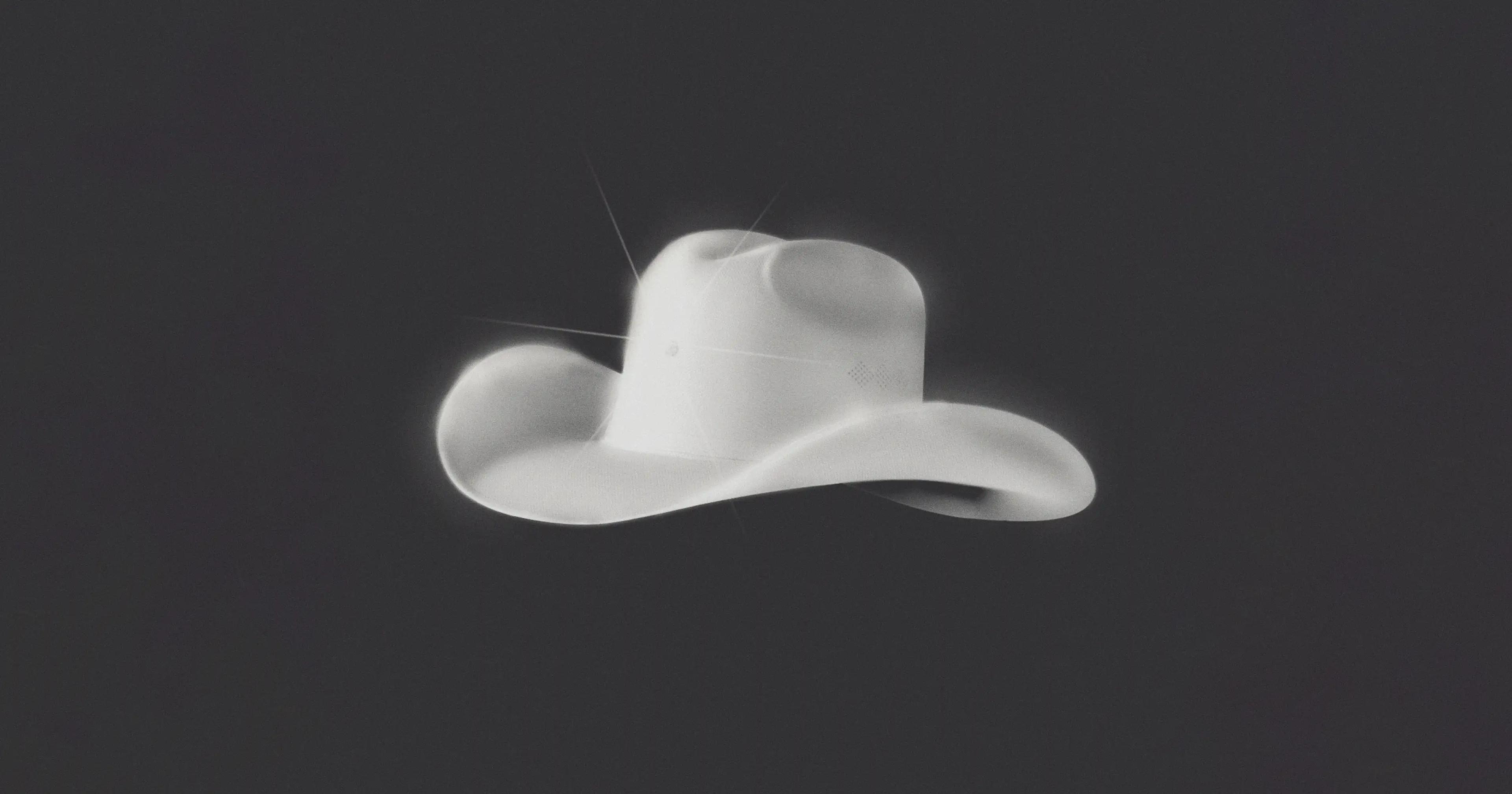
Smokey has been repainted many times: buckskin, pinto, black with a stripe and white socks, and possibly chestnut, each time to look like a new horse. He was originally mounted lower on the building, where bolt holes are still visible, and was stolen at least twice from that position, once by a University of Arizona fraternity. But he was always returned. Smokey is a guidepost in Tucson, a landmark people use to give directions: Turn right where the horse is on the roof.
Since Smokey moved on the roof, he hasn’t been stolen in at least 15 years. “He has a lot of sentimental value,” King says. “If something were to happen to him, like a storm blew him off or something, we’d all be really upset. He’s basically a staff member.”
*
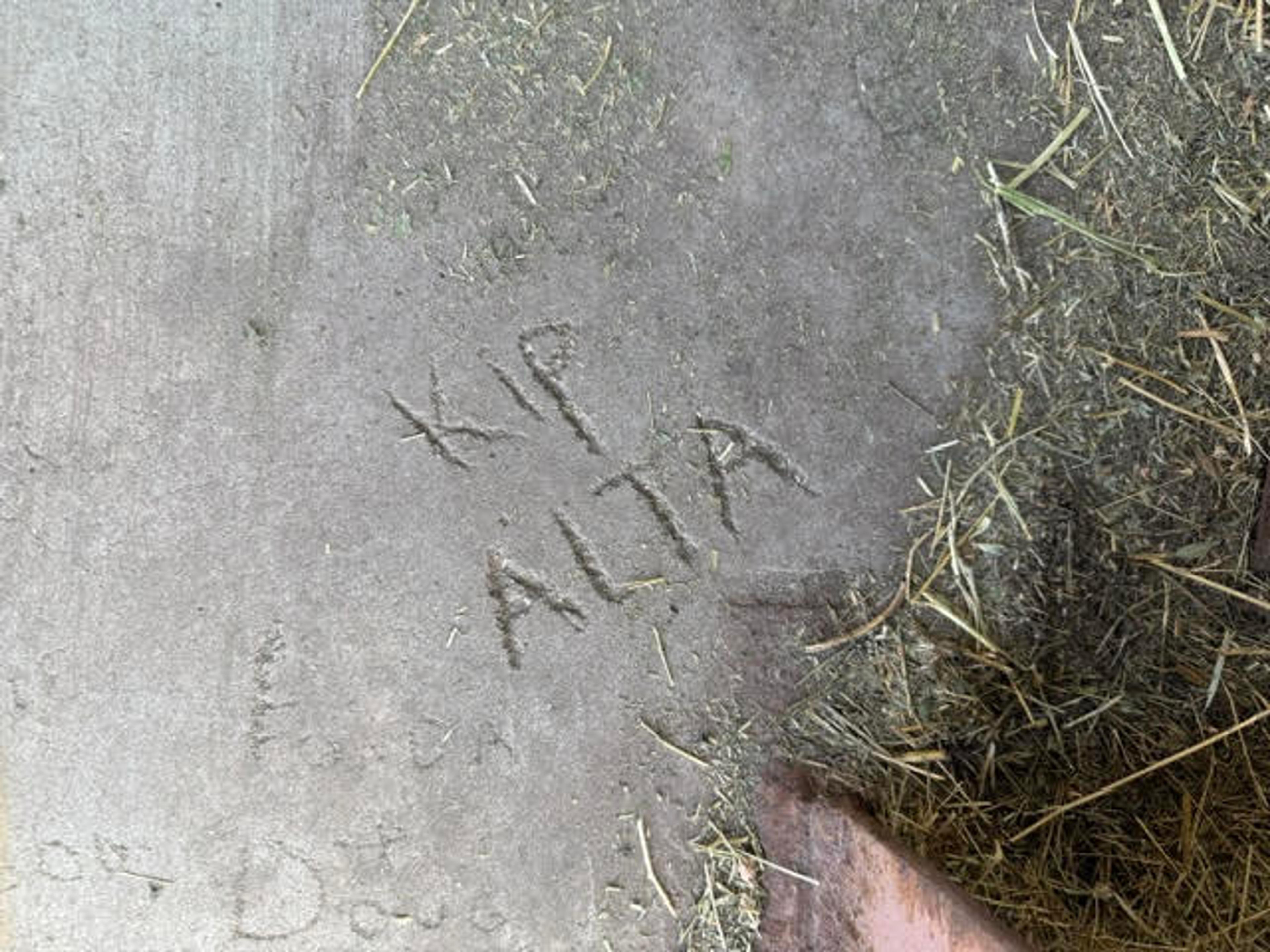
King has worked at OK Feed for 15 years, coincidentally the same length of time Smokey hasn’t been stolen. She started as a cashier because she came in with horse and pet knowledge, and gradually worked her way up to store manager. She is the longest-tenured current employee, but not the longest in the store’s history. Kip Arnold spent roughly 25 years building the horse side of the business before he died in 2017. Several other women have put in 20 to 25 years apiece. Some still come in to shop.
One of the women met her husband at OK Feed. When the dry barn and the concrete lane were poured, the employees wrote in the wet surface, names that overlapped and accumulated into what the store’s website describes as “well over 100 years of combined experience.” Employees come, and they stay. So do their customers.
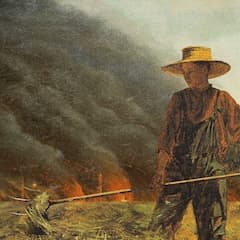
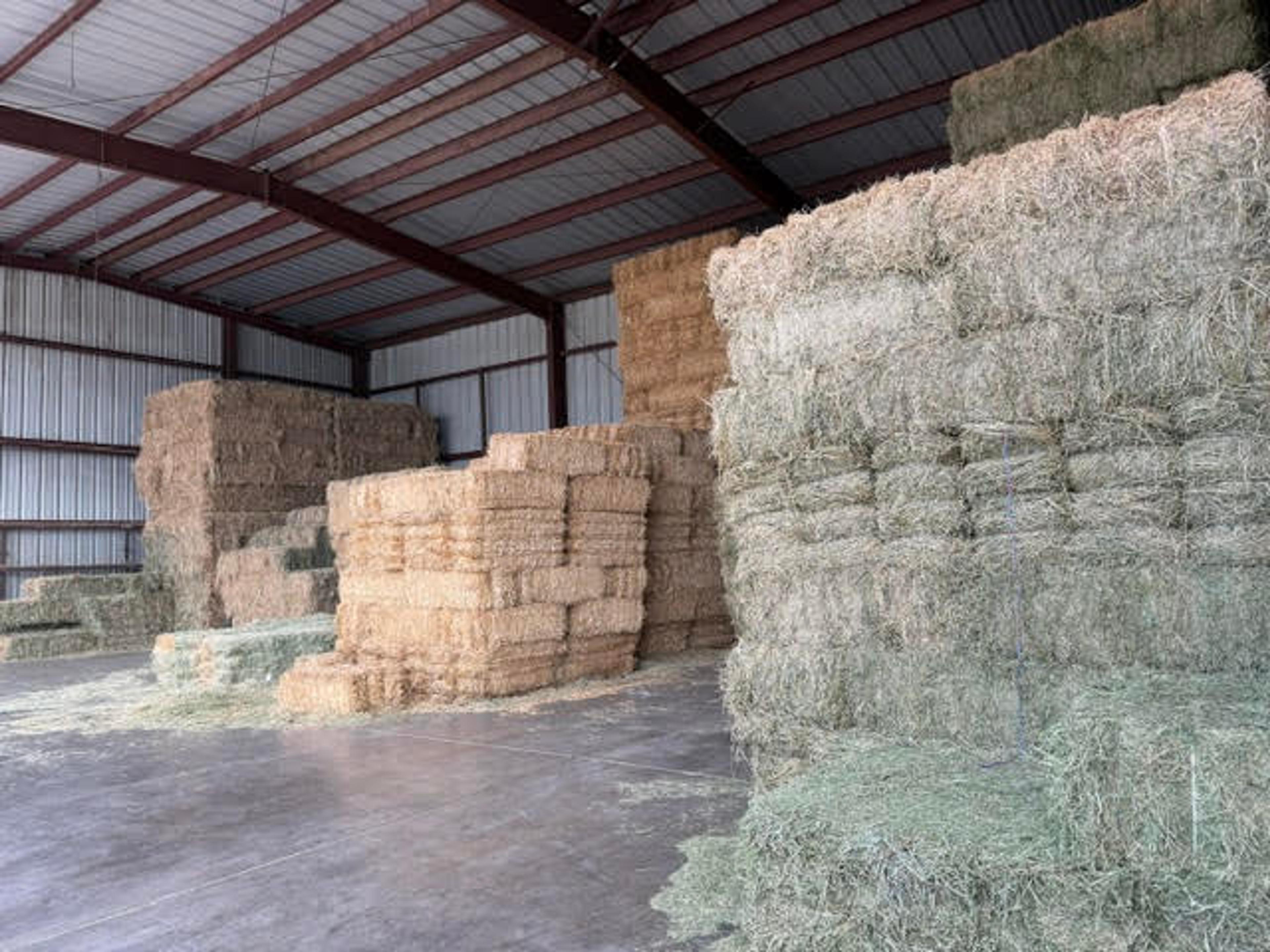
You can still buy hay at Ok Feed, and farmers and ranchers still come by for it. The dry barn itself is 30 to 40 years old, probably built after one of the hay fires. There have been several over the years, caused by cigarettes or by rain. Hay baled when still too damp holds heat inside, moisture trapped in the compressed grass building until the center ignites on its own. Inside the barn, pigeons shuffle in the rafters. Straw crackles underfoot. The air carries dry wood, straw dust. A rusted sign bolted to the corrugated wall reads QUALITY FEEDS — ARIZONA FEEDS — FOR ALL YOUR LIVESTOCK NEEDS. The front barn doors are hung with horseshoes.
Tamara MC
The horse side of the store was added in the late 1980s. Before that, everything including horse supplies, pet food, and hardware was on one side. That inventory has declined with online sales and the drop in horse ownership, but the store still carries horse feed and some supplies. What has exploded is backyard chickens: The chicken feed business has become a significant part of OK Feed’s operations. When the store gets chicks in, and they grow old enough to leave the brooder — the heated enclosure where they start out — they move to the dry barn’s poultry pens for sale. A few birds belong to the store itself, six or seven years old, permanent residents who answer to no one.
The emphasis on nutrition goes back to Doug Jordan, who trained every employee to know what they were selling. The store’s current niche is something that, according to King, nobody else in Tucson really occupies. People come from across the city for the staff knowledge — not just brands but ingredients, formulations, what to recommend for a specific health problem in a dog or cat. The primary trade now is pet food for a clientele that has no memory of the farms that once surrounded this building.
The frozen and raw food lines are a particular competitive advantage. Frozen raw and lightly cooked pet food is difficult to ship, and customers ordering online risk receiving melted product on a Tucson porch. First Mate, one of the kibble brands the store carries, is certified low glycemic, truly limited ingredient, and calorically dense, the kind of detail King can rattle off about every product on the shelf.
Tamara MC
“We try to get products that serve a nutritional purpose, but also the company seems to be a good company that’s aligned with our values,” she says. “Small, independent, taking care of the customer and our pets.”
The current owners, who took over in 2017, have maintained the OK Feed & Pet Supply name and invested in the storefront, including new signage with a clean white outline. King says they really care about the store’s legacy and history and staff. Doug Jordan, fully retired, still comes in about once a month with his wife to buy dog and cat food. The original OK Post hay truck, the one with the phone number 50122 painted on the side, is no longer in Tucson. Jordan took it to Vista Feed, a second store he owned in Sahuarita, a small town south of the city, and used it as a sign out front.
That store has since changed hands and been renamed. Even the truck migrated, the way everything in this part of the desert eventually does — outward, away from the center, following open land. The truck, as far as King knows, is still sitting there. Its image appears on the OK Feed gift card. “Personally, I think it should have stayed here,” King says.
*
As King walks me through the store, she stops mid-sentence. “The store is possibly haunted,” she says. Items fall off shelves. Employees come in and find things on the floor that weren’t there the night before. On Sundays, when she comes in alone to care for the birds, she gets a feeling she can’t quite explain, not threatening, not terrible, but present. “There’s a sense that there’s something here,” she says. Given everything that has passed through these walls — the farming families, the horse ranchers, decades of Posts behind the counter and decades of Jordans after them, the employees who wrote their names in concrete and the ones who never left, it would be strange if there weren’t.
The irrigated fields are gone. The river is dry. The pecan groves and boarding stables and the dancing on dirt floors on Friday nights. All of it has been absorbed into a city of over a million people. But somebody still needs hay. And Smokey still watches from the roof, painted white for now.
My beloved Blazer is no longer with us. And my sons, one who just turned 30, are living their big and beautiful lives. But I still go to OK Feed sometimes, and the minute I step inside, I miss all of it: the full car, the leashes, the years when someone always needed something from this store. I miss the girl with her parents. The mother with her boys. The woman who kept coming back. The feed store remembers who I was, even when I come in with nothing to buy and no one to feed.