The vast majority of American chicken is raised under the contract system. A network of advocates aims to help unhappy producers get out.
Paula Boles still gets emotional when she thinks of the decades she and her husband, Dale, staggered under the weight of a $400,000 loan. They’d borrowed the money back in 2002 to purchase equipment and build two chicken houses on their family’s former 34-acre tobacco farm in western North Carolina. They signed grow-out contracts, agreeing to build those barns and raise broiler hens, first for Case Farms, then for Tyson, which had recently begun courting area farmers “who still had the land but didn’t really have a crop to grow,” Boles said. As the federal tobacco program wended toward demise, using their land to raise chickens was alluring.
Like other contract chicken farmers enticed by the promise of a lucrative deal, the Boles discovered that, “It’s not so much what they tell you, it’s all the things they don’t tell you that entrap you and you become an indentured servant,” Paula said. Between the day they received their first batch of 50,000 chicks until the day they paid off the last $5,000 on their loan 20 years later, “We almost lost the land, lost our sanity, lost our marriage, lost our 401K, almost lost everything.” Today, however, they’ve emerged at the end of a very long tunnel — both a cautionary tale to other would-be chicken farmers, and an example of how to exit that system. “You can get there,” Paula wants other producers to know.
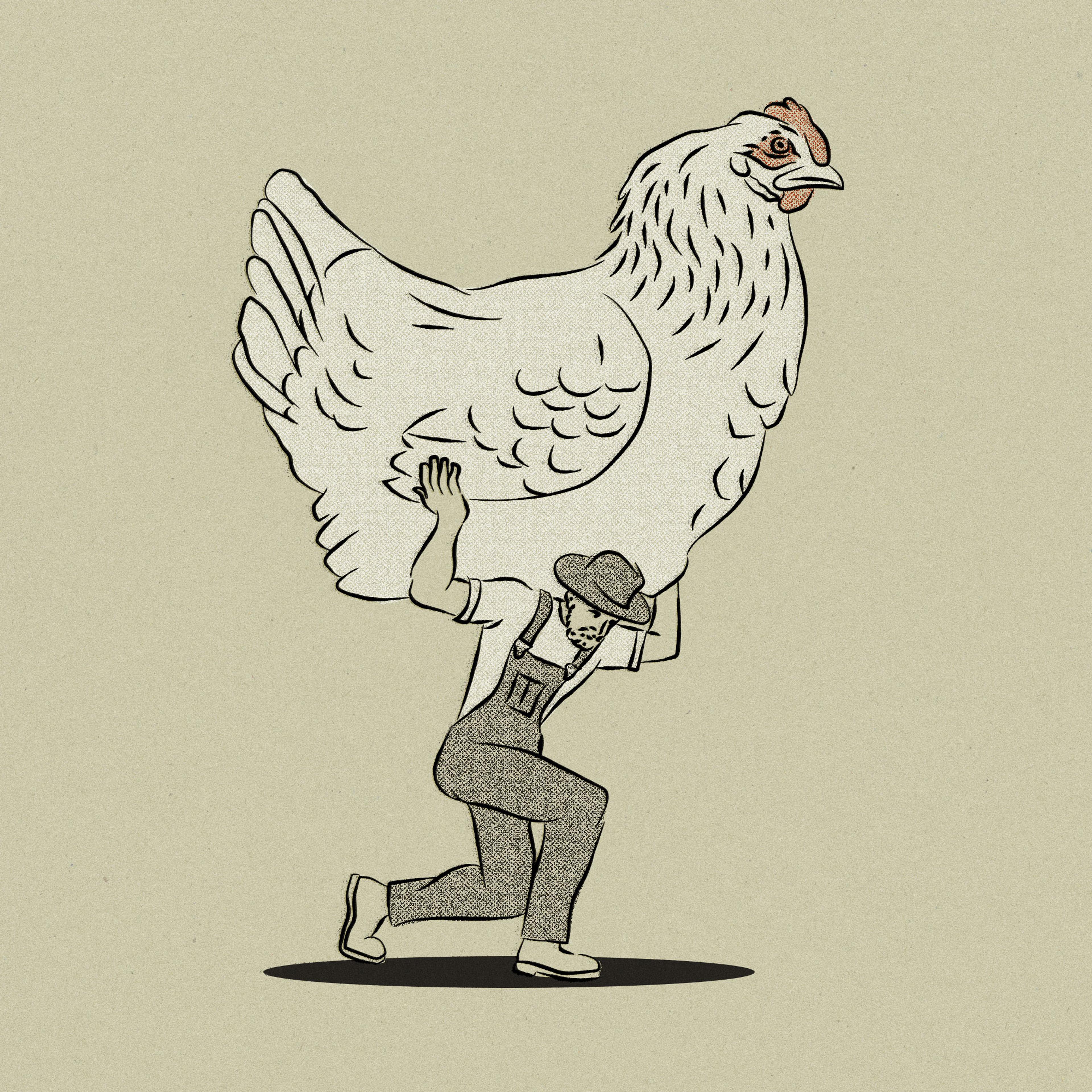
Under the contract system, a company provides the animals, the feed, the medicine, the trucking to slaughter, and stringent mandates around all aspects of care; the farmer owns the land, and pays for barns and infrastructure upgrades when the company demands them. This is an enticing prospect for beginning producers in need of capital. But they might soon become heavily leveraged in debt, according to Craig Watts. He’s a former contract chicken farmer who now runs the Contract Grower Transition Program.
As of this writing, close to 100 percent of the broiler chickens in the U.S. are raised under this decades-old contract model; it informs similar systems that are becoming more common in the pig and cattle sectors. Past studies showed that median earnings for contract chicken farmers were higher than the average for most farmers, according to James MacDonald, an agricultural economist at the University of Maryland who once ran these analyses for USDA’s Economic Research Service. A perusal of a lively contract poultry thread on Reddit’s r/Farming showed that while many participants had negative experiences to share, at least some producers were able to make the math pencil out. The top comment reads: “From talking to neighbors and people I grew up with back home, when it’s good, it’s great. When it’s bad, it’s horrible.”
But for farmers who feel dissatisfied with the terms of their contract, it can be highly challenging to break free. There’s also the matter of those chicken houses. “I think most people probably do not get the return on that money that they could have gotten if they just put it in the stock market,” MacDonald said. These sorts of issues have left the Socially Responsible Agriculture Project (SRAP) — creators of the Contract Grower Transition Program — and other farmer advocacy organizations like Farm Aid determined to figure out ways to extract producers. The experiences of Watts and the Boles show distinct paths forward.
*
Watts remembers waking up before dawn one morning after 23 years in the chicken business and deciding he would quit that day. “No Plan B, that was so stupid,” he said, “but I was just done.” He got a job at a Lowe’s garden center, sold off what specialized poultry equipment he owned outright, and refinanced his mortgage. He hauled a shipping container to one of his chicken houses to grow mushrooms in. “That way I could use existing electrical, existing plumbing, it’s out of the weather,” he said.
The road to transition happened for the Boles on a Saturday afternoon in December of 2015, watching a 2014 documentary by the Rural Advancement Foundation International (RAFI), which portrayed this system as opaque, exploitative, and financially ruinous to farmers, some of whom not only didn’t make big bucks from the enterprise but often found themselves on the brink of bankruptcy.
“From talking to neighbors and people I grew up with back home, when it’s good, it’s great. When it’s bad, it’s horrible.”
“I was just bawling — I’m like, it’s not just us!” said Paula. At the time, the couple was working five off-farm jobs between them, on top of poultry care, but they were behind on their mortgage and convinced they’d have to foreclose on their home. Instead, they wrote to Tyson to cancel their contract. Dale is handy, Paula said. So, he sold the tin off one barn and used the money to sheathe it in plastic and converted the chicken water lines into a drip irrigation system. In the resulting greenhouse, the couple grew tomatoes and peppers to sell at a farmers market, then annual flower starts that Paula could sell at a roadside stand.
Both Watts and the Boles made mistakes along the way. There was scarcely a market for mushrooms anywhere near Watts’s North Carolina hometown. “You need to have somewhere to sell it first, then you work backwards,” he said. The Boles quickly realized they had to home in on niche tomato varieties so as not to compete with other farmers at the market. But everything they’ve learned since, even as they continue to grow and morph their businesses, is being synthesized into data other contract farmers can use, as an interconnected aid network begins to grow across the country.
Watts’ experience is part of what compelled animal rights nonprofit Mercy for Animals — a group focused on dismantling factory farming writ large — to start the Transfarmation Project in 2019, a program aimed at pivoting industrial livestock farmers to things like specialty crops. They’ve shared Watts’ and other farmer stories across media and at informational events at Farm Aid. As a result, “Whenever there is a processing plant closure, farmers are like, oh shit, what else can I do? And we’ve had a lot of them reach out to us,” said Transfarmation’s senior program specialist Megan Hunter.
Although they have some private donations and grant money to help with transitions, they don’t have the resources to assist every farmer in need — especially those with insurmountable debt, who they might refer to Watts to talk about filing for bankruptcy. So, Transfarmation has been documenting every transition they’ve worked on, in order to provide detailed models farmers can replicate on their own. That includes plans for how to convert 100 feet of a poultry house to crop production; how to make a whole chicken barn into a greenhouse containing raised beds or hydroponics; all the materials needed to start growing mushrooms. They’re also piecing together an educational program to reach even more farmers.
A couple years before Transfarmation took off, another anti-meat nonprofit, Animal Outlook, had become aware that “farmers were being impacted by the [contract] system,” said Angela de Freitas, director of the Farm Transitions program that arose out of that awakening. They’ve collaborated with Transfarmation on a state-specific farmer toolkit that highlights where a producer can go for technical, financial, marketing, and mental health services.
Working mostly across Arkansas, Alabama, and Delaware, de Freitas devises hyper-individualized farmer transition plans that start with understanding the local market (a lesson learned the hard way by Watts). Alabama, for example, has a Farm to School program that provides a farmer with a good, stable market, said de Freitas. For small-scale Mennonite farmers in Arkansas, using shipping containers to grow strawberries may be an option. One farmer might maintain the poultry contract for one barn, to keep earning income, while quietly transitioning the second to growing lettuce; another might have less sentimental attachment to his land and exit ag altogether.
“For farmers who are leveraged heavily in debt, they are in a tough spot” when it comes to finding an off-ramp.
Hunter and de Freitas admit that to date, they’ve been able to help only a handful of farmers out of the possible hundreds who want to transition. For those unable or unwilling to leave contract farming, some advocates hope legislation passed under the Biden administration, updating 1921’s Packers and Stockyards Act in three phases, would create a more equitable playing field. MacDonald thinks they show promise, since they’ll do a better job of alerting farmers to potential risks. “If they work,” he said, “fewer farmers will agree to these contracts and that’s going to force companies to pay them more to get them to grow.”
The first update, which went into effect in February 2024, mandated greater contract transparency for poultry growers specifically, explained Emily Miller, staff attorney at Food and Water Watch; this was meant to prevent “poultry companies [from making] a lot of promises about what this contract could do for a grower and how much they would be making that really didn’t comport with reality.” The second update, which went into effect later in May 2024, “defined what constituted unjust [company] discrimination and retaliation and deception” more broadly across the livestock sector, said Miller; the meat industry is suing USDA to stop it (Food and Water Watch is representing several farm and ranch groups seeking an intervention ).
“I don’t have a metric but I gotta believe we changed a lot of minds.”
USDA is seeking to delay implementation of the third update from July 2026 to December 2027, which is meant to address the tournament system; the public comment period ended April 17. “For all this administration says that it’s for farmers, these actions … surely don’t show that that’s the case,” said Miller. Calling the proposed delay “disappointing,” Zippy Duvall, president of the American Farm Bureau Federation, noted in a public statement: “Growers have spoken on the need to level the playing field with more transparency surrounding how they are compensated, and they believed progress was being made.”
For its part, the National Chicken Council has long opposed any changes to the contract rules as they stand. Stating the Biden-era updates would end up “ultimately destabilizing a successful compensation system for our farmers,” NCC president Mike Brown said in a public statement: “Make no mistake, this isn’t about transparency. This rule was specifically designed to chum the water for lawsuits. It is just the first salvo in the administration’s attempts to resurrect failed policies that would dismantle a successful industry structure that has benefited farmers, chicken companies and ultimately consumers all around the world.” The council has also long defended the tournament system, specifically.
USDA’s perceived unwillingness to stand up for contract farmers fuels Watts’ work with SRAP, trying to convince producers to stay away from the chicken business. He’ll advise contract farmers he’s never met, who drive up and park behind his barn, worried they’re being surveilled. He’ll reach out to farmers who post about their plight on Facebook, thinking, “Well, I can help here,” Watts said. When reps from Lincoln Premium Poultry, which produces rotisserie chickens for Costco, came to Fremont, Nebraska, Watts was asked by SRAP to go county to county, sharing his story. Something about it must have clicked, because several years later, the company was still looking for contract farmers to sign on. “I don’t have a metric but I gotta believe we changed a lot of minds,” Watts said.