New technology aims to help cattle breeders deal with a down-to-earth problem: lameness in their herds.
Most startup founders want to project an outsized presence when sharing their big idea, a bit of swagger and surprise for the crowds. They’d be hard-pressed to improve on the advantage Catie McVey enjoyed for a presentation at North Carolina’s Research Triangle Park: a full-grown dairy cow named Pearl.

In the midst of an airy glass-and-steel lobby, Pearl stood patiently on a blue tarp covered with sawdust as McVey ran an iPhone around each of her hooves for a few seconds. Pictures of Pearl’s feet zipped online into the cloud, where computer vision algorithms stitched them together into three-dimensional models. In a few short moments, McVey got back an analysis of Pearl’s hooves, quantifying size, toe angle, and claw curvature — key traits for avoiding lameness, which can reduce milk production, harm animal welfare, and eventually lead to a farmer euthanizing a cow.
Cattle breeders have spent decades refining dairy cows like Pearl, according to McVey, into high-performance milk-making machines. And they haven’t shied away from harnessing computers to help.
“Dairy farmers were into big data way before it was cool,” she said, citing the literature she relied on while earning her doctorate in animal biology at the University of California, Davis. “Some of the original papers from the 1960s we learned in grad school reference data on tapes.”
Dairy farmers first used technology to improve easy-to-measure quantitative traits with big commercial impact, like milk yield and carcass weight. But the rapid progress they achieved outpaced improvements to foundational traits like bone structure and hoof size, leading to what McVey calls “Ferrari genetics with flat tires.” Those larger, more efficient cattle started to suffer higher levels of lameness.
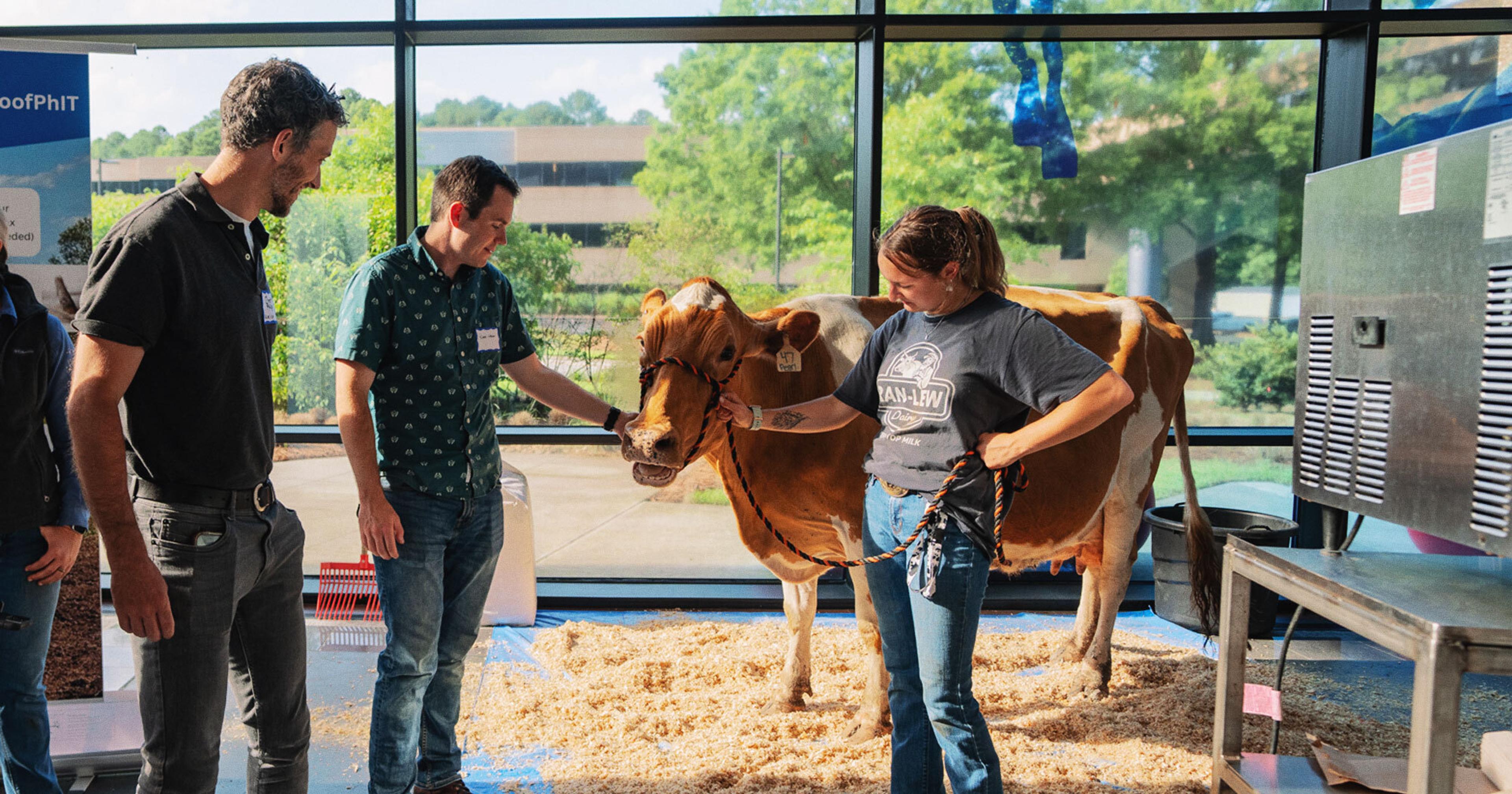
Pearl's big day
·Courtesy of Catie McVey
McVey is part of a growing movement to help high technology literally touch grass. Camera systems such as PediVue and CattleEye are helping farmers catch and correct hoof issues before they cause real harm. The breed association for Holstein cattle, the most popular dairy cow in America, includes foot traits in its “Build a Better Cow System” for evaluating animals.
McVey’s own Graham, North Carolina-based startup OsRostrum has been developing an iPhone app, BoviPhIT, to give dairy farmers the same easy, precise measurements for hoof traits that they’ve long had for weight and milk production. While she hasn’t yet taken on investors, the company has gotten over $155,000 in backing from state government and another $60,000 in nonprofit seed funding.
“Being able to look at a cow and pick her apart and make breeding decisions at the farm level is always going to be the cornerstone of any breeding program,” said McVey. “But being able to take some of that time-tested knowledge on what makes a strong, structurally correct cow and quantify it and put it into national-level genetic evaluations — that’s really the missing link to make some truly spectacular cows.”
“If you’re not careful when you’re selecting out specific traits like milk production, what you end up doing is ignoring everything else.”
Lameness has always been a concern for cattle farmers, said Jan Shearer. A professor emeritus at Iowa State University’s College of Veterinary Medicine, Shearer has been a veterinarian for over 50 years and once ran his own Angus operation. He’s also the co-author of a 2023 paper summarizing the scientific research on lameness in dairy cows.
Shearer said the problem really started to escalate for the dairy industry in the 1990s, as farms became more consolidated and herds got bigger. The indoor confinement systems common in larger dairy operations meant more cows were standing for long periods on hard concrete floors, exacerbating any existing genetic weaknesses in their hooves.
Nearly a quarter of dairy cows now suffer from lameness, with about 7% considered severely lame. “When an animal gets down, they usually get euthanized,” said Shearer, noting that lameness is one of the top reasons farmers cull animals from their herds.
He emphasized that dairy farmers are well aware of the problem and take steps to keep their cows comfortable: Foot baths, hoof trimming, and topical antibiotics all help, as do technological systems for early detection of hoof issues.
But management can only address symptoms. Shearer believes the industry will need to breed with hoof health in mind to make lasting progress.
“If you’re not careful when you’re selecting out specific traits like milk production, what you end up doing is ignoring everything else,” he argued. “Ultimately, that’s how we have gotten ourselves into this circumstance, where we have diseases that are cropping up that we realize are heritable.”
“If we can identify animals that have locomotion issues that may or may not be related to lameness, we can build and breed a better cow that walks more smoothly, that’s more athletic, that can handle various conditions.“
Cattle breed associations, responsible for maintaining and improving popular varieties like Angus and Jersey, are paying attention. Jeffrey Bewley, executive director of genetics and innovation with the Holstein Association USA, points to the system his group is developing together with Western Kentucky University’s SmartHolstein Lab.
As Bewley presented at last year’s World Dairy Expo, the “Build a Better Cow” technology uses multiple cameras to capture three-dimensional images of cattle in motion. Algorithms then extract 26 different traits from the photos, including movement-related details like foot angle and stride length.
“If we can identify animals that have locomotion issues that may or may not be related to lameness, we can build and breed a better cow that walks more smoothly, that’s more athletic, that can handle various conditions,” Bewley explained. “We want to be able to use this information from a phenotypic perspective to be able to understand the underlying genetics in those animals.”
That kind of tech-informed breeding is a long-term project, Bewley continued. While the Holstein Association has piloted Build a Better Cow at several large dairies, engineers are still working through the practical kinks of installing and maintaining cameras across real-world farms. He estimates the system won’t be ready commercially until late next year, and reliably linking camera measurements to genetic markers is likely five to 10 years away.
Meanwhile, farmers continue to wrestle with the hooves on the ground now. Preston Green, who milks about 70 Jersey cows at Big Bottom Milk Company in Forest City, North Carolina, wishes ag-tech evangelists like McVey and Bewley all the best. Yet he’s skeptical that phone scanners or fancy cameras can help him with the day-to-day realities of his herd.
Green’s pasture-based operation is relatively small, but he still fights against lameness. Hoof trimmers, who use grinders and knives to balance out hooves’ shape, can be hard to come by for smaller herds in rural areas. When a trimmer does come, each cow still requires individualized attention based on her age and hoof growth. And while natural surfaces may put less stress on hooves than concrete, mud can lead to injury, and manure to infection.
“Farmers just want to do the best job that they can,” Green said. “And they’re doing the best they can with the cows they’ve got and the system they have to raise those cows in.”
But if technology can help shape dairy cattle genetics, farmers like Green may manage the hooves of better cows in the future. Breeders, after all, always want to put their best foot forward.