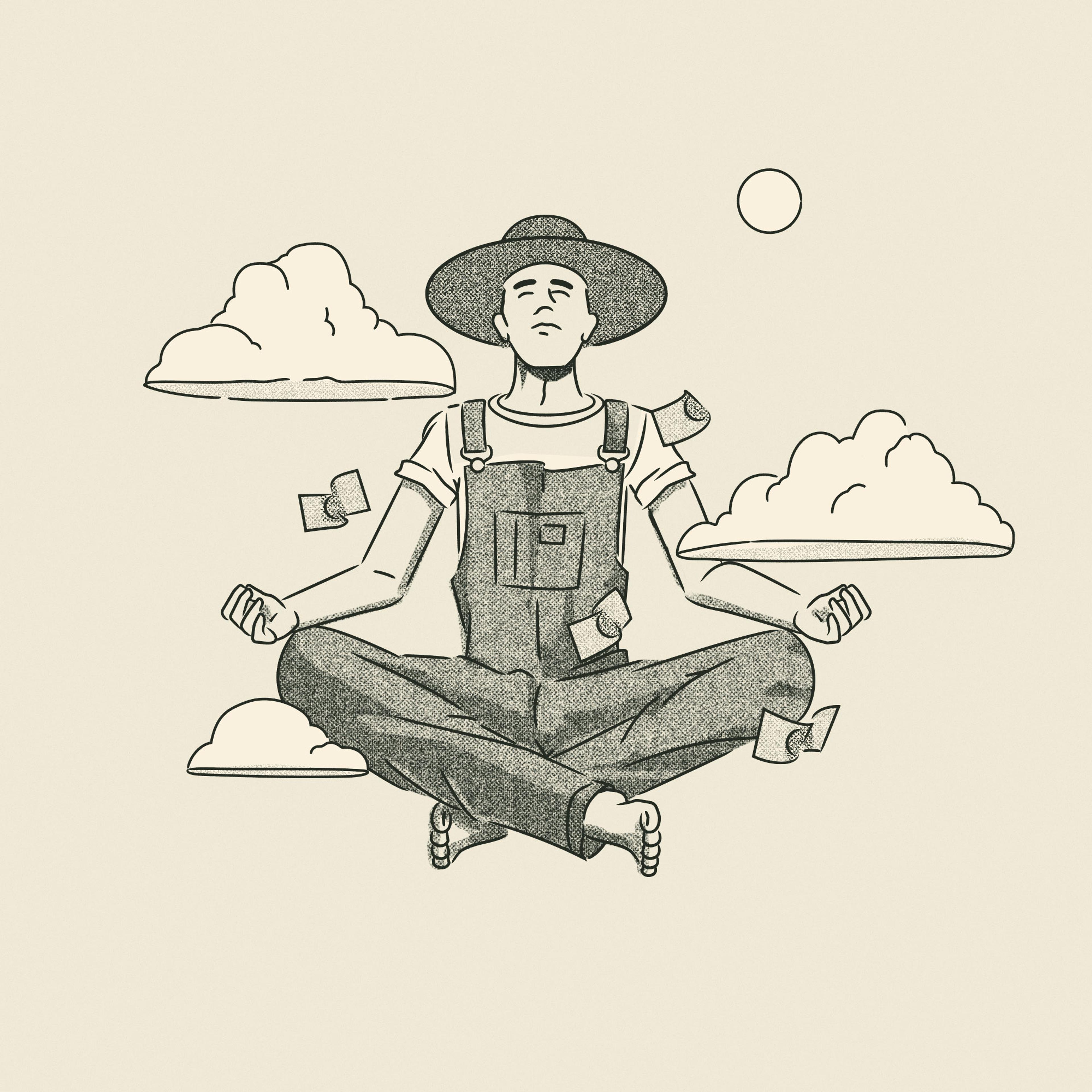
In a tightening economy, Real Farmer Care is advancing a radical idea: help farmers prioritize self-care by giving them the cash to do so.
It’s no great revelation, but farmers take care of a lot. Along with tending crops and livestock, they also tend to the needs of their families — caring for children, supporting aging relatives, and often working off the farm to make ends meet. With so many competing demands, taking care of themselves can fall low on the to-do list. Clara Coleman knows the consequences of that firsthand.

For 15 years, she lived in Colorado’s mountainous landscape, where she built a four-season farm inspired by the organic systems she’d grown up with — while also raising two sons with her partner.
“All along, I was desperately exhausted as a mother,” Coleman said. “I felt like I was supposed to have this all figured out and be incredibly successful at it, but meanwhile, I was struggling emotionally and mentally.”
Today, Coleman is the founder of Real Farmer Care, an organization that awards $100 self-care microgrants to farmers. Since its launch six years ago, nearly 600 farmers from 45 states have received these grants, which they can use for anything that promotes well-being — think therapy or acupuncture, a stress-relieving massage, a pair of sturdy work boots, or just a dinner outing with friends. The grants are small, but can potentially have a big impact.
Farmers have had a rough year, walloped by tariffs, shifting trade agreements, federal funding cuts, immigration raids, skyrocketing healthcare premiums, and now a fertilizer shortage driven by the U.S.-Israel war on Iran. The rise in farm bankruptcies and worsening farmer mental health are two signs of just how hard things have become. If wellness services like massage and acupuncture felt like a stretch before, they may seem further out of reach now. Yet, seemingly small acts of self-care can help to keep mental health crises at bay.
Coleman is quick to point out that Real Farmer Care wasn’t founded to assist with crisis management. She’s just one person trying to change the narrative around self-care in farming culture — but lately, her efforts have gained traction. With a new wave of funding from The 11th Hour Project and fiscal sponsorship from American Farmland Trust, Real Farmer Care is entering its biggest growth phase yet. This year, Coleman is doubling the self-care grants to $200, fundraising for a new $500 award to support costlier self-care activities (think gym memberships or weekend getaways), and laying the groundwork for a new wellness retreat. “A hundred dollars is great, but it’s just a tiny drop in the bucket,” she said. “That was never going to be the end-all.”
The Microgrant Model
Real Farmer Care began with a simple online appeal. On January 1, 2020, Coleman launched a GoFundMe campaign, asking people to contribute so farmers could prioritize caring for themselves, with a particular focus on Black, Indigenous, and other farmers of color (BIPOC). Within a few months, the campaign had raised about $12,000. When it came time to distribute the funds, Coleman started with farmers she knew, inviting them to send a photo and a few words about what self-care meant to them. In return, she sent each of them $100 via Venmo or PayPal. To date, half of Real Farmer Care recipients identify as BIPOC or LGBTQ.
A few early grants went to farmers in Canada, but most have gone to farmers in the U.S. Coleman attributes this to the program’s early referral scheme, in which she asked each recipient to recommend another farmer. Since then, the process has become more formal, and largely for tax purposes, eligibility has narrowed to farmers and farmworkers in the U.S. and its territories. The process, however, remains simple: a brief three-question application and, if approved, a $100 Visa gift card.
“It’s meaningful to me that there’s somebody out there doing this work,” said Brenda Gonzalez, co-owner of Finca Seremos, a hillside farm in the Catskills where she and her spouse grow Caribbean and Mexican staple crops. Gonzalez said she applied for Real Farmer Care in 20 minutes — typing with dry, cracked hands, split cuticles, and unraveling hangnails. When the application asked what she planned to use the money for, she said skincare products and waterproof work gloves. She’d spent weeks washing and packing produce, leaving her with wounds that risked infection. Access to healthcare providers in her county is limited, making preventive care critical.
“If farmers are exhausted, injured, or struggling to take care of themselves, the future of that land is at risk too.”
By the time her gift card arrived, she had already picked up the skincare products she needed, so she decided to use the money for a mail art subscription, allowing her to collect small, original works of art through the postal service. “Every month, I’m gonna get this little surprise in the mail that’s unrelated to the farm,” Gonzalez said. “That’s gonna cheer me up and inspire my own creative practice and beautify my home, and that’s really exciting.”
Some might see this as a luxury — even frivolous. But research shows that engaging with art and creativity carries very real mental and physical health benefits. Opening the door to alternative therapies like this that aren’t widely recognized, and letting farmers decide what actually helps them feel restored, may be the most radical thing about Real Farmer Care.
“[It’s] clearly a lot of labor to try to get these tiny little increments of money to people to make this tiny little dent in this really big issue that is sort of crippling so many farmers,” Gonzalez said. “But this work is important ... it gets us a little bit closer to survival.”
Growing the Community
Coleman grew up inside one of farming’s favorite stories. Her parents, Sue and Eliot Coleman, were icons of the 1960s and ‘70s back-to-the-land movement, famous in organic agriculture circles for turning two acres of Maine woodland into a thriving farm. You can still hear their influence in today’s buzz about sustainable and regenerative practices. But Coleman says something is missing from that conversation: the farmers themselves.
“For sustainable and regenerative agricultural practices to be successful, we can’t expect the land and animals to be cared for well without equal and commensurate care offered to the farmers and land stewards first,” she wrote in a recent email. What could that look like? Coleman has been gathering data to answer that question. According to Real Farmer Care’s ongoing Self-Care Support Survey, a whopping 70 percent of respondents have cited time poverty and financial stress as obstacles to practicing self-care. For support, more than half prefer a combination of cash and wellness programming. Around 60 percent say they want access to online therapy.
While wellness resources for farmers are limited, Real Farmer Care is not the only organization out there advocating for them. The Northeast Farmers of Color Land Trust provides funding for healing retreats and other restorative activities. Cynthia Flores offers strength and mobility training for farmers through her company, Labor-Movement. Rise & Root Farm in the Hudson Valley also gives self-care stipends to its team members.
Even so, Rise & Root co-founder Michaela Hayes-Hodges is among the latest recipients of Real Farmer Care. Hodges appreciates how accessible it is, saying that it stands out from most grants that require farmers to navigate metrics and reporting processes that ultimately don’t serve them. “We just need the help,” she explained. Hodges plans to divide her self-care grant between a massage and soap-making supplies, a craft she’s always wanted to learn.
“For sustainable and regenerative agricultural practices to be successful, we can’t expect the land and animals to be cared for well without equal and commensurate care offered to the farmers and land stewards first.”
Getting philanthropic foundations to invest in farmers’ self-care hasn’t been easy, but that began to shift when American Farmland Trust (AFT) signed on as Coleman’s fiscal sponsor in 2024. For AFT, the logic for supporting Real Farmer Care was clear, lining up with their holistic approach to farmland protection: “Protecting land for the long term is not just about conservation tools or policies,” Ashley Brucker, AFT’s senior manager of grantmaking, told Offrange via email. “It is also about the people who steward that land every day. If farmers are exhausted, injured, or struggling to take care of themselves, the future of that land is at risk too.”
With AFT as a partner, money is starting to come in: The Schmidt Family Foundation contributed $20,000 to Real Farmer Care last year and doubled that this year. It’s helping Coleman raise the baseline microgrants from $100 to $200 for the first time, and draw a modest salary as she plans for further expansion.
In Real Farmer Care’s Self-Care Support Survey, farmers are asked how they’d spend a hypothetical $500 self-care award. Many have given the same answers: monthly massages, yoga classes, therapy, or time away from the farm. Coleman hopes to make that level of support possible this year, if she can secure additional funding. In the meantime, she’s organizing a four-day wellness retreat for women and nonbinary farmers in partnership with a psychotherapist. Called “Tending the Land, Tending the Farmer,” the pilot is set for November, with plans to offer the retreat multiple times in 2027.
During a recent Zoom call from Costa Rica, Coleman looked relaxed, dressed in a colorful top with warm sunlight shining on her face. She was there with friends to celebrate her 50th birthday. With her youngest son now off at college, she said she has more time to devote to Real Farmer Care and to herself. For Coleman, self-care is more of a collective practice than an individual one — and the organization she’s built is making sure that farmers, including her, aren’t doing it alone.