
For decades, detector dogs have helped protect our environment and agriculture. Dogs trained to find the invasive spotted lanternfly have joined their ranks.
Mary Glover began her dog handler training with a leash attached to a rolling suitcase. Glover, a Tennessee Department of Agriculture plant inspector, had recently arrived at the National Detector Dog Training Center (the Center) in Newnan, Georgia. Over the next several weeks, she and Winnie, a black lab mix about a year and a half old, would learn to work together to find spotted lanternflies, an invasive species originally from Asia. Federal and state agencies are so concerned about the spread of these insects that they have encouraged citizens to kill them on sight.
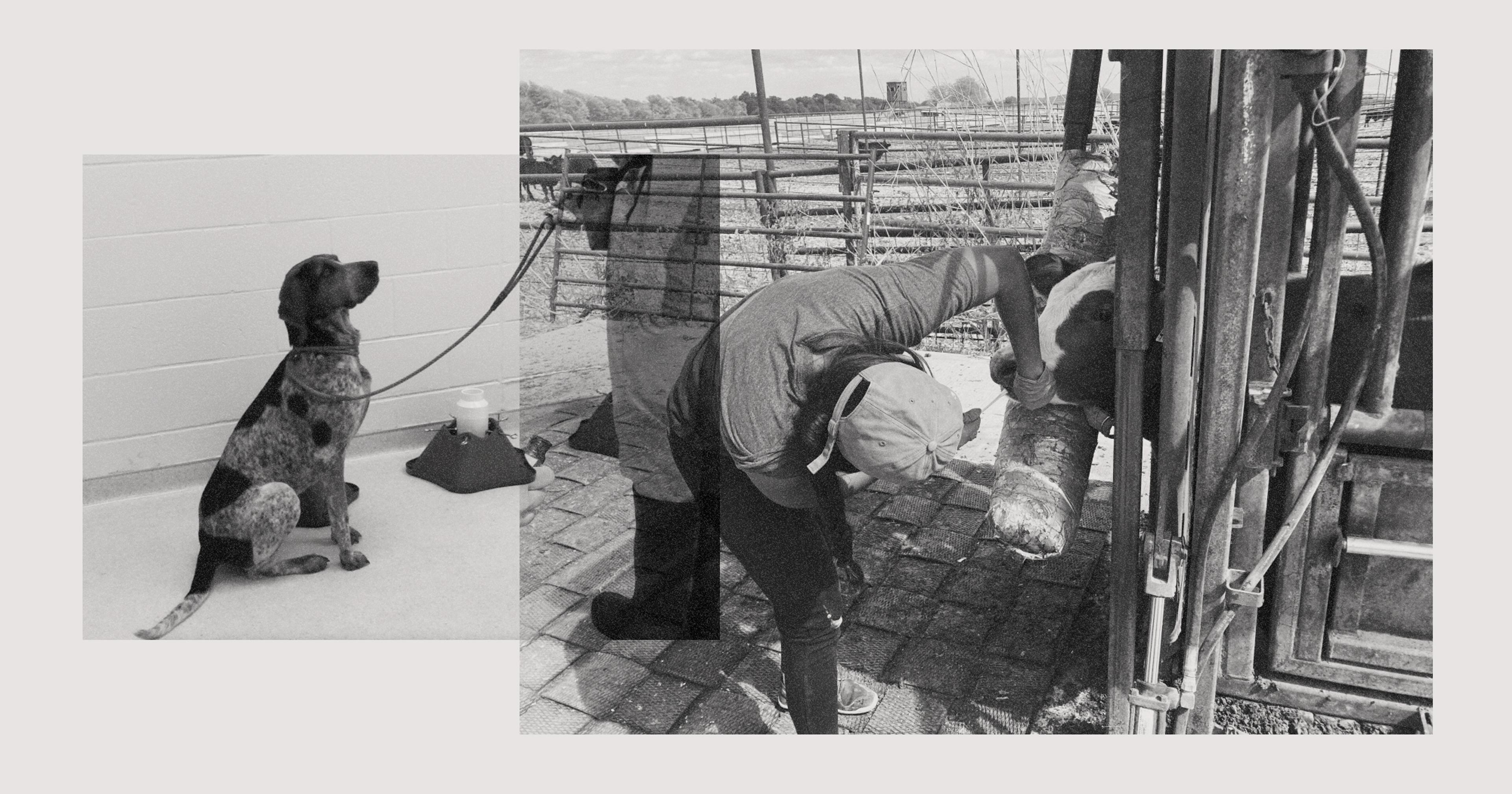
But first, Glover had to master proper leash handling, holding it low and managing its length with her index finger and thumb. This would allow her to control Winnie — or for now, the suitcase — while ensuring she didn’t accidentally pull the leash and unnecessarily correct her canine partner. “I had no idea when I went the detail that I was going to be instructed [in],” Glover said.
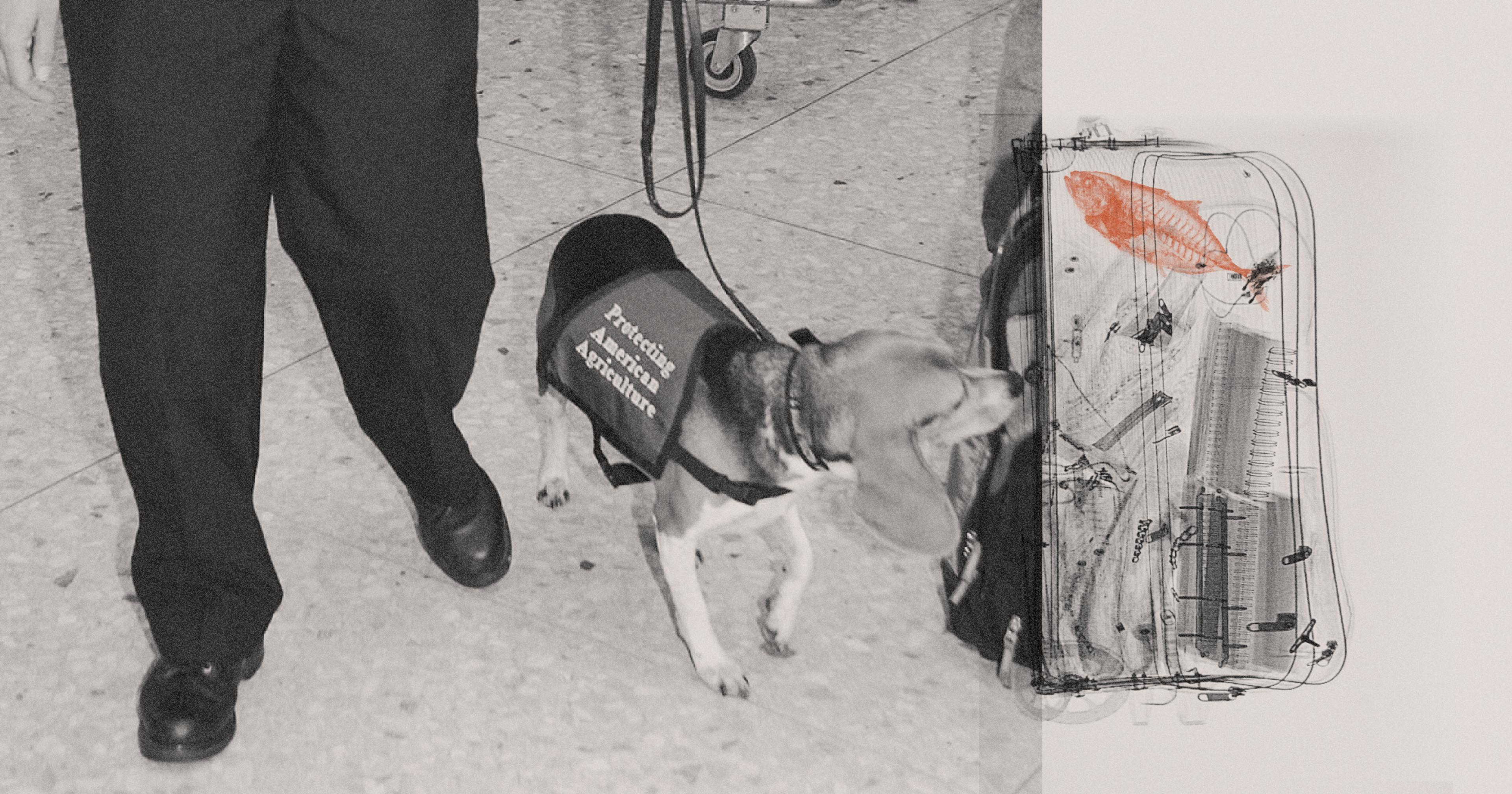
Since 1984, the Center has trained dogs — and federal and state agency employees — to find plants and animals that can harm our country’s environment and agriculture. Graduates include members of the “Beagle Brigade” that search airport luggage for prohibited foods, and Jack Russell terriers that search aircraft and cargo in Guam for the invasive brown treesnake. The Center’s labrador retrievers also helped remove all nutria from Maryland where the rodents were devastating wetlands.
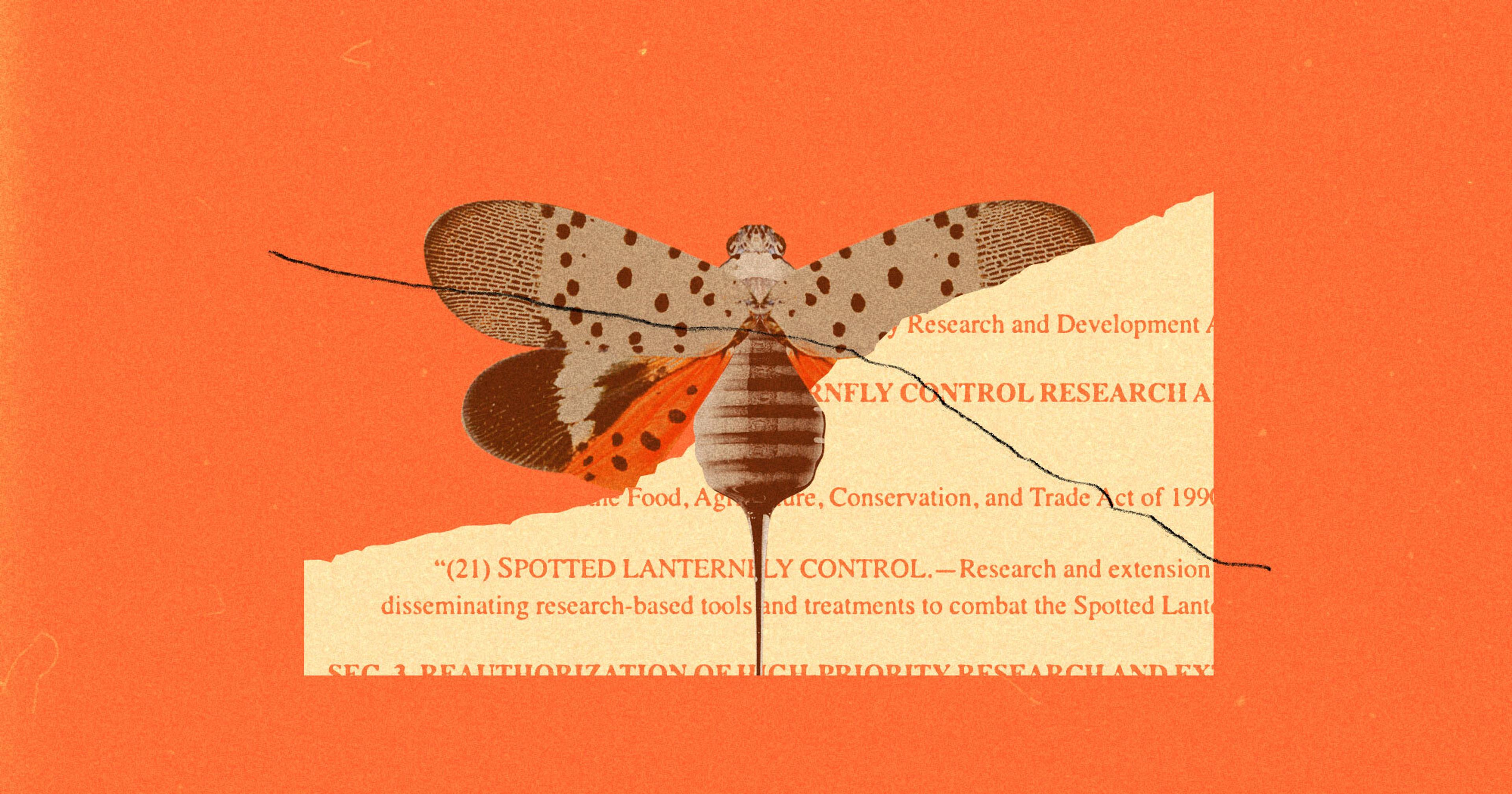
Spotted lanternflies are a more recent concern. Discovered in 2014 in Pennsylvania for the first time in America, they have spread to 19 Eastern states and the District of Columbia. These insects, with their distinctive gray and orange wings with black spots, feed on more than 70 plant species by piercing them and consuming the sap. A large number of lanternflies feeding on a plant weakens it, making it vulnerable to diseases. It also may not survive a winter it otherwise would.
The lanternflies produce a substance called honeydew which attracts insects. When sooty mold grows on the honeydew and collects on leaves, this can prevent proper photosynthesis. Spotted lanternflies have killed grapevines, black walnut saplings, and trees of heaven. The latter, also an invasive species from Asia, is their preferred plant.
“It’s a really interesting insect to work on, but it’s also incredibly frustrating,” said Gregory Parra, a staff scientist in the USDA’s Plant Protection and Quarantine (PPQ) program, referring to unanswered questions about lanternflies. For instance, while experiments indicate they may feed on additional crops, their actual harm can’t be confirmed until they invade a large area growing those plants. And scientists are still working to calculate the exact amount of damage they’ve already caused; estimates indicate that the damage from lanternflies is serious. In 2019, Pennsylvania State University researchers estimated that losses could total more than 300 million dollars each year if the lanternfly invaded the entire state.
“It’s a really interesting insect to work on, but it’s also incredibly frustrating.”
Lanternflies are more common in some states than others. For instance, Pennsylvania has found them in more than 50 counties while Tennessee has had sightings in only about a dozen. But no matter the extent of the invasion, affected areas try to limit the spread of these pests. Many states ask their residents to join this effort and regularly inspect their property and possessions. Citizens are encouraged to report their finds and kill the eggs or insects by smashing them and submerging them in alcohol.
Other attempts to control lanternflies include removing trees of heaven. But this can be difficult and time-intensive, and lanternflies can survive without them. Landowners can mount traps on trees to capture these insects, and insecticides can kill these pests (but may kill pollinators as well). Some states have quarantined infested areas. For instance, due to Pennsylvania’s quarantine of counties where lanternflies have been found, businesses need a permit if they move items which might harbor them, such as firewood or vehicles, in or out of these areas.
Parra and his colleagues recognized that detector dogs might be able to assist in the effort to contain spotted lanternflies. Since 2011, Parra has been part of a PPQ team that collaborates with the Center to identify opportunities for dogs and handlers to use their skills, and this situation seemed well-suited for canine teams. Female lanternflies lay their eggs, 30-50 at a time, on solid surfaces such as trees, vehicles, and trains. While humans can find these egg masses on their own, a dog can search more efficiently, especially when covering an area containing a small number of eggs or when examining spots that contain plenty of hiding places. And after locating the insects or eggs, the handler can immediately confirm and reward the dog, either with a treat or favorite toy.
So from the end of 2019 to the beginning of 2020, researchers at the University of Pennsylvania School of Veterinary Medicine conducted an experiment, funded by PPQ, and confirmed that dogs could learn to find lanternfly egg masses. The Center and other groups, such as the Indiana and Pennsylvania Departments of Agriculture, began training their own canine teams. A few years later, Virginia Tech and Texas Tech researchers proved that community scientists and their dogs could also be taught to find these masses.
Currently, there is no list tracking the number of lanternfly dogs in the country, and there’s no uniform standard canine teams must meet. At the Center, dogs must achieve a successful detection rate of 85%. They learn to signal when they find devitalized egg masses in containers indoors; these eggs have died after storage at extremely cold temperatures. They indicate their find by either sitting, barking, or placing their paw or nose on it. Other smells that they could encounter, like bark, grass, or other insects, are then added, and they eventually train with these items in the field before searching for live egg masses or lanternflies. A dog will begin training without its handler, and then the handler will spend about 10 weeks with their dog learning how to work with, care for, and continue training them.
“These dogs have been on the job since July. And I think they’re only going to get better.”
According to Parra, the Center finds dogs in shelters or rescue facilities, but it’s become difficult to find suitable candidates. To be eligible, dogs must be between one and three years old, and they must have a strong desire to work. Breed preference depends on the job such as beagles for checking airport luggage because they’re small and friendly. For lanternfly detection, large dogs are preferred since they can more easily manage outdoor terrain. To address the shortage, the Center works with breeders and professionals who search for appropriate prospects. It might pay between $5,000 and $10,000 per dog.
It also can be difficult for the Center to find an agency that will accept a detector dog. “We can train plenty of dogs, but you have to have a place for them to go,” Parra said. State organizations may refuse these canines if they need legislative approval to develop a new handler role or to combine those duties with someone’s current job and raise their salary. For instance, Glover is still a plant inspector but now has additional tasks. Even though Winnie works with a Tennessee agency, she is owned by the federal government which requires her to be kenneled. So Glover picks Winnie up from her kennel and drops her off every day, and she must train with her for 15 hours every month.
Parra has had good feedback on the four lanternfly detection dogs trained by the Center, including Winnie and her fellow Tennessee lanternfly dog, Marcel. All have had successful finds on the job. Just weeks after Winnie and Glover returned to Knoxville in July 2025, Winnie made her first identification. A citizen had reported a sighting in a group of trees of heaven. When Winnie and Glover arrived, Winnie went straight to a tree with a single adult on it. “It’s kind of like finding a needle in a haystack,” Glover said. “And if people can get us to an area where they spotted it, then we can almost always find it.”
Parra hopes that more organizations will request lanternfly detection dogs from the Center once they hear of other states’ experiences. And he’s seen an additional benefit of detector dogs beyond their identification abilities: They are good at getting people’s attention. “We have plenty of pictures of them sitting at booths,” Parra said. “And people just come and learn about spotted lanternflies because there’s a dog sitting there.”
As Glover approaches the end of her first full year with Winnie, she hopes to expand their work. Because the nursery industry is important to her region, she’d like to check for lanternflies in their shipments to other states. “These dogs have been on the job since July,” she said. “And I think they’re only going to get better.”