Could the “farm stop” model provide a more lucrative way for local farmers to reach consumers?
The aisles of Argus Farm Stop are stocked with fresh produce in March — muddy-rooted parsnips, dark leafy greens. Gone are the days when Michigan fields sat dormant this time of year, and farmers were in a holding pattern, ordering seeds, repairing equipment, or just catching up on the bookkeeping.
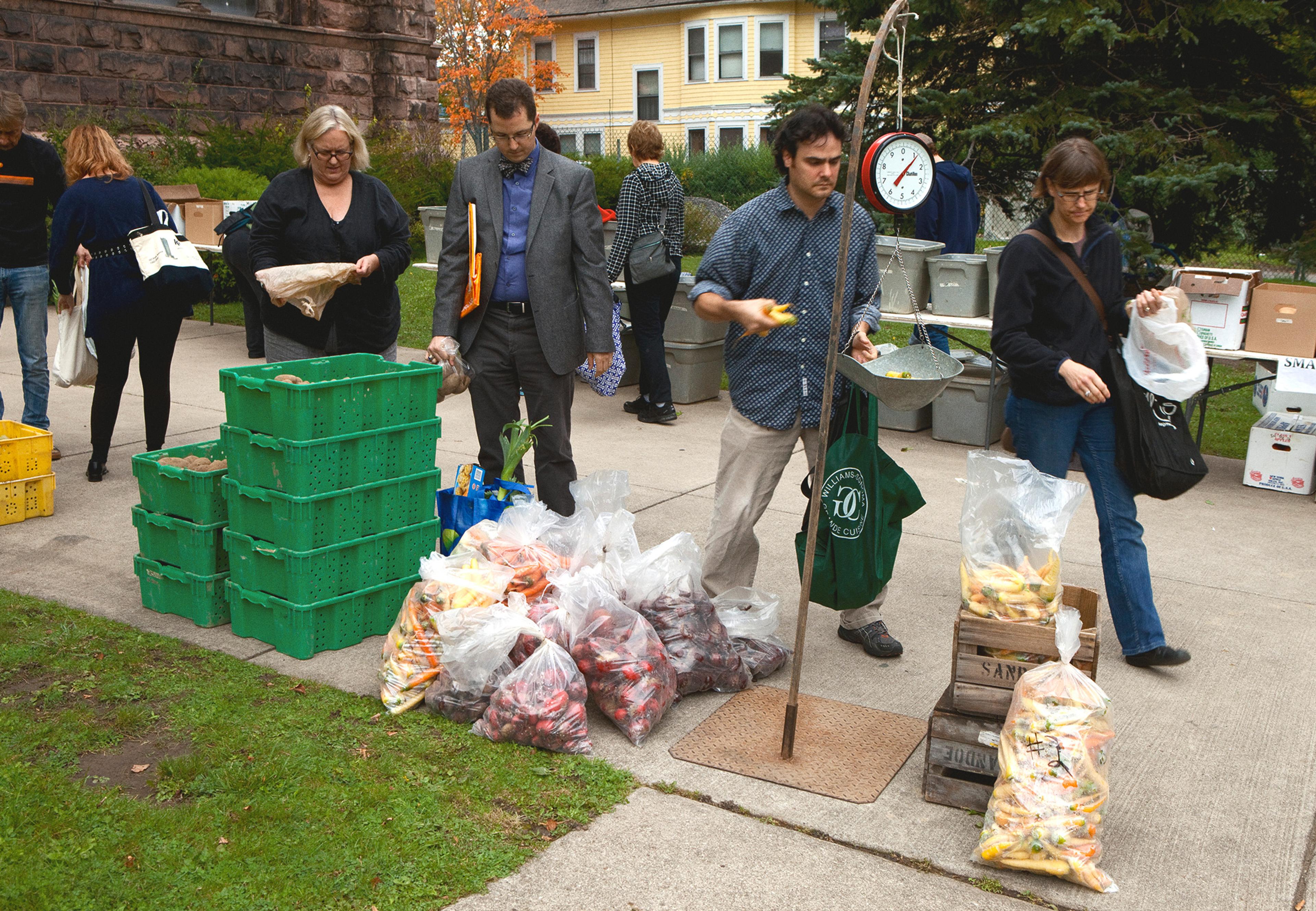
Instead, a farmer named Lucas orders a coffee at the store’s café counter after dropping off his weekly product at one of Argus Farm Stop’s three local locations. Spotting a customer with his eggs, he calls out: “Hey — those are my eggs!” and starts chatting them up.
It might be 6:30 on a Tuesday evening, but the store is bustling and open. Shoppers who missed the weekend farmer’s market can still find locally grown produce and meat, grab-and-go prepared foods made from local ingredients, and a community that feels a lot like the farmer’s market they love — available every day of the week.
Newly retired, Bill Brinkerhoff and Kathy Sample launched Argus Farm Stop in 2014 after asking how their local food system could better support small and mid‑scale farmers. They used funds from their retirement savings — roughly $170,000 — to open a year‑round market they hoped would function like a permanent indoor farmer’s market. From the beginning, they chose a low‑profit LLC (L3C) structure and treated the business as an experiment: Could they design a commercial store that could grow farmer income while making it more convenient for people to buy local food?
The Problem They’re Solving
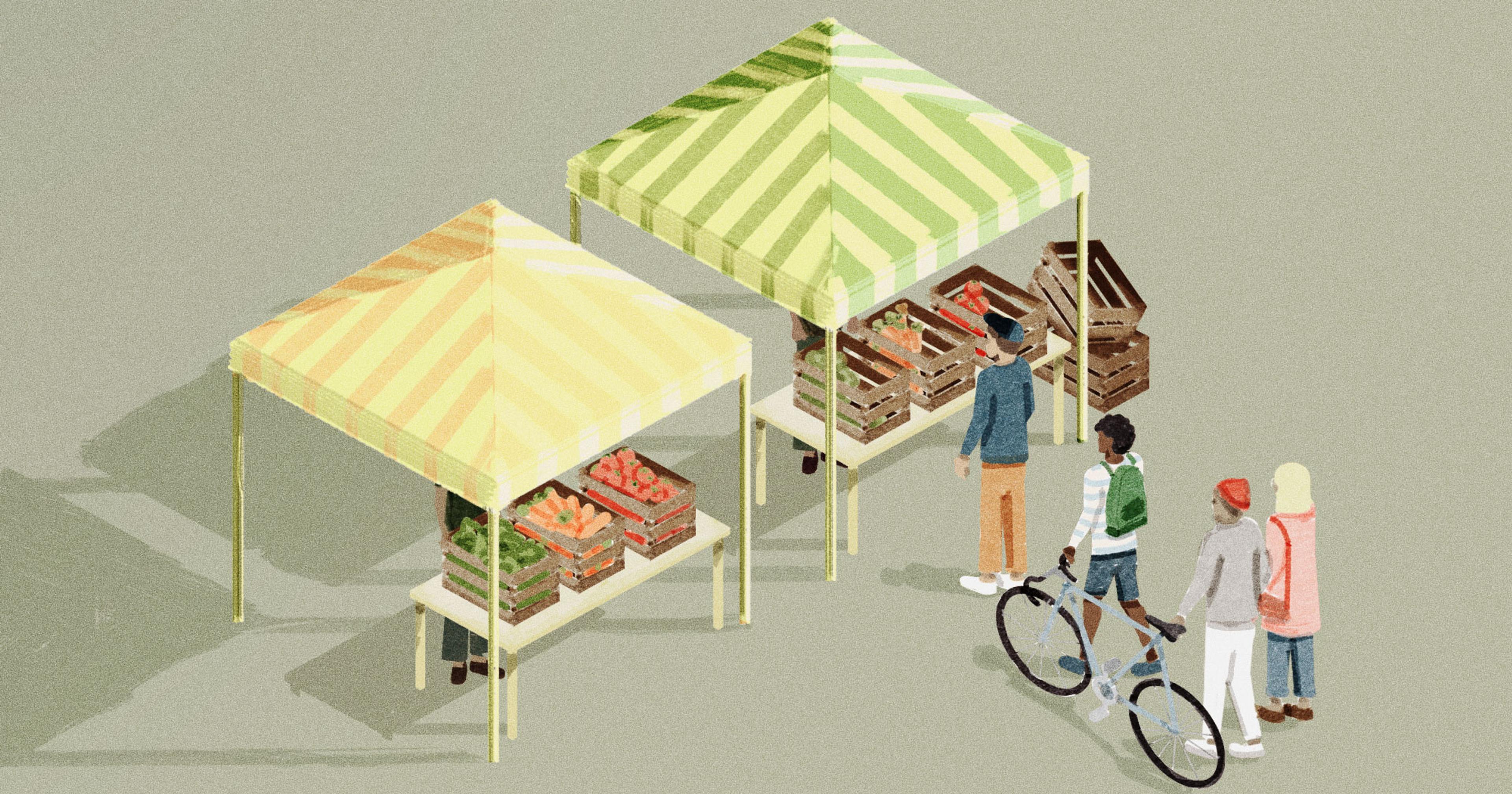
When it comes to promoting an “eat local first” message to consumers, farmer’s markets matter, but they can also be seasonal, exhausting, and financially precarious for small producers. They’re also not as convenient for consumers as shopping at a local market, where shoppers can find most of what they need at one location.
For every person who makes it to the farmer’s market, there may be 20 to 30 who wanted to go but couldn’t. Farmer’s markets provide high margins for farmers and a genuine producer-consumer connection, but they’re one or two days a week at most, leaving shoppers headed to supermarkets the rest of the week.
Some state initiatives have built year-round retail outposts for local products. New York’s Taste NY program, for instance, operates stores at transportation hubs across the state — airports, highway rest stops, train stations — selling locally grown meat, dairy, produce, and prepared foods to travelers year-round. It’s a meaningful step toward convenience. But state-run retail programs typically operate on conventional wholesale arrangements, meaning the farmers supplying them are likely still receiving a fraction of what ends up on the price tag.
Making an effort to shop at their market even more convenient, The Nashville Farmers’ Market, founded in the early 1800s, is open year-round, seven days a week, with a market house building that is open 8 am to 8 pm daily. But the outdoor farm sheds where vendors sell fresh produce directly keep variable hours Monday through Thursday and close as early as 2 pm on the weekends. It’s meaningfully better than a one-day-a-week market, but a shopper looking for eggs on a Wednesday evening could still be out of luck.
For every person who makes it to the farmer’s market, there may be 20 to 30 who wanted to go but couldn’t.
Outside of Whole Foods, which provides specialized support and pays farmers and producers directly, the conventional grocery system pays producers, on average, 15 cents on the dollar for produce. The rest is absorbed by middlemen and industrial distribution: packaging, storage, multiple shipping legs, and warehousing. It’s not that the grocery store is getting rich on the difference; everyone in that system is operating on margins that make it nearly impossible for a small farm to participate at any viable scale.
According to USDA census data, Southeast Michigan should be one of the best places in the country to be a farmer. Its diverse growing conditions, the number of engaged restaurants, and customers who want local food paint a positive picture. In researching whether their model would work, Brinkeroff and Sample found that the difference between a farm staying in business and a farmer taking a second job was sometimes as little as $10,000 in annual sales.
In Clatskanie, Oregon, a town of 1,700 people roughly 90 minutes from Portland, Jasmine and Brandon Lillich-Schilling founded the Clatskanie Farmer Collective — a nonprofit that operates both the local farmer’s market and the Clatskanie Food Hub, a year-round farm stop. Before the Food Hub opened, Jasmine watched a familiar dynamic play out among local growers. “All of the farmers here were taking their product directly to Portland to sell. This incredible food was bypassing our local community because growers weren’t making enough money at the farmers market.”
Follow the Money
The Argus Farm Stop model is built on a consignment basis with a 70/30 split: Farmers set their own prices and keep 70% of every sale, while Argus retains 30% to cover operating costs. A café inside each location accounts for roughly a third of sales but about half the profit, effectively subsidizing higher farmer payouts while creating a community hub where farmers can gather and customers can meet producers.
There are no strict delivery windows. The sales teams at each Argus farm stop tell farmers what they think they can move that week, and the farmer decides. This model was designed to reduce risk for farmers. It was designed to invert the power dynamic of conventional buying. When it comes to unsold product, farmers can direct it to a food pantry so they aren’t stuck absorbing the loss. Ultimately, the farmer makes the call.
In contrast to Argus, Clatskanie Food Hub started with an 80/20 consignment model out of necessity. “Why we started at 80%,” Jasmine explained, “is because our other food hub partners that we work with are an online farmer’s market, and their consignment rate was 80-90%.” In order to convince their local farmers to sell at their market, they had to compete with that. This means even tighter margins for Clatskanie.
Farm + Flourish, a farm stop model I stumbled on in a small town in southwest Washington, operates differently still. Owner Alliyah Perry buys outright from farmers rather than selling on consignment, paying them at the point of purchase and absorbing the risk herself. For her, the pricing negotiation is direct and bilateral. A farmer tells her what she needs, and Alliyah tells her what the store can support. So far, she’s never had a disagreement.
What’s working for all three of these farm stops is the same underlying logic: Get more money to the farmer, and keep enough money to survive.
Streamlining the System
The consignment model solves the payment problem, but it creates a different one. When any farmer can bring any product, someone has to manage what actually ends up on the shelf. At Argus, working with 250-300 active producers, produce managers actively manage the mix of fresh produce to avoid redundancy. Argus general manager Laura Matney explained, “It doesn’t really do us a lot of good to have 15 different farmer’s kale. So our produce managers are working really carefully to curate a mix that’s going to move as much product as possible for all of our farmers in the most fair way that they can.”
To understand that better, Laura walked us through a farm that primarily sells apples, but they also move their cherries, potatoes, nut butters, and apple cider through the farm stop. In a conventional grocery arrangement, that farm would sell only its primary product. This type of curation enables revenue diversity that a conventional grocery buyer rarely makes room for.
For Jasmine and Brandon of Clatskanie Food Hub, the challenge is a bit harder. Curating products for a small, rural market is different compared to Argus. They’re still building out their staff, and Candy, who handles operations at the store, does a delicate dance when it comes to curation. If all their farmers have arugula, whose arugula are they going to sell that week? Because they can only move so much. Brandon shared, “It’s inefficient for us to have to be labeling and managing four different vendors of arugula versus: I’m going to get arugula from this person because they don’t have spinach, but this farmer does.”
To help with this, Jasmine and Brandon create a gap list as a farmer coordination tool. This list, made up of products requested at the market but not currently offered, is shared with farmers, and they collectively develop a growing plan.
In the early days at the market, Jasmine and Brandon’s personal farm and licensed kitchen were filling those gaps. They pulled produce from their own land; made pesto, hummus, and seasonings; and rescued near-turn produce — fruits and vegetables approaching the end of their retail window — to create value-added products. As more producers came on, they’ve been able to step back from that role, but it speaks to what founder sacrifice could look like in a small rural farm stop.
The Replication Question
The Argus Farm Stop model is growing. There are now 27 farm stops operating across the country, with about 15 more in the buildout phase. They are not Argus franchises but independent operations that have adopted the Argus model. The replication structure that Argus has developed — from consulting services to their annual conference which drew 250 attendees from 38 states in 2025 — is an infrastructure that feels repeatable.
Both Clatskanie Food Hub and Farm + Flourish started independently of that model, which made me wonder whether the concept is spreading because it’s simply the sensible response to a structural gap. Jasmine and Brandon discovered Argus through a Modern Farmer article on farm stops in 2024, and Jasmine spoke on the rural/emerging farm stop panel at their 2025 conference.
When it comes down to how Jasmine and Brandon developed their farm stop model, Brandon describes the simultaneous emergence of the model across disconnected communities this way: “I think of it like bamboo, and how it all blooms at the same time, without being connected. It just knows. I feel like this idea has been born from all of our collective consciousness.” Jasmine brings it back to earth by adding, “We were going to have to rebuild this food system if we wanted to stay here and farm. So that’s where the idea of the food hub came from,” she laughed. “Our own selfish needs.”
“If you are interested at all in starting a farm stop, contact me. I will give you so much information.”
And while their farm stop closely models Argus, there are two specific Argus advantages that don’t exist at Clatskanie (or Farm + Flourish, for that matter). First, the Argus Farm Stops feature a dense farming population that delivers directly to the stores, versus Clatskanie’s volunteer-run 100-mile pickup route — necessary for them to get product to the store. And second, Ann Arbor, Michigan, is a college town with a labor pool of food-passionate workers, versus the logging and union labor culture of northern Oregon, where finding staff can be genuinely hard.
So what does a community honestly need to support a successful farm stop? The Argus Farm Stop method recommends building a leadership team with complementary skill sets, choosing a space between 3,000-4,000 square feet, and (critically) having a pre-existing successful farmer’s market. Clatskanie Food Hub adds one more: community buy-in that’s built before you even open the door. Jasmine and Brandon first surveyed 165 people, then raised $30,000 in one month from a town of just 1,700 people. Then they began their buildout, helped by a generous match from the Oregon Coast Visitors’ Association.
Alliyah of Farm + Flourish didn’t have the Argus model as inspiration, and she didn’t set out to replicate anyone. She just saw the same gap between food grown in a region and local access to it, and filled it. She’s closed on Tuesdays to encourage locals to head to the farmer’s market in Chehalis. She’s also all for being open-source. “If you are interested at all in starting a farm stop, contact me. I will give you so much information, you won’t know what to do with it all.” Shortly after opening the market, she partnered with friends to develop Heritage Bakery and a community-focused commissary kitchen — a key factor that isn’t a magic fix, but a necessary one.
Limitations and Tradeoffs
Argus is clear that the 70/30 model only works if the farm stop incorporates the traditional wholesale margins that come with a café. It’s not a “nice to have” or optional decoration — it’s load-bearing. And while the farm stop model does make it somewhat more convenient for shoppers than the farmer’s market alone, it still has potential limitations. Casey Miller, external training manager at Argus, admits, “Argus is not the easiest place to shop or the cheapest place to shop.”
A shopper may need the convenience of a traditional market to purchase things like paper goods and toilet paper, but they’re making an Argus farm stop their first market stop simply to discover what’s fresh and seasonal that week. The conditions in Ann Arbor are prime for success because their customers, most of whom have disposable income and have an established local-food identity, already accept that. For communities that can’t support a café or don’t have the right foot traffic for one, this is a real constraint.
Clatskanie’s café isn’t fully operational yet, but they have a freezer case full of value-added products like bone marrow broth, ready-to-eat soups, and frozen berries to tide them over until it is. The 100-mile pickup route to stock the store also runs at a loss.
While the farm stop model might mean less hardship on farmers, there is still hardship to be borne somewhere. Here, it’s administrative. Alliyah went through a local entrepreneurship program, had two prior businesses, and still finds invoicing and financial tracking her hardest ongoing challenge. That burden starts before you even open the door. Her initial build-out came from a GoFundMe rather than investors, which meant most of the capital went to equipment and refrigeration rather than product.
Jasmine says she underestimated the advocacy requirements that went into building out the collective. “I had to be part of the county tourism branding initiative just to make sure agriculture had a voice in the conversation.” On top of running the collective, she serves as a planning commissioner, sits on the Chamber of Commerce and downtown revitalization committee, and writes the grants that keep much of it funded.
The farm stop model doesn’t eliminate the burden entirely. What it does is redirect it from farmers to founders.
Open on Tuesday
Farmer’s markets tell us whether a community values its farmers. Farm stops might tell us something different: whether a community is ready to act on that value on a Tuesday in January, not just a sunny day in August.
“People are moving here and starting farms,” says Jasmine. “I’m just really excited to see our little economy move towards agriculture again.” Brandon adds, “The seeds have been planted.”
The replication infrastructure that Argus is sharing — the conferences, the webinars, the open-source model — that’s the quiet optimism. The deeper signal is that communities don’t seem to be waiting for permission. The idea, it turns out, already knows where it needs to go.