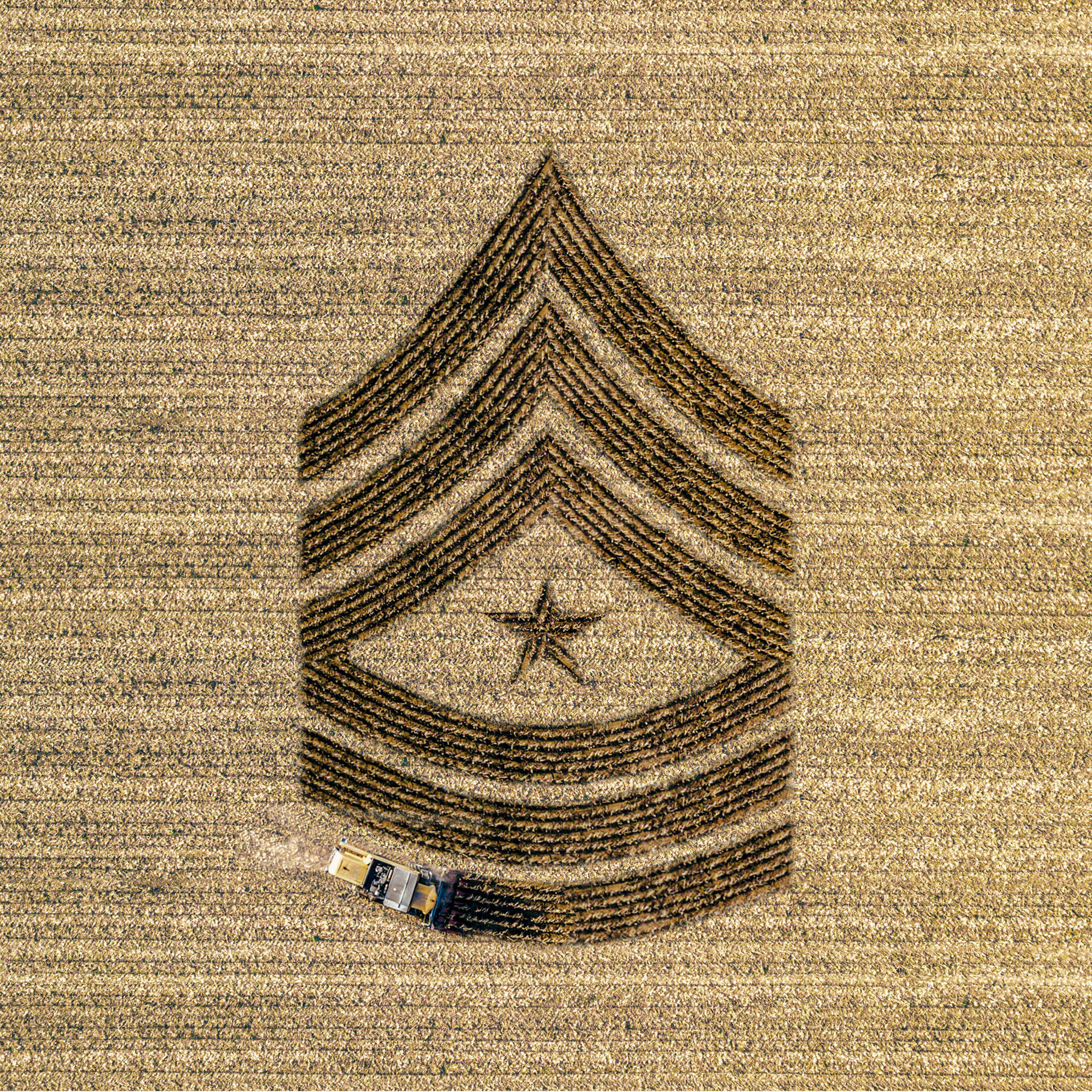
In recent years, dozens of affinity groups and training programs have popped up for military vets transitioning into agriculture. What’s behind it?
On the last day of August, a heavy fog descended on the mountains around Vilas, North Carolina. Behind Aaron Banner’s house, the moisture settled on a thick rug of spider webs hammocking between ferns on the forest floor, painting the threads white with dew. About four to six feet off the ground another web—this one made of 5/16” blue plastic tubing—wove between 24 maple trees. In cooler months, the tubing collects sap from the trees and sends it to a holding tank. Eventually it will flow to Banner’s sugar shack—newly constructed using poplars from his property—where he’ll process it into maple syrup.

Banner has learned everything he knows about making maple syrup from YouTube. He’s pretty new to this. In 2023 he retired from the military after a 32-year career and began building a small honey and maple syrup operation. Banner said he entered agriculture for two primary reasons: He wants to stay physically active post-retirement and he’s concerned about food security.
“When I say food security, I don’t just mean for myself; I mean in the broader sense,” Banner said. “I’m concerned about food security for the nation.”
Veterans like Banner are slightly overrepresented among farmers; many enter into agricultural careers out of a sense of service and duty. “I guess [service is] why I was attracted to the military. It’s probably why I’m a volunteer firefighter,” Banner said. “It’s just this desire, whether it’s to serve or to better the nation, something certainly drives me.”
The vets bring skills and an attitude particularly suited to farming: They’re mission-driven, with the training and discipline to develop a plan and execute on it. Many come with pensions, which allow them a measure of financial stability other farmers may not have. In return, farming can provide adaptability, spiritual fulfillment that may be missing in an office job, and healing after careers that often involve violence.
New people entering ag is necessary. The average American farmer is now over 58 years old. While the number of producers over 65 is growing rapidly, the number of younger farmers is not keeping up. At the same time, large moneyed producers are consolidating farmland and smaller farms—which feed communities and sustain rural economies—are disappearing. It’s a crisis that has been brewing for decades.
Of course, vets have their own crises. In the early aughts and 2010s, veterans returning home from the wars in Iraq and Afghanistan had higher rates of unemployment than vets from other wars and the general population. They also suffered from higher levels of acute Post-Traumatic Stress Disorder than returning service members from other conflicts, and had a harder time readjusting to civilian life. Some of those veterans found solace and work in farming. Government officials saw an opportunity to create pipelines for veterans into agriculture, nudging the problems of unemployed vets and a shrinking, aging farmer population towards a linked solution.
“The reason that we focused on veterans was not out of a sense of sympathy or duty, but out of a sense of this is an enormously capable part of our society.”
In 2014, the Farm Bill for the first time named veterans as a distinct class of beginning farmers within the U.S. Department of Agriculture, giving them access to money for everything from animals and equipment to conservation practices. In 2015, the Department of Defense introduced agriculture into the education programs offered to veterans transitioning back to civilian life.
The USDA also gives out grants to training programs focusing on vets. This summer, Aaron Banner attended one such program at Appalachian State University in North Carolina, called Frontline to Farm. The federal support for agricultural training for veterans has been consistent, even during the current Trump administration, which has cut funding to other disadvantaged farmer initiatives.
“The reason that we focused on veterans was not out of a sense of sympathy or duty, but out of a sense of this is an enormously capable part of our society,” said Pamela Hess, who runs another vet-to-farmer program at the Arcadia Center for Sustainable Food & Agriculture in Virginia. Approximately 200,000 people leave the military each year and, Hess said, “some portion of them are going to want to be farmers and they are uniquely capable of doing this work both mentally and physically, as well as financially.”
*
The work of farming is particular—often generationally entrenched and passed down, demanding and financially unpredictable. It takes, in other words, a certain type of person to choose it willingly. But Hess said veterans are a perfect fit. “The qualities that a veteran has are qualities that farmers really need,” Hess said.
Those qualities include the ability to “not be freaked out by crises because everyday on the farm is a crisis,” said Hess, as well as the capacity to do long-range planning, institute structure, organization, and discipline, be able to work outside in sometimes scorching or cold weather, and think creatively to solve problems using limited means. “They’re mission-focused,” said Anne Fanatico, who runs Frontline to Farm at Appalachian State University. “They’re really resilient people that do the type of work that takes on risk.” Many vets also possess ancillary skills, like engineering know-how, plumbing, or mechanical expertise, which are useful on a farm.
Still, those attributes don’t mean one knows how to farm. Programs have popped up around the country that offer instruction and farm visits to groups of veterans. Frontline to Farm is a weeklong intensive focused on Appalachian farms, where land can be steep or forested and one needs to get creative to make use of it. Such programs also offer participants a network and a community to turn to for questions, support, and help. The camaraderie can be intense. Fanatico recalled visiting a Marine’s farm during a training one year and the trainees immediately pitching in. “I realized they were not going to leave until the work was done,” she said. “We wanted to do a little bit of corn planting and I thought, ‘Oh my gosh, they’re not going to leave.’“
Arcadia offers vets a Reserve program—a year of classes, farm visits, hands-on training, and machinery maintenance, held one weekend each month for a platoon-sized cohort. Alternatively, paid fellowships allow vets to work for Arcadia’s teaching farm and gain hand-on experience. And because land access is a serious and pervasive problem for beginning farmers, vets who want to jumpstart their own operations but don’t yet have land can rent ⅛-acre plots and use Arcadia’s tools in the Incubator program.
“I produce food for people. People come out to my farm and they pick and I see them smile … That’s rewarding because I’m still serving my country.”
Doug Stark, 61, went through the Reserve program and then received a plot. He grew up in farm country in Missouri but didn’t work the land himself. He escaped to the Navy to see the world and get an education. After 20 years he retired; all he wanted to do was drink coffee and watch the trees grow. But then he had what he says was a vision from God telling him to grow vegetables. “I believe God wanted me to do it and there’s a reason for that,” he said. “But I didn’t know where to begin.”
Even after the Reserve experience and his own studies, actually working the land was tough. “My first month as an incubator farmer was really awakening,” he said. “If I had to do it on my own, I might have been discouraged.”
In total, Stark spent three years with Arcadia, time that counted towards the required ag experience necessary to secure loans when he was ready to buy land. Like most vets, he has a pension. About 40% of farmers have off-farm jobs and a majority of ag households—84%—rely on those jobs for at least half of their total income. But vets, many of whom are able to retire in their 50s, 40s, or even younger, have an income and health insurance without having to clock in, allowing them a measure of financial security and time that other potential farmers might not have.
Stark now grows a variety of Asian produce, like Chinese eggplant, bok choy, long beans, and kabocha squash, on about 13 acres in Virginia. He sells it to Asian grocers in the area—a niche he discovered because his ex-wife happened to be Cambodian. He gets a little choked up talking about what the farm has meant to him.
“People that join the military do it these days because they want to serve our country,” he said. Working office jobs like he was doing after military retirement didn’t feel like service, but now, he said, “I produce food for people. People come out to my farm and they pick and I see them smile … That’s rewarding because I’m still serving my country.”
“These are people who are not trying to become the next zucchini mogul in their county.”
Eva Rollins, 69, joined the military young and retired in 1995. She’s worked various jobs since then but has always had a garden and loved being outside. A couple of years ago she decided she wanted to go all in on a farm and went through Arcadia’s training. She’s raising her grandson, Alex, 9, and wants him to grow up on farmland.
Rollins envisions a food forest, with fruit trees and bushes, mushrooms, and raised beds—something she’s received help planning through Arcadia. She’s preparing to close on a property in Virginia with 10 acres on it and knows she’ll have to make some money to sustain it, but it’s not what motivates her. “I want to get commercial because I want to help,” Rollins said. “More than money, I want to help. I want to give back because I see people struggle.”
Vets make up about 6% of the U.S. adult population, but about 9% of all farmers. Their farms tend to be smaller than the average American farm and their sales leaner. It’s unclear whether those disparities exist because veterans prefer to operate smaller, community-focused farms or due to unrelated reasons. Lynn Gibbard, who previously co-managed Frontline to Farm and is herself a veteran, said many of the people applying to that program were specifically and strategically hoping to contribute to their communities.
“These are people who are not trying to become the next zucchini mogul in their county,” said Gibbard. “These are folks who are saying there is a need in my community for food at the local church, at the local homeless shelter, and that’s where my produce is going to go.”
*
As much as a veteran may have to offer to the farm, the farm has much to offer to the veteran, too. For one, farming is a job that can be done with one’s family. After active duty, which often involves lengthy separations from their families during deployment, some service members seek out ways to stay close to their loved ones, like working the land together.
Farming is also endlessly adaptable and, because it is dangerous and farmers often end up injured, can accommodate disabilities. For example, there are tractors with hand pedals instead of foot pedals for people with missing legs. One can plant trees or vines instead of veggies for a bad back and people in wheelchairs do well with chickens, said Hess.
“Farming has a long history of adapting to physical injury,” Hess said. Established organizations like AgrAbility work with farmers and ranchers to find solutions to various mobility issues. That can be important for younger veterans in particular, as post-9/11 service members, who served in wars defined by improvised explosive devices, have the highest rates of disability of any veterans.
Farming also offers something intangible: peace. When Rollins sticks her hands in the soil, the stress falls away. “That dirt grounds me,” she said. “Being out in nature is very calming to me as a PTSD person.” Rollins was assaulted when she first came on active duty and carried the trauma with her for decades without telling anyone. After retirement, she started getting triggered and night terrors haunted her. Eventually she sought out treatment and improved, but it’s something that’s still with her. Working her land will help her continue healing, she said.
Stark, too, manages PTSD from his military career and seeks solace in his fields. “Part of dealing with depression is focusing on other things,” he said. “You know, listen to the sounds around you, not focusing on your depression because if you focus on your depression, depression is going to win.”
“What really attracts them to farming is after a lifetime of work and being trained to destroy things to have the opportunity to create things.”
Farming can be therapeutic, but even for vets who aren’t actively dealing with PTSD, a farm could represent a drastic and welcome departure from their military lives. “What really attracts them to farming is after a lifetime of work and being trained to destroy things to have the opportunity to create things,” Hess said.
“I wanted to kind of live in harmony with people and nature to the best of my ability,” Banner said. “I’m not not a hippie or anything, but I just wanted that.”
Banner’s current land is forested, enclosed by hills and a sense of safety. His garden is on a tiny flat stretch, the stacked beehives the busiest thing within view. His house has a capacious wrap-around porch with many rocking chairs. This year, he plans to expand his operation to 120 trees. He hopes, for the first time, to turn a profit. After attending Frontline to Farm he also has other ideas for his forested land, like ginseng cultivation. Eventually, he’d like sheep. He’s currently looking for pastureland.
“We’ve been in perpetual conflict so we’ve not lived peaceful lives,” Banner said. “We’ve bounced around a lot so putting down roots and growing where you’re at, trying to live in some type of harmony and having something peaceful to do every day, I think it just attracts a lot of veterans whether it’s because they’re trying to get over some some mental challenges they have, some experiences they have, or it’s maybe just a good way to live and a very different lifestyle than what they have lived in the past.“