Something about the Pacific Northwest turns fig enthusiasts into all-out fanatics.
For Marisol Bazaldua, finding a fresh fig at a store in her Texas hometown was a novelty. Like many Americans, Bazaldua’s knowledge of figs didn’t go much farther than the bright yellow Fig Newton cookie boxes on supermarket shelves. But during a trip to Albania in her 20s, Bazaldua indulged in the country’s abundant fig supply, and she was hooked. “I was exposed to all these different kinds of tropical fruits from South Texas, and then this fruit—where has this fruit been all my life?” she said.


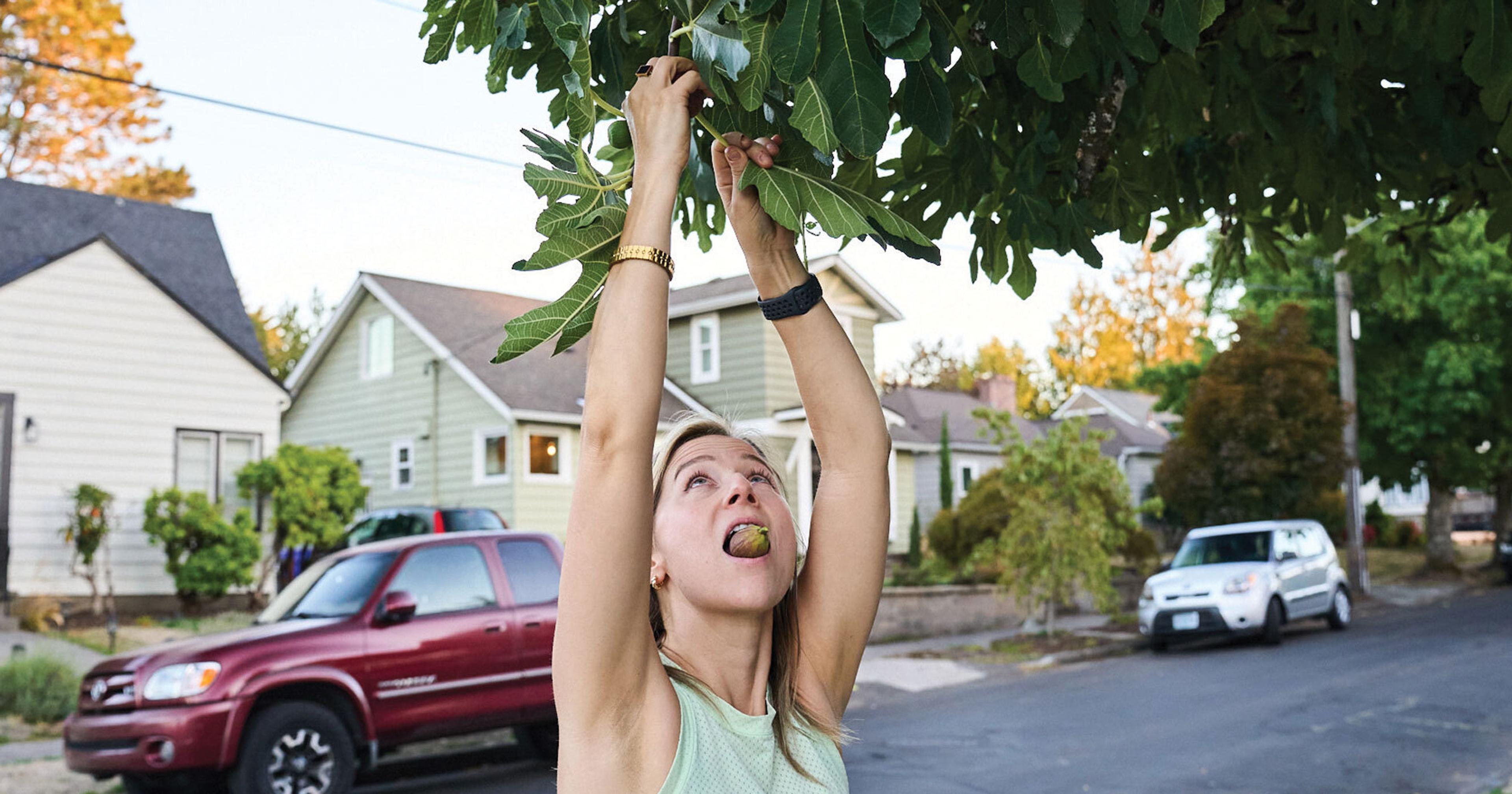
Now a resident of Portland, Oregon, Bazaldua is discovering a passionate culture where many Pacific Northwesterners obsess over figs during the region’s short but robust season. In the dwindling light of Portland’s early autumn evenings, walk down any neighborhood sidewalk and you will likely find branches weighed down, drooping over fences and sprawling over property lines. Urban foragers like Bazaldua scatter throughout the city’s lush neighborhoods collecting fig fruit that will only last a short time, but will be enthusiastically jammed, preserved, dried, or eaten fresh on the spot.
The sheer diversity of produce that can be grown in Portland has created a special urban foraging culture in general, but the thousands of fig trees throughout the city are remnants of its once-hearty fig farming industry. Immigrants from southern Europe brought fig tree clippings with them, and 150 years later, the descendents of those trees are still bearing fruit.
And, it turns out, they bear a lot of fruit. Many residents who inherited fig trees don’t quite know what to do with them or don’t have time to prune the fast-growing fig trees that can quickly take over a yard. According to Bazaldua, she can’t get enough even though she now lives in a place where they grow easily. “...it’s turned into a fig addiction,” she said. And most of the people she asks to harvest from are very willing to share. “Sometimes people will have signs saying ‘Help yourself,’” she said. It’s a symbiotic relationship of sorts—tree-owners want to enjoy their green canopies but don’t want to deal with the fruit, and fig-lovers can’t or don’t want to care for a tree and will take the masses of fruit off their hands.
Foraging fresh is the much-preferred alternative to hunting down figs in a store. They are difficult to cultivate and ship on a commercial scale. Figs are fragile and short-lived, appearing at shockingly high prices for just a short blip of time. So for those who want to satisfy their fig addiction without hurting their wallet, foraging can be a nice solution. But in the Pacific Northwest, planting your own fig tree is the next step on the journey toward fig Nirvana.
Sam Hubert has spent a decade as the nursery manager at One Green World, one of Portland’s go-to fig tree suppliers. He recommends figs for first-time growers since they are one of the easiest plants to cultivate in Oregon’s temperate and rainy climate. “With a fig as a first-time grower, you are almost always guaranteed success because you are planting something that wants to be here,” he said. “It’s one of those plants that is so expressive of where it’s grown and in a lot of ways needs to be grown in a climate like ours.”
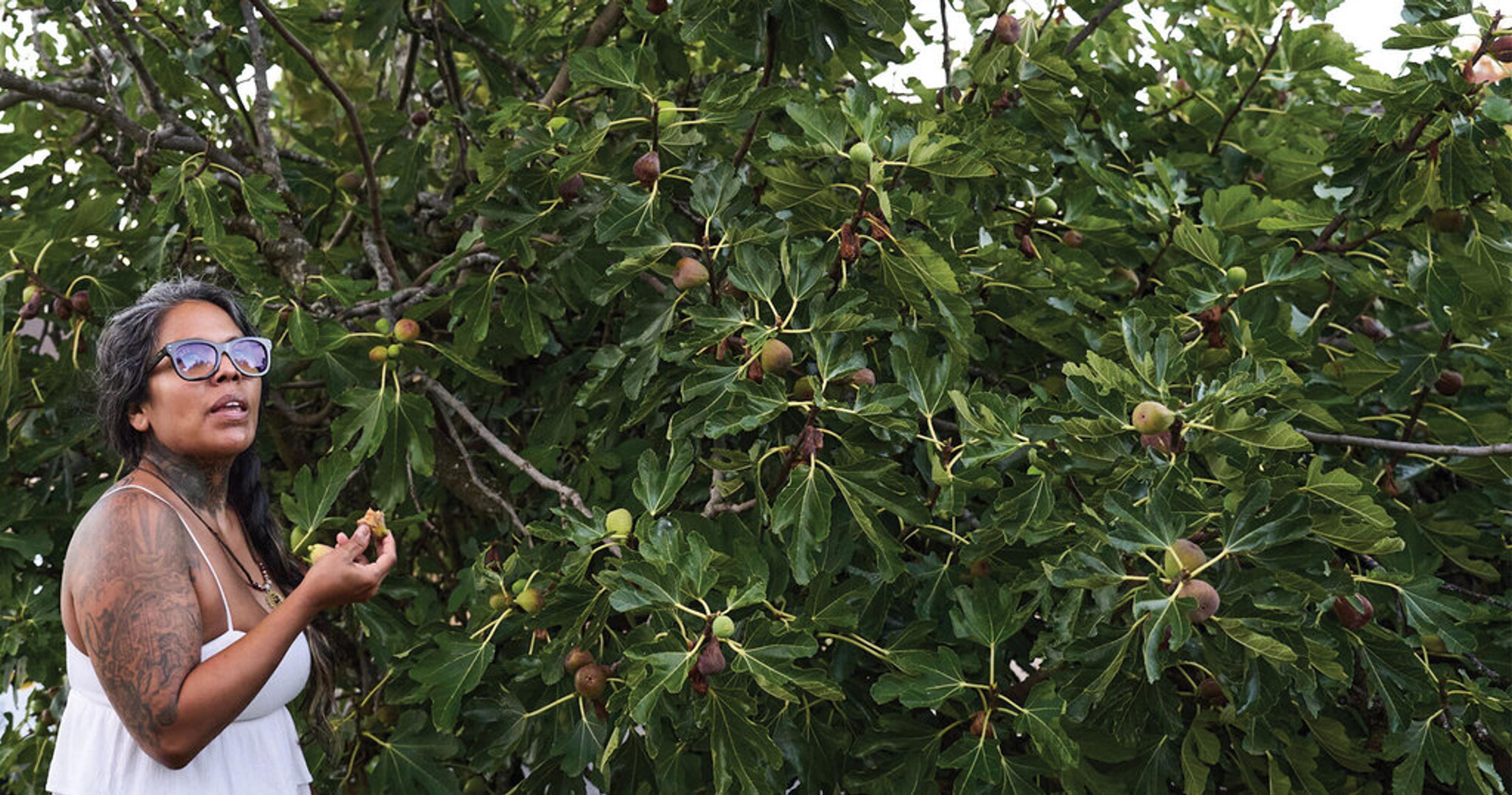
Marisol Balzadua foraging for figs in her north Portland neighborhood
One Green World hosts a yearly Fig Fest where fig enthusiasts and newbies alike can learn about growing figs and taste dozens of varieties. For the uninitiated, figs come in a wide spectrum of colors and taste profiles. Pale green Italian Honey figs taste like, well, honey. Rich purple Black Mission figs are common on charcuterie boards for their beautiful appearance and hints of berry flavor. Some figs are grassy and earthy—perfect for jams and chutneys—and some evoke delicate floral notes or strong brown sugar profiles. But not all of the world’s 800-plus fig varieties will grow well in the PNW, so diving in and collecting all sorts of clippings might not be the best strategy—especially for first-timers.
Hubert urges potential fig parents to do a taste test of just a few types and cross-reference flavors they like with what will actually grow in an Oregon yard. Growers can’t go wrong with the hearty Desert King, by far the most popular and plentiful fig type in the area. But because fig wood is easy to graft, fig growers can always create trees with multiple varieties, which Hubert recommends to everyone interested in growing. “Every tree I grow has four varieties on it so I can taste a lot of things,” he said.
The Pacific Northwest is hardly the first to propagate a fervent culture around figs. It being one of the oldest cultivated fruits in history, the obsession goes back thousands of years to Greek and Middle Eastern cultures. As California native and Oregon transplant Nisha George found out when searching for her perfect fig type, modern fig fanaticism can feel Greek mythology-adjacent—but with more Facebook groups.
George remembers eating plentiful fruit from a fig tree growing in her childhood backyard in Los Angeles, and fell head-first into the PNW fig world of potlucks, tastings, collectors, grafters, and festivals. “Once I was able to get a house where we got our own backyard, the first plant I wanted to source was a fig tree to recreate that experience for my kids,” she said.
While figs grow well in California, George doesn’t recall the same zealous energy around figs there. “California has the advantage that anything grows there, and I think people take it for granted that you can have any type of fruit at any time of the year,” George said. “I think people in the PNW get so passionate about fruit because we have a limited season and you have to get really specific on what you are going to grow.”
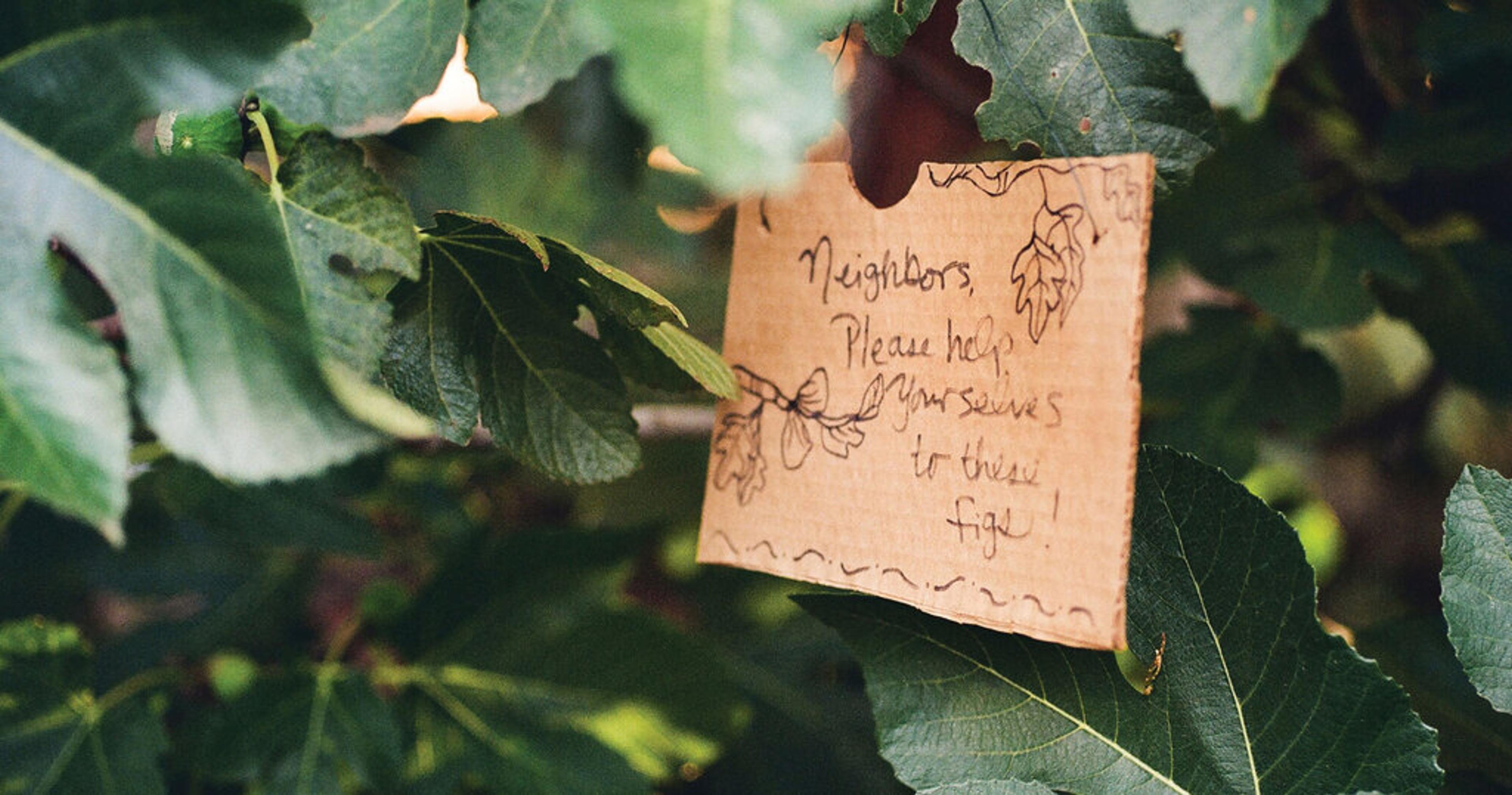
A sign welcomes urban foragers to harvest figs in Portland.
Both Hubert and George point out that figs can easily grow in containers, so diehard enthusiasts can amass collections of diverse assortment. The advantage to this approach, George said, is that the trees stay small in pots, taking up less space and can be moved indoors during cooler weather. And while their yield is much less than established outdoor trees, container growers can taste a large variety if they choose.
“People kind of treat it as a collection,” George said. “I can have 50 different fig trees in pots and I can taste a different flavor each week as things ripen. I won’t get a huge haul, but I get variety. So people have fallen into this fig culture because they can have that diversity of fruit.” She recalled going to a fig potluck in Seattle where attendees had dozens of varieties in containers ready to share. “I said I had [only] one tree in the ground and people were like, ‘How are you surviving?’” she laughed.
Because they are so easy to cultivate, it’s not hard to go down the collector rabbit hole. But, George cautioned, it’s also easy to get burnt out. “People come and get excited and go and buy a ton of figs, and then people realize they have to water them and prune them,” she said. “You don’t have to collect them all, it’s not like Pokemon.”
While raising a family and working full-time, George is upfront about the fact that keeping multiple trees alive in pots is not realistic, so she’s settled on one type—the Negronne— to plant in the ground at their Oregon home. Plus, her kids are getting a similar experience that she had growing up in LA. “I feel happiest when they go outside and they snack on stuff from the garden,” she said.
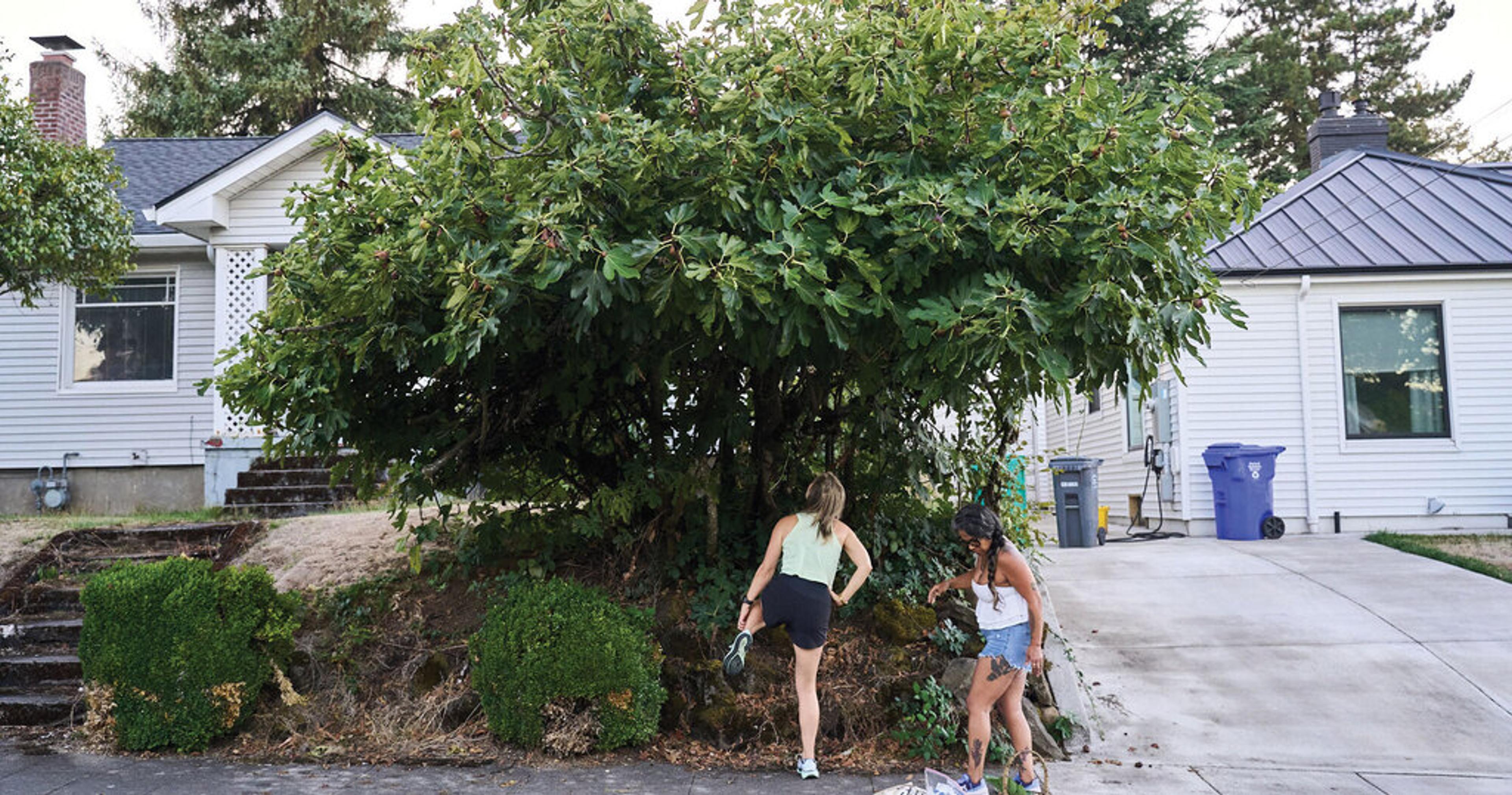
Marisol Balzadua and her friend Kayla foraging for figs in her north Portland neighborhood
But for those who do voyage into the wide corners of the fig universe, sites like Fig Bid allow collectors and traders to set up profiles and sell fig clippings all over the country. “There’s a collection culture with anything where people get obsessed with getting the rarest thing,” Hubert said. “Some of the varieties we grow we wouldn’t have without that community bringing them out of obscurity. The fig trading people have introduced a ton of varieties that we wouldn’t have had.”
Hubert said One Green World experiments a lot with “lesser-known oddball stuff” that isn’t necessarily commercially viable. They’ll make one international trip per year and connect with European collectors as well as gather wild seedlings and try to cultivate them back in Oregon. But the main goal is to naturalize different types to the PNW growing season so more and more people can discover the joy of cultivating their own figs at home.
Even though Marisol Bazaldua can find her beloved figs on almost every corner in Portland, she recently purchased her first trees to try growing at home. She’s taking a chance with a couple of breeds that aren’t found too often in Oregon—the Black Mission and the Robert’s Golden Rainbow—but also playing it safe with the reliable Desert King.
“I’m so lucky to live in an area where the soil is so fertile and produce is so abundant,” she said. “I’m still baby new to this. I bought my plants with the intention to let them grow big and happy so when I find my own house I can plant them and have a variety.” It will be a few years before her twiggy fig clippings bear much fruit, but maybe one day she’ll boast an abundance of figs to share with passersby, who like herself, have succumbed to the allure of the PNW’s fig magic.