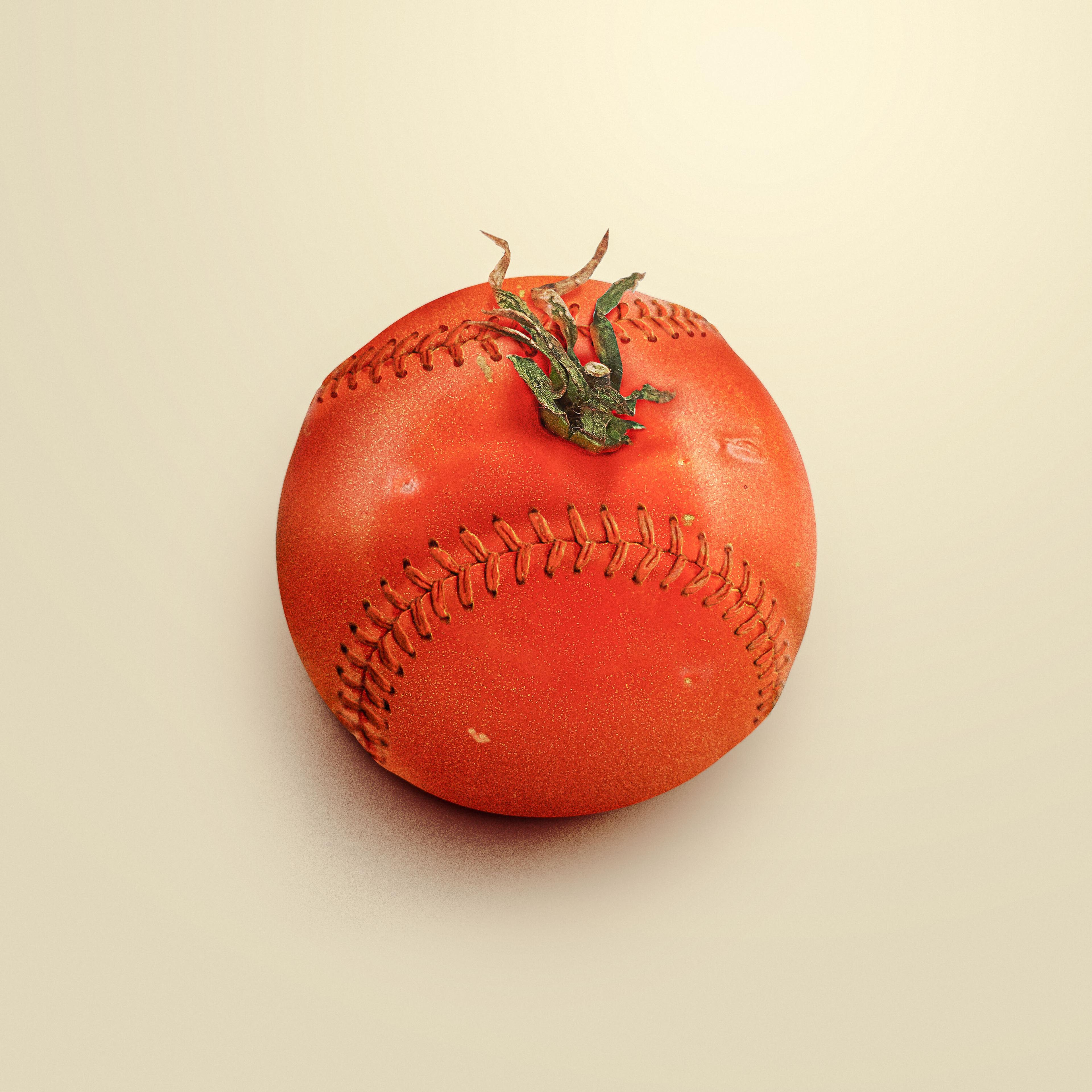
Why, exactly, are people always throwing tomatoes at each other?
An overripe tomato evokes strange and violent passions. It’s the projectile heft in your palm, suggestive of a baseball. It’s the water-balloon squish, the tactile promise of detonation upon impact; you can’t help but anticipate the splatter. It’s that raw red shade, the promise of strewn innards, gross and gory and gleeful all at once. These factors conspire to make a tomato the perfect vegetal instrument of mayhem. At least, that’s what I thought on a recent evening outside my childhood home in the stark illumination of a porchlight, about to lob a tomato at my younger sister and get pelted in return. Anything for the pursuit of truth.


The thrill of tomato-based combat has a long and storied history. Most famously, the Spanish city of Buñol hosts the annual La Tomatina festival, where celebrants fill the streets with over 100 tons of tomato missiles. But such revelry maintains a grip on the folk imagination of Americans, as well.
Even a casual search will reveal scores upon scores of regional, local, and hyper-local tomato festivals across the United States, featuring parades, costume shows, quirky tomato-themed contests, and almost invariably, some variation on the smash-hurl-splatter experience. At first, I was baffled by the widespread celebration this fruit has garnered. Why not, say, cucumber fairs or lettuce jamborees? While there are occasional oddball celebrations for other produce, none have reached the fever pitch of the tomato.
Keen to better understand these events, I spoke with Roman Braglio, who recently launched the statewide Maryland Tomato Festival on his family farm. Braglio emphasized that small growers have been raising tomatoes across Maryland for generations. He chose the theme for his festival “because of that abundance,” showcasing local tomato farms and products like sauces.
Braglio’s view reveals a throughline between tomato festivals. Epithets abound, such as Jacksonville, Texas, “the Tomato Capital of the World”; Reynoldsburg, Ohio, “the Birthplace of the Tomato”; and Pittston, PA, “the Quality Tomato Capital of the World,” lest some fool confuse it with Jacksonville. In each case, a tomato festival has emerged from — and, in turn, sustained — the town’s longstanding connection to the crop.
Yet perhaps there’s more to it. After all, the rotten tomato has been a symbol of dissatisfaction and even political dissent since its first recorded deployment by a theater audience in 1880s New York. Braglio concurred, pointing out the fruit’s distinct physical appeal for his festival games, like Tomato Tee-Ball: “Hearing it splat, seeing the deep red color … It’s the sensory part of it.” The tomato’s riotous appeal seems to stem from two sources: on one hand, its wholesome agricultural ties to rural communities; on the other, an intrinsic tendency toward havoc.
That suspicion led me further into the weeds of the proverbial tomato patch, until I stumbled across an annual battle now waged in the scenic climes of Buena Vista, Colorado. It’s a festival with scant pretense or commerce, only the embrace of the primordial urge contained in every overripe tomato — to throw it hard at another human being. I am referring, of course, to the Great Colorado vs Texas Tomato War.
As the official website tells it, the war was first declared in the early 1980s as an outlet for the rivalry between Coloradan locals and the Texans vacationing in their mountains. Each summer, hundreds of participants took to an open field, barraging each other with several tons of the season’s unsellable tomatoes. The Texans defended a strawbale fort dubbed “the Tomalamo,” sometimes parachuting or helicoptering onto the field. After a lapse, the battle was revived in the last decade as a charitable fundraiser. Admirable auspices notwithstanding, I’d finally found what I sought. Here was a pure celebration of the tomato as a weapon of harmless but visceral combat.
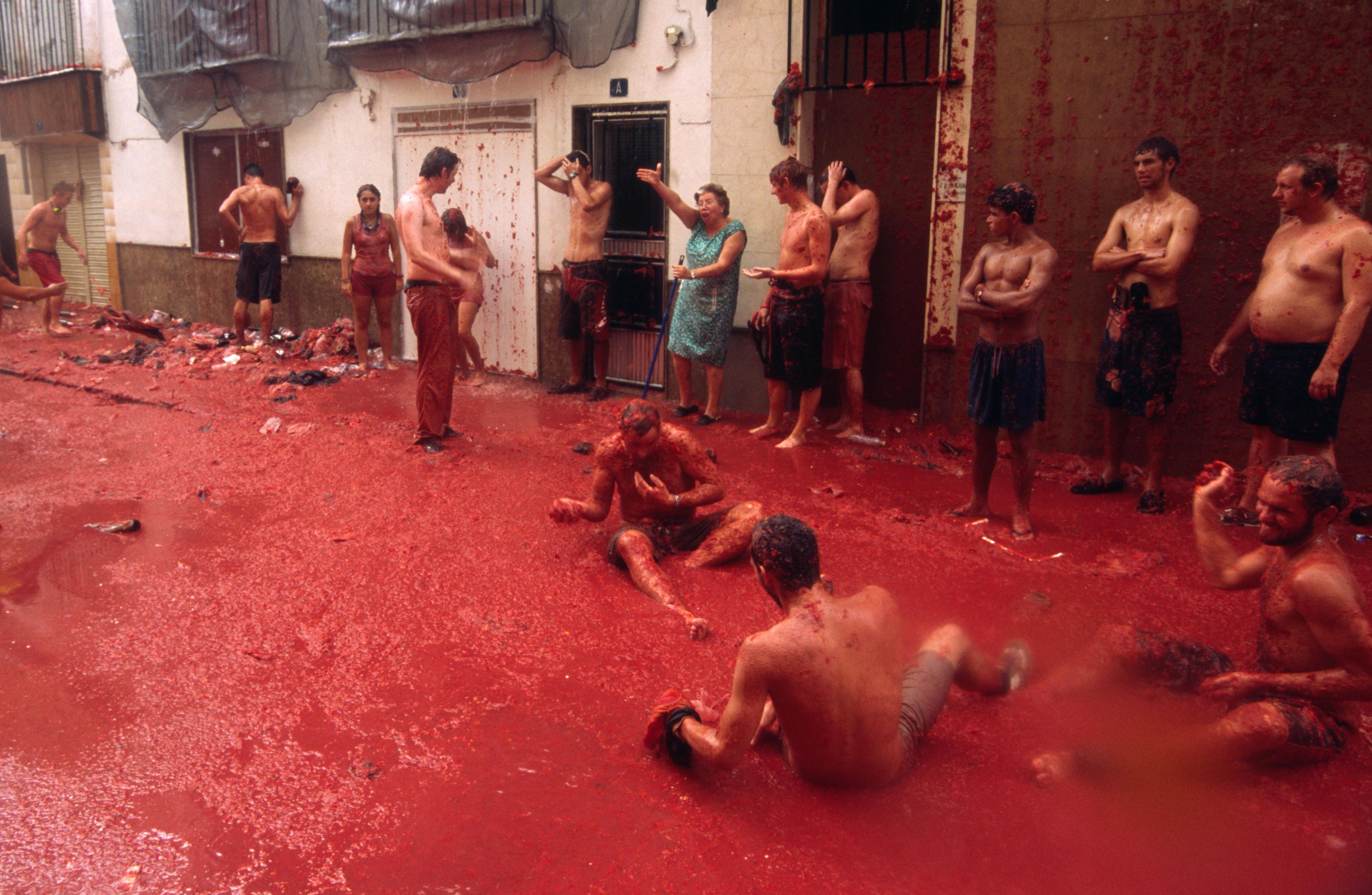
The La Tomatina festival in Spain
·Alamy
J. David Holt, an author and Tomato War organizer who first pitched its revival to the BV Rotary Club, took a less gruesome perspective. “It’s amazing how much fun people have,” he told me, “throwing overripe tomatoes at each other.” Seth Williams, a recent Tomato War administrator, agreed. They each pointed to the scaled-down children’s event that precedes the adult battle as an example of the guileless, messy fun of it all.
Nervously, I presented my own emerging theory about the experience of holding an overripe tomato. The weight and texture, the raging red. Williams was amenable to the idea. As he put it, “There’s nothing like that satisfying squish or splat that you get when that tomato lands on its intended target and makes a nice juicy, gooey mark.”
Yet, when pressed, both Williams and Holt admitted that neither of them had ever actually thrown a tomato at anyone. They prefer to safely enjoy the spectacle from the spectators’ tent or the MC microphone. Despite the insights and context they offered, they could not speak firsthand of the savage thrill that, I assumed, accompanied one’s first throw. The central quandary of the Tomato War remained unanswered. I had no choice but to take matters — or rather, ’maters — into my own hands.
I cannot claim to have fought in the mythical Tomato War. In some respects, the panoply of local tomato festivals is still puzzling to me. But now, thanks to my sister humoring my pleas, I have seen the way an overripe tomato flies through the air like a smiting thunderbolt. I have felt the cathartic wrath from launching the first salvo and the satisfaction of receiving scarlet-stained bruises in turn. I’ve plucked the slick seeds from my hair and crushed the flesh between my fingers. This much have I learned, at least. If you wish to do the same, then find a worthy opponent and take your squishiest tomatoes to the dueling field, where the grass will run red with juice.