It’s so much more than it seems.
When Giuliana Furci first declined an invitation to the Telluride Mushroom Festival—an event that brings fungal science, conservation, foraging, cultivation, psychedelic research, art, and community together in the Colorado mountains—she had no idea she would eventually become one of its most recognizable faces. For four consecutive years, Art Goodtimes, a poet, former San Miguel County commissioner, and the festival’s beloved “Shroom Pa,” invited her to speak about the entheogenic use of fungi in Chile. For four years, she declined.
“I didn’t know anything about that,” Furci recalls. Then came the fifth year, when Art tried a different approach: “Can you just come and talk about anything?” She accepted. That was 2015, and she has not missed a festival since, except once.
Furci, a Chilean-Italian field mycologist who lives in Chile, is the foundress and executive director of the Fungi Foundation, the world’s first nonprofit dedicated to fungi. She is also an associate at Harvard University and a Dame of the Order of the Star of Italy, an honor conferred by the president of Italy; Furci received the distinction for her work on fungi. She serves as deputy chair of the IUCN Fungal Conservation Committee and is part of Team Mushroom, the Telluride Mushroom Festival’s organizing group, where she co-leads one of its most spectacular events: the mushroom parade.
The 46th festival took place August 12 to 16, 2026, in Telluride, Colorado. Furci’s appearances included co-leading the parade in her signature costume and delivering a keynote presentation titled “Conks, Puffballs, and People.”
“Don’t miss it,” she says simply. “Do yourself a favor and attend a Telluride Mushroom Festival at least once in your life.”
A Festival Unlike Any Other
Nestled in the Colorado mountains, Telluride has long been a town of festivals: Bluegrass, Film, Mountainfilm, and Jazz. But for more than four decades, the Telluride Mushroom Festival has carved out its own niche as the largest gathering of its kind in North America.
The festival began as the Aspen Mushroom Conference before moving to Telluride in 1981. Its early circle included Dr. Emanuel “Manny” Salzman, a Denver radiologist and one of its founders, and his wife, Joanne Salzman, along with Gary Lincoff, author of The Audubon Society Field Guide to North American Mushrooms; Dr. Andrew Weil, the integrative medicine pioneer; Paul Stamets, the mycologist and entrepreneur who founded Fungi Perfecti; and Goodtimes himself. Furci credits Goodtimes with helping bring the gathering from Aspen to Telluride. Today, the festival operates as a program of the Telluride Institute.
What began as a relatively intimate gathering focused on psychedelics and fungal science has grown considerably. More than 700 people attended in 2019; by 2025, Furci says, attendance had reached about 1,500. The growth accelerated in the pandemic years, when mushroom foraging and other outdoor pursuits drew new interest, part of what Furci calls “the mushroom hype.” Roughly 70 percent of recent attendees, she says, were experiencing the festival for the first time. Yet despite the influx of newcomers, the gathering retains what Furci describes as a “tribe or family feeling,” with regulars returning year after year and considering one another family.
The 2026 theme, “Rewild,” explores reconnecting with land, ecology, and community. The program reflects that ethos, with spaces for integration and connection, a BIPOC Community Gathering, and, new this year, an LGBTQ+ Social Hour.
“I have been to mushroom festivals all over the world for many years,” Furci says, “and there is nothing as fun and as unique as the Telluride Mushroom Festival.”
Part of that distinction comes from the range of subjects packed into a single gathering. Conservation science and taxonomy share the program with psychedelic research, cultivation, foraging, art, and the MycoLuscious MycoLicious MycoLogical Poetry Show. At the Mushroom ID Tent, experts help visitors identify specimens collected in the surrounding San Juan Mountains, while vendors, workshops, and forays offer other ways into the fungal world.
Just as important to Furci is the access. Over the years, attendees have encountered figures such as Stamets, Mycophilia author Eugenia Bone, and ethnopharmacologist Dennis McKenna not only onstage but as part of the larger festival community. Furci describes the opportunity as meeting one’s “mushroom heroes and heroines” up close. Britt Bunyard, the festival’s programming director and founder, publisher, and editor-in-chief of Fungi magazine, helps shape the eclectic roster year after year.
Honoring Katrina Blair
The 2026 festival pays tribute to Katrina Blair, the Durango wild-foods advocate, author, and founder of Turtle Lake Refuge, a nonprofit she established in 1998 to celebrate the connection between personal health and wild lands. Blair died June 5 after a battle with cancer. She was 56.
For 16 years, according to festival organizers, Blair made an annual pilgrimage on foot from Durango to Telluride, a six-night journey through the San Juan Mountains. She foraged as she walked, often carrying little more than oil and spices and eating wild plants, berries, and mushrooms along the way. She gathered ingredients during the trek and continued foraging after reaching Telluride, ultimately transforming the harvest into her Wild Foods Dinner, one of her signature contributions to the festival.
A month before her death, Blair met with Team Mushroom to talk about how she wanted the tradition to continue. She entrusted the pilgrimage and dinner to Mila Garelle, who is carrying the tradition forward with culinary artist and chef Gerard LaBonté. Her wish, according to the festival, was that the joy, abundance, and knowledge of wild plants remain part of the gathering.
The festival’s tributes to Blair include the Wild Foods Dinner, a memorial gathering with Turtle Lake Refuge, a Wild Food Walk and Magical Tea Party, and an Ecstatic Dance in her honor on the final day. The dinner also incorporates Blair’s songs, poems, and stories, and attendees receive a copy of her book, The Wild Wisdom of Weeds: 13 Essential Plants for Human Survival. Together, the events carry forward the philosophy that shaped Blair’s work: that wild food can reconnect people to the land beneath their feet.
The Parade: A Cathartic Manifestation of Fungal Love
The festival spans five days, packed with forays into the forest to hunt for mushrooms, workshops on making paper from fungi or cultivating your own, conference sessions with keynote speakers, and concerts at night. But the undisputed highlight arrives on the penultimate day: the parade.
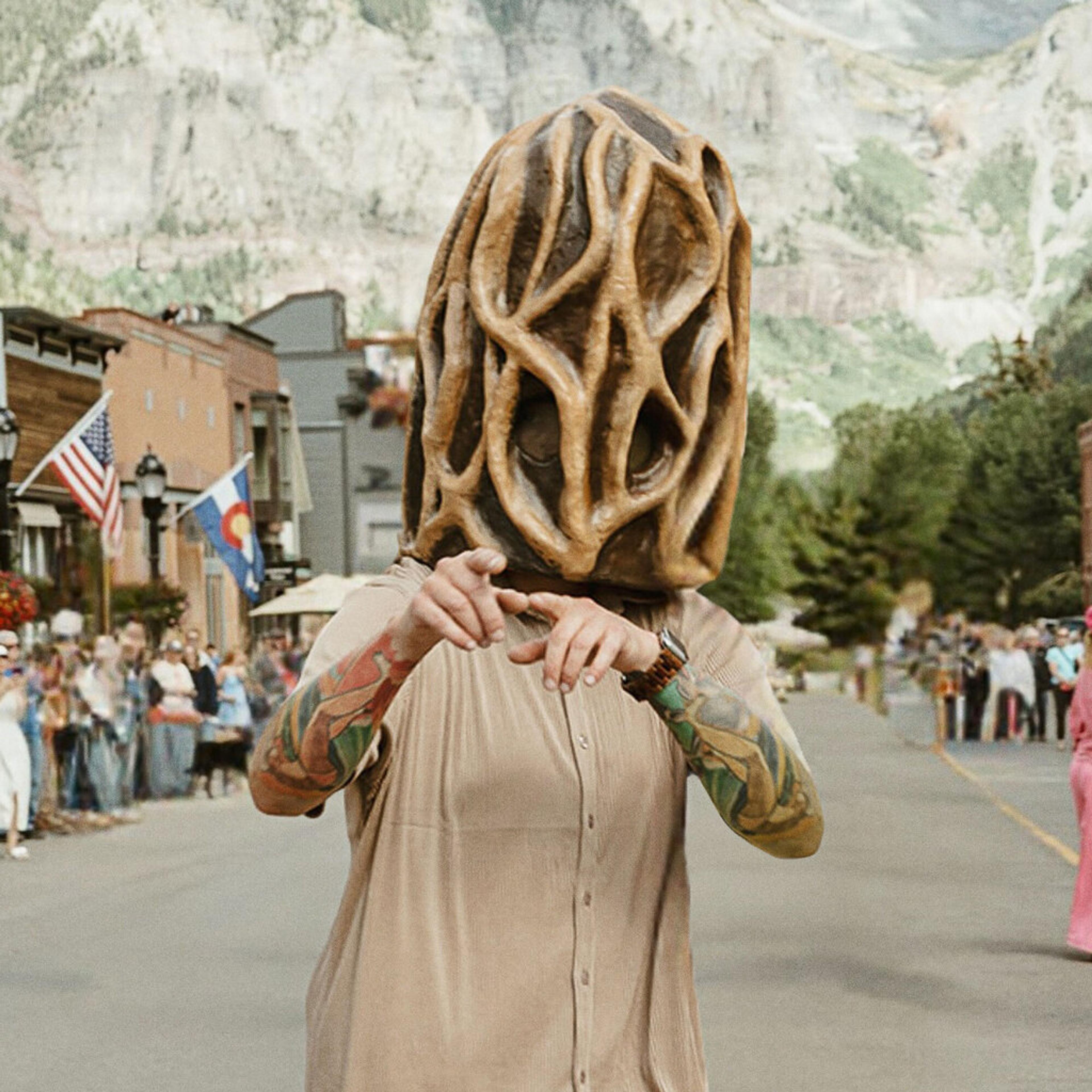
On Saturday afternoon at 4 p.m., the town closes off a huge portion of Main Street. Hundreds, now thousands, of people dress in elaborate mushroom-themed costumes and march through Telluride, led by Goodtimes and Furci.
Behind them rolls the Amanita Mobile, an old, broken-down truck painted to look like an Amanita muscaria, the iconic red-capped mushroom with white spots. The truck no longer runs; volunteers push it through the streets. Following the Amanita Mobile comes a larger truck carrying the Silly Drummers, a West African drumming group that has been part of the festival for 15 to 20 years.
And behind them? A river of costumed humanity: parents, grandparents, children, even pets dressed as mushrooms, flowing down Main Street, chanting in unison.
“We lead them with a 1-2-3, and they chant, ‘We love mushrooms,’” Furci explains. “In both English and Spanish. Nosotros amamos los hongos.”The chanting continues for about an hour and a half, punctuated by drumming and dancing, until the parade reaches the town park. More dancing follows before the costume contest begins at 5 p.m.
The costumes themselves have become legendary. Furci once won the Long Distance Spore Dispersal award, which recognizes the parade participant who traveled farthest to Telluride. Coming from Chile, she marched beneath a beach umbrella painted like a mushroom, with a Chilean flag draped down the back. In 2024, longtime costume collaborators Ben Kinsley, Jessica Langley, and Riitta Ikonen, joined by Natalie Score, won Best of Show with an enormous foot overtaken by Trichophyton rubrum—toenail fungus and athlete’s foot. The grotesquely comic creation featured oversized toes, discolored nails, and fungal growth rendered in exaggerated detail.
The team has a history of ambitious group costumes: in 2023, they organized a 50-person Psilocybe cubensis spore cloud and spore print, with participants becoming individual spores that collectively formed the much larger fungal image as they moved through the parade. Their costume archive includes photographs of both creations, along with earlier entries ranging from Dead Man’s Fingers and packaged enoki mushrooms to an Aspen bolete complete with maggots.
For festivalgoers who wanted help creating their own fungal looks, Finnish artist Riitta Ikonen, known for Eyes as Big as Plates, her long-running collaborative portrait series with photographer Karoline Hjorth exploring people’s relationship with nature, led a Costume Creations workshop Saturday morning at Telluride’s Ah Haa School for the Arts. But Furci emphasizes that competition is not the point: “The parade isn’t about the prize. It’s about this possibility to have a cathartic manifestation of fungal love.”
Furci and Goodtimes deliberately return to recognizable versions of the same parade looks each year, with occasional variations and upgrades. Goodtimes cycles through mushroom hats, often pairing them with a coat decorated with mushrooms and a large mushroom walking stick; Furci wears her towering mushroom headdress, mushroom-embroidered Mexican shirt, usually yellow trousers, and, more recently, a mushroom walking stick.
Furci says the continuity matters because roughly 70 percent of recent attendees are first-timers who have not experienced the festival’s decades of traditions. “To both Art and me, tradition is important,” Furci says, “and holding the essence of the festival together.”
The Puff Ball
After the parade and a break for dinner, the celebration continues at the Sheridan Opera House with the Puff Ball, a costumed dance party named for the round fungi that release clouds of spores when disturbed.
“A puffball is a type of fungus that produces a ball on land that is full of a powder, which is spores,” Furci explains. “A lot of people have a lot of fun either throwing them at people, kicking them, or just making them puff. When you break them, you’ll get a big spore cloud come out.”
The party channels some of that same exuberance. DJs keep the crowd dancing in costume, although many attendees trade their towering parade creations for smaller versions that are easier to maneuver on the dance floor. As Furci puts it, some parade costumes can get “pretty tall and wide.”
The name carries another layer of fungal lore. Giant puffballs are edible when young, and dried puffball material has historically been used as tinder. After a day spent sending costumed “spores” down Main Street, ending with a dance named for a fungus famous for releasing its own spore cloud feels fitting.
They Choose You
Furci’s path into mycology began in 1999, when she was a university student in southern Chile. One day, she spotted a large orange mushroom growing from a tree stump and wanted to know who she was. Furci deliberately refers to fungi as “she” or “they,” never “it.”
“There were no books on Chile and fungi,” she recalls. “And I thought, I’m going to write this. I’m going to do it.”
She did. In 2007, Furci published Fungi Austral: Guía de campo de los hongos más vistosos de Chile, a pioneering field guide to Chilean fungi. Five years later, she founded the Fungi Foundation in Chile. Her advocacy helped make Chile the first country in the world to explicitly include fungi in its environmental legislation in 2013. The change, incorporated into the country’s environmental-impact assessment regulations, meant fungi could be considered alongside plants and animals when ecosystems were evaluated before development and helped open the way for fungal species to be assessed for conservation status.
Furci built much of her expertise outside a traditional academic path. Rather than leave Chile to pursue formal study in mycology elsewhere, she chose to help create the resources and institutions she had lacked when she began. In 2005, she traveled to Washington State to study mushroom cultivation with Paul Stamets at Fungi Perfecti—a connection that would later come full circle at Telluride, where Stamets was among the festival’s early influential figures.
When asked how she fell in love with fungi, Furci’s answer is characteristically direct: “They choose you, that’s the thing. Once you fall in love with them, you can’t do much. Once you’re inoculated, you’re inoculated, and you can’t get out of it.”
She compares the pursuit to birdwatching, both driven by the urge to keep searching for something fleeting. Much of a fungus can remain hidden underground or within wood, while the mushrooms we notice are temporary reproductive structures. Part of the thrill, Furci says, is being present for those brief appearances and encountering “a macroscopic manifestation of a microscopic organism.”
But fungi, she emphasizes, are far more fundamental than any hobby might suggest. They are, in her words, “the firmament of life on Earth.”
The Kin-dom of Fungi
Without fungi, everyday life would look radically different: no beer, wine, chocolate, coffee, or bread. No penicillin. Fungi decompose organic matter and return nutrients to ecosystems, while fungal partnerships with plants helped make life on land possible and remain essential to much of terrestrial plant life.
“They are a life form that is different than plants and animals,” Furci explains. “They are neither plant nor animal nor bacteria. They can live on land, in the air, in water, both oceans and fresh waters.”
The fungal kingdom is astonishingly diverse, encompassing yeasts, molds, and mushroom-forming fungi, including everything from morels and chanterelles to conks and puffballs. Fungi also form the structural basis of lichens. When Furci mentions that morels and chanterelles are both fungi, she quickly puts the distance between them in perspective: “They are as closely related as a whale and a flea.”
Both whales and fleas belong to the animal kingdom, she notes, yet occupy profoundly different branches of it. The same is true within the fungal kingdom. “There are more ways to be a fungus than there are ways to be an animal,” Furci says.
Some of those differences challenge familiar ideas about reproduction. Schizophyllum commune, a widespread wood-decaying fungus, has more than 23,000 mating types—a genetic system far removed from a simple male-female binary.
Are fungi gendered? “No,” Furci says flatly. But she cannot bring herself to call them “it,” either. “They’re definitely not things, so I can’t talk about them as things. And they definitely don’t have a he vibe.”
For Furci, the problem is partly one of language. Calling a living organism “it” can reduce it to an object, while “he” or “she” imposes a gender fungi do not have. That attention to words extends well beyond pronouns.
Furci is one of the driving forces behind the “3F proposal”: Fauna, Flora, and Funga. For generations, “flora and fauna” has served as shorthand for the living world while leaving fungi linguistically—and often institutionally—out of the picture. In 2018, Furci and mycologists Francisco Kuhar, Elisandro Ricardo Drechsler-Santos, and Donald Pfister published a paper formally delimiting “funga” as the fungal equivalent of fauna and flora: the diversity of fungi within a particular place or region.
The idea has traveled far beyond the original paper. The Fauna Flora Funga Initiative now counts more than 2,500 signatories across 77 countries and documents adoption or use of mycologically inclusive language by conservation groups, universities, museums, and government agencies around the world. In 2021, the IUCN Species Survival Commission and Re:wild formally embraced the three-F framework, calling for fungi to be recognized alongside fauna and flora in conservation language.
“Language creates reality,” Furci says.
People sometimes call her a “fungal queen,” but she rejects the title. “I’m not a queen. I’m in service of the kin-dom.” She drops the “g” deliberately. “If otherwise, why not queendom?”
Finding Fungi in Telluride
The mountains surrounding Telluride offer rich terrain for mushroom hunting. Aspen and spruce-fir forests create varied habitats for fungal life, including mycorrhizal fungi that form partnerships with tree roots: the fungi help their hosts obtain water and nutrients from the soil, while the trees supply sugars produced through photosynthesis. During the festival, expert mycologists lead forays into the San Juan Mountains to see what is fruiting aboveground.
The late Gary Lincoff, one of the festival’s formative mycologists, estimated that roughly 300 fungal taxa had been documented around Telluride over the decades—and suspected the true number was considerably higher. His Telluride Mushroom Checklist encouraged collectors to look beyond showier finds such as porcini and chanterelles to the tiny, unfamiliar mushrooms that can easily go unnoticed.
What appears on a foray can range from coral-shaped Ramaria and hefty king boletes to golden chanterelles, black trumpets, puffballs, and Cordyceps and other parasitic fungi whose hosts can include insects. What mushroom hunters see is only a fleeting part of the organism: the mushroom is a reproductive structure, while much of the fungus remains concealed in soil, wood, or other substrates.
For visitors from drier climates, Furci offers reassurance. Deserts have fungi too; they simply may not resemble the familiar cap-and-stem mushroom. “You’ll see puffballs galore in the desert,” she says. “Small puffballs, normally, puffballs with stipes”—the mycological term for stalks. “They just don’t look like what you might associate to be a fungus.”
Fungi have even followed humans into orbit. NASA has documented numerous fungal species aboard the International Space Station, including strains associated with the human body and the built environment. In one investigation, researchers sequenced dozens of fungal strains collected aboard the station to better understand how microorganisms behave in microgravity. From the forests of the San Juan Mountains to deserts and even the International Space Station, fungi demonstrate just how extraordinarily widespread the kingdom is.
Planning Your Pilgrimage
For anyone inspired to make the pilgrimage to Telluride next year, planning early pays off. The festival typically returns during the third weekend of August, with passes limited and sold on a first-come, first-served basis. Keep an eye on the festival’s passes and tickets page for the next round of sales, then turn quickly to accommodations. Telluride lodging and nearby campgrounds can fill during the busy summer festival season, and the town’s official visitor site is a useful place to start researching where to stay and how to get there.
Once there, attendees face a different challenge: choosing among more activities than any one person can possibly experience. Lectures, workshops, mushroom forays, performances, and special events often run simultaneously, so Furci recommends studying the schedule in advance and deciding which experiences matter most.
And give the costume some thought. Whether the goal is Best of Show, Long Distance Spore Dispersal, or simply joining the stream of mushroom-clad revelers chanting down Main Street, the parade rewards imagination.
Just remember that the Puff Ball comes later. After an afternoon of towering caps, giant fungal feet, and billowing spore clouds, many festivalgoers trade their elaborate parade creations for smaller, dance-floor-friendly versions. You will want room to dance the night away.