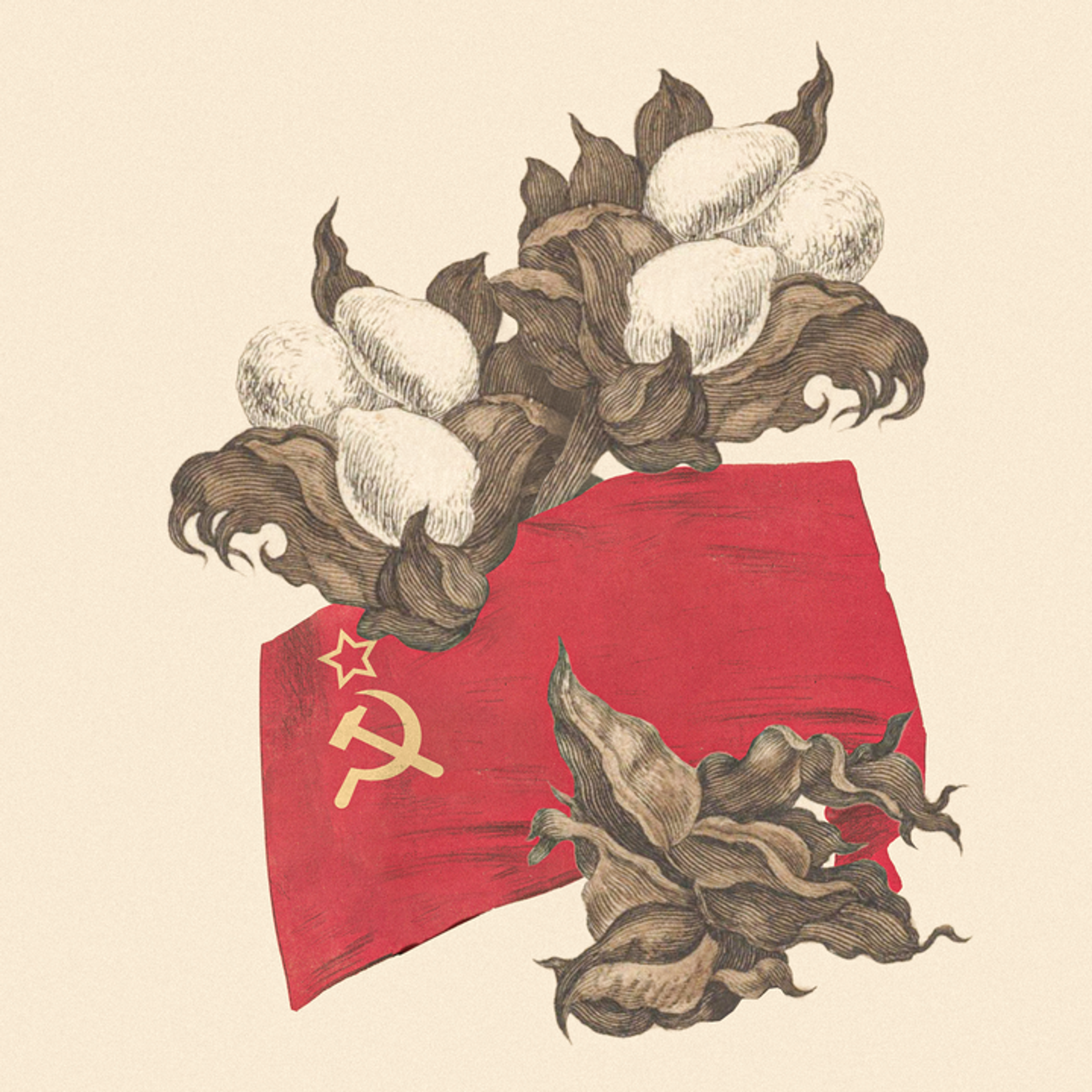
The early Soviet Union transformed vast swaths of Central Asia to grow cotton. They asked for help from American scientists whose ancestors had spent their lives picking it.
At the tail end of the Cold War, a Russian journalist came to interview Joseph Jepthro Roane about his time developing cotton seed strains in a fledgling Soviet Union. During her visit to Roane’s clapboard home in the (coincidentally named) Kremlin, Virginia, she met Roane’s adult son. So the affable journalist asked the middle-aged man—innocently, and unknowingly—for his name.

“‘Joseph Stalin Roane, he said, obviously expecting an amazed (or shocked) reaction,” the journalist Yelena Khanga later wrote in her memoir. “He got it. A friend who accompanied me said the pupils of my eyes widened visibly (and that’s not easy for anyone to see when your eyes are as dark as mine).”
Khanga and the junior Roane both belonged to an incredible lineage, descended from a unique moment in agricultural history. Joseph Stalin Kim Roane was born in Uzbekistan shortly after his father’s arrival to the Central Asian republic alongside a group of fellow Black American experts, enlisted by a newborn Soviet Union to help usher in a new era of Soviet cotton.
Joseph Roane had graduated from the Virginia State College for Negroes with a degree in agronomy in 1931. His timing, let alone his circumstances, could have been better: In Great Depression/Jim Crow America, Black men and women would have struggled to find a job even if they’d carried a PhD and a law degree printed on an American flag. Even “lucky” Black professionals still clocked in through the back door: Vivian Thomas, a pioneer of pediatric cardiac surgery, spent the 1930s doing postdoctoral research at Vanderbilt University, but remained on the books as a janitor.
Knowing this, a Black Communist cotton agronomist by the name of Oliver Golden—along with fellow traveler and activist Lovett Fort-Whiteman—recruited over a dozen Black men and women to sail their way to Leningrad. The Soviet Union, as it turned out, had both 1) a desperate need for agricultural expertise as the Stalinist drive for collective farming took the country by storm, and 2) a burning desire to promote themselves as a classless utopian state, particularly as it came to race.
This campaign did not dabble in subtlety: The entire plot of the 1936 Soviet film Tsirk centered around a white woman fleeing the U.S. because of her interracial child, and ends with her baby being sung lullabies in five different languages before everyone marched together in a May Day parade. But Roane—who later admitted that he didn’t even know what a Communist was, when Golden came to speak at his college—opted to sign up for much less political reasons: He’d just gotten married, and the pay was several times what he could ever find domestically.
A Black Communist cotton agronomist by the name of Oliver Golden recruited over a dozen Black men and women to sail their way to Leningrad.
Golden, Roane, and the others did not arrive in a vacuum: In 1928, the USSR embarked upon their first (of many) Five-Year Plans, which promised to kickstart a workers’ utopia through a whirlwind of rapid industrialization and collective farming. Its goals also included the creation—from more or less whole cloth—of a self-sufficient, Soviet cotton industry.
Many of the local ethnic groups in Uzbekistan did not “cotton” to this Communist vision, burning fields or migrating with their cattle into the inaccessible, remote steppes, or even China. Soviet leadership responded accordingly: deporting Uzbek insurrectionists to labor camps, forcing Azerbaijani herdsmen to work the cotton fields, and prohibiting Turkistani rice cultivation so water could be diverted to the thirsty fiber.
Central Asian exiles and newspapers lamented the importation of foreign expertise that did not understand local context or languages (“not even Russian,” they lamented). The push for Soviet cotton, they felt, doubled as a Trojan horse to disrupt traditional social structure, and assimilate a historically tribal, overwhelmingly Muslim population into the Soviet state. As bureaucrats laid claim to as much land and water as possible to sustain new cotton fields, much of the harvests of consumable crops like wheat and grain found themselves exported. By 1933, Uzbeks experienced widespread starvation.
(Years later, a 1939 propaganda poster would feature Stalin welcoming throngs of adoring Uzbek peasants, thanking him for the creation of a 270-kilometer-long canal for cotton irrigation. The water flowed from the Aral Sea, then one of the largest lakes in the world, but now a salty desert.)
The demands were as steep as the culture shock: On his second day in Tashkent, Roane got lost in a snowstorm and asked directions from an Uzbek man riding a camel and carrying a saber. Still, this surreal frontier life in Uzbekistan provided the group with privileges unlike anything a group of Black scientists may have been afforded in the United States. But even sympathetic visitors like the American poet Langston Hughes—who spent Christmas at the farm in 1932—couldn’t help but look a bit askance at the team’s unlikely “far-off oasis”: “I found the whole collective farm one vast swamp of Asiatic mud,” he wrote with dismay, “in which a man sank almost to his ankles.”
This surreal frontier life in Uzbekistan provided the group with privileges unlike anything a group of Black scientists may have been afforded in the United States.
At one point, Roane contracted malaria, and got reassigned to manage a tomato-canning plant in Soviet Georgia. But eventually, the group developed a quick-maturing hybrid of American and Central Asian cotton, which allowed the crop to grow in between intense local winters. Luckily, they did so just before Stalin’s favorite crackpot biologist, Trofim Lysenko, got put in charge of Soviet agriculture. For scientists schooled in Mendelian genetics, this was likely for the best: Lysenko didn’t believe in genes, and proceeded to have imprisoned or executed any scientists who did.
But this Uzbek slice of paradise—houses, maids, health care, vacations at Crimean resorts—could only stay insulated for so long from the political purges to come, which by the late 1930s turned against the same foreigners that they’d once enticed. By 1937, former recruiter and card-carrying Communist Fort-Whiteman found himself convicted of being a counterrevolutionary, and shipped off to a Siberian gulag. He died there in 1939, a month after his 49th birthday.
Golden, by contrast, managed to evade the secret police sweeps and survived the purges; he became a Soviet citizen, and taught at Uzbek research institutes in Tashkent until dying of heart failure in 1940. But his Polish Jewish wife, Bertha Bialek, did not relish returning to the U.S. with their Soviet-born, mixed-race daughter Lily Golden. Lily’s own daughter would go on to become Roane’s visiting journalist, Yelena Khanga, who published her memoir, Soul to Soul: A Black Russian Jewish Woman’s Search for Her Roots, in 1992.
Other Black Americans navigated the system as best they could: An auto engineer from Detroit, Robert Robinson, kept a low profile while applying for an overseas vacation visa every year (and getting denied each time), until finally managing to reach Uganda in the 1970s and then returning to the U.S. from there.
“In just a few years—you’d be surprised—you could forget what segregation was like.”
Joseph Roane, by his own admission, claimed to have largely believed Soviet propaganda about the guilt of those swept up in the purges, and didn’t himself feel concerned for his safety. Nevertheless, in 1937—shortly after being ordered to adopt Soviet citizenship immediately, and fretting about the fading health of his own mother back home—Roane returned to his Virginia hometown, with a six-year-old Joseph in tow. Roane took a job as a teacher in the area’s first Black public school, earning a wage of $90/month (compared to the $600/month he’d been earning in the USSR). Having only known Russian, the young Joseph spent the next couple of years learning English. The Roanes’ more enduring struggle, however, came from reintegrating back into a country still riven by racial discrimination.
“In just a few years—you’d be surprised—you could forget what segregation was like,” Roane recounted to Khanga. “When Golden spoke at my college, I didn’t believe him when he said there was no segregation in the Soviet Union. Why should I? But it proved to be absolutely true.”
In a sick twist of fate, the Uzbek cotton industry soon replicated many of the same conditions that once oppressed the group’s ancestors. To meet government quotas, Uzbekistan relied on forced labor—including millions of children—well into the 21st Century, until the introduction of sweeping reforms in the 2010s. Textile companies only lifted their boycott on the country in 2022.
History does not repeat itself, but it does rhyme. In 1925, just three years after the USSR’s birth, a Soviet cotton scientist named Alexander Fedotov tried to warn the state about hitching their wagon to a crop with such a troubled legacy: “The beautiful sunny South of the United States suffers from the white plague,” he said. “Cotton, instead of being a blessing, has now become a curse.”
A year before Roane arrived, Fedotov stood trial and was sentenced for crimes against the Russian Revolution.