Artist and researcher Maggie Coblentz fermented miso in orbit, chasing a deeper question: What makes a miso a miso—or a person a person—away from Earth?
Right before Maggie Coblentz’s miso experiment was supposed to launch to the International Space Station (ISS), someone opened the package. It was giving off a smell, and no one handling it realized it was food.
“They were concerned, like, there’s something growing inside your experiment,” Coblentz says. “And I got this urgent call, like, what’s up with your experiment? And they almost didn’t let it on the rocket.” Coblentz had to explain—fast.
“I had to basically give a safety protocol, which I loved. It was almost like an aroma safety protocol that was like, it’s supposed to smell nutty. You might smell a bit acidic, and that’s all within the range of normal, but if you start to smell it more in this direction, then maybe something weird is happening. So, yeah, maybe now on the NASA safety card, they have some tasting notes.”
For four years at MIT’s Media Lab, Coblentz specialized in space food research. “My goal was never to make astronauts healthy,” she says. “I hope they’re healthy, but I also trust that there are professional people who are making sure they get their nutrients. I was having this sideline conversation. Why does food matter? How does space food reflect what humans are eating on Earth?”
What she was really after was a design question: Why is an astronaut fed like a machine? Space food became her way of seeing Earth’s own eating from the outside, a place where “everything is stripped down to the most fundamental thing.”
Industrial Design to Space Food
While Coblentz was getting her master’s in industrial design from the Rhode Island School of Design, a lifelong love of cooking began to feed into her design work (literally). It began, she says, as “this seed of an idea.” School was a chance to stretch her imagination and think about whatever she wanted, “without the prospect of actually having to make work out of it.”
While researching her two-year thesis—a project on space food itself—Coblentz began collaborating with the Space Exploration Initiative at MIT’s Media Lab, a program that unites artists, designers, scientists, and engineers to prototype and fly experiments to space. She stayed on after graduating, and it led to a job there, “very much to my surprise.”
“I was suddenly working in space exploration, next to people who’ve been dreaming about being a space engineer their whole life. That was not my journey,” Coblentz says. “I wasn’t an aspiring astronaut. I just kind of landed in this niche place as a specialist, and then my world opened up.”
What Space Food Actually Is
When people think of space food, they might picture astronaut ice cream, the chalky novelty from museum gift shops. Real space food is closer to camping food. In the past, astronauts relied on canned food, typically shaped like a tuna can but heavier. But because launch costs scale with weight, the freeze-dried kind eventually won out, as it is lighter and longer-lasting.
Space food travels as bricks or sponges of dried matter, rehydrated at a station on the ISS where the water has a startling provenance, reclaimed from human perspiration and urine. “It’s quite an impressive system to recycle and regenerate water,” Coblentz says. “But maybe not so palatable.” You warm the water, rehydrate the pouch, cut it open with scissors, and eat straight from the package.
The menu runs the gamut from scrambled eggs that look like a yellow sponge to chicken teriyaki, chili, and tortillas that double as plates. Bread, with its crumbs, rarely makes the trip. “You can’t have food flyaways in space,” Coblentz says. Crews grow plants, too, though she frames those experiments as being about mental well-being and “the act of caretaking.”
Before a long mission, an astronaut undergoes medical exams and works with a nutritionist, choosing from a fixed set of meals. A few store-bought favorites can come along if they clear approval, though not, say, a case of blueberries. Once everyone is aboard, roles sort themselves out as in any shared house. Someone usually ends up tracking the food and making sure everyone’s getting what they need. Coblentz says it’s less about who signed up for what role and more about how small groups naturally divide labor when they’re living in close quarters for months at a time. “People are people.”
As more countries reach orbit, the menu has widened. The European Space Agency and the cosmonauts keep their own menus; astronauts barter and trade among themselves. NASA’s is the most tightly controlled system, a standardized set of about 200 items, developed, repackaged, and safety-tested in-house at its own food labs.
JAXA’s menu impressed Coblentz most. The Japanese agency even put out a manga-style comic book about its space food, and its lineup ran livelier, with dishes created by outside universities, companies, and student groups—down to items like soy-glazed eel.
The first Korean astronaut flew with kimchi engineered specially for the trip. Because kimchi is a live ferment, Korean scientists spent years and millions of dollars taming it for orbit. They irradiated it to kill the bacteria that give it its tang, cut its smell by up to half, and stabilized it so a sealed bag wouldn’t keep fermenting and burst near the spacecraft’s equipment. Coblentz notes that the significant amount spent to send kimchi into orbit reflects how much a government putting its national dish into orbit is a statement of cultural presence.
Into the Field
Soylent, the meal-replacement drink that caught on in Silicon Valley around 2013, was an early entry point for Coblentz’s research. Its marketing stuck with her: ads of office workers too busy to eat, one of them “an astronaut sitting at a desk typing.” The pitch sold an odd fantasy: people on Earth living on engineered food, as if fresh produce and home cooking weren’t options. The same logic shapes space food, built on military rations that train the astronaut’s body to be “militant” and leave Earth’s food culture behind. Coblentz’s own research pushed the other way. She wasn’t chasing nutrition, which NASA had already covered; she wanted to know whether food could carry culture and identity into orbit rather than stripping them away.
The same instinct eventually pulled her off the desk and into the field. Svalbard is among the northernmost places people live year-round, an archipelago in the Arctic Ocean roughly 1,300 kilometers from the North Pole. Its remoteness suggests bare survival, but Coblentz found the opposite. Svalbard has a well-stocked grocery store, and the research stations, where scientists live and work while doing fieldwork, are fully equipped. The lone explorer surviving in the wilderness is a myth, she says; the reality is communities working together. She has seen it firsthand at Arctic research stations: someone had hauled a raclette maker all the way from France, the Italians filled a suitcase with Parmesan, and others brought coffee from home.
Coblentz wanted to do more than imagine how astronauts ate. “I was writing about it and doing some science experiments, but I couldn’t really put it into practice,” she says, and her work, as an artist and researcher, is “very embodied.” It was in 2021, while still with the Space Exploration Initiative, that she set up the field school on Svalbard, where scientists and artists could live and where she could bake bread, ferment yogurt, make sauces, and watch how it fed back into their work. She was based there until 2023.
One night, over a station dinner, a visiting MIT researcher asked Coblentz whether she planned to write up the evening. She found the question funny. “For me, this is the output. You’re eating. This is the publication, in a way,” she says, while granting the logic behind it: “The academic mindset is, if you didn’t write about it, it didn’t happen.” Letting people ask their own questions in the field makes room “for something that wasn’t coming from you.”
Thirty Days on the ISS
If engineered food promised efficiency, Coblentz’s miso promised the opposite: a set of living questions. Coblentz sent a miso to ferment on the International Space Station, not to feed anyone but to ask what an Earth food becomes when it grows up somewhere else. Most coverage stopped at the finding that miso tastes nuttier in space; she wanted the underlying question.
“Why does it matter that miso tastes nuttier in space?” Coblentz asks. “What does that actually mean for the future of food, or for the future of the human gut microbiome?” To her, fermentation is a relationship: in a sealed habitat, the environment shapes the people, the people shape the environment, and both shape the food. “Everything is shaping one another via microbes,” she says, and in food, that exchange “just happens to express itself through flavor.”
Miso is a living, fermenting food, and getting it to orbit took coordination. Other such foods had already flown to the station completed; this was the first time the fermentation itself occurred in space. The miso flew through Voyager, one of the operators that helps researchers send experiments up, packed into a box about the size of a microwave that MIT engineers had fitted with sensors and a GoPro to photograph the surface and track the mold day by day. Every part had to clear a safety review, the kind that asks “Does it leak? Is it flammable?”
The miso cleared, barely, and launched in March 2020, just before COVID lockdowns.
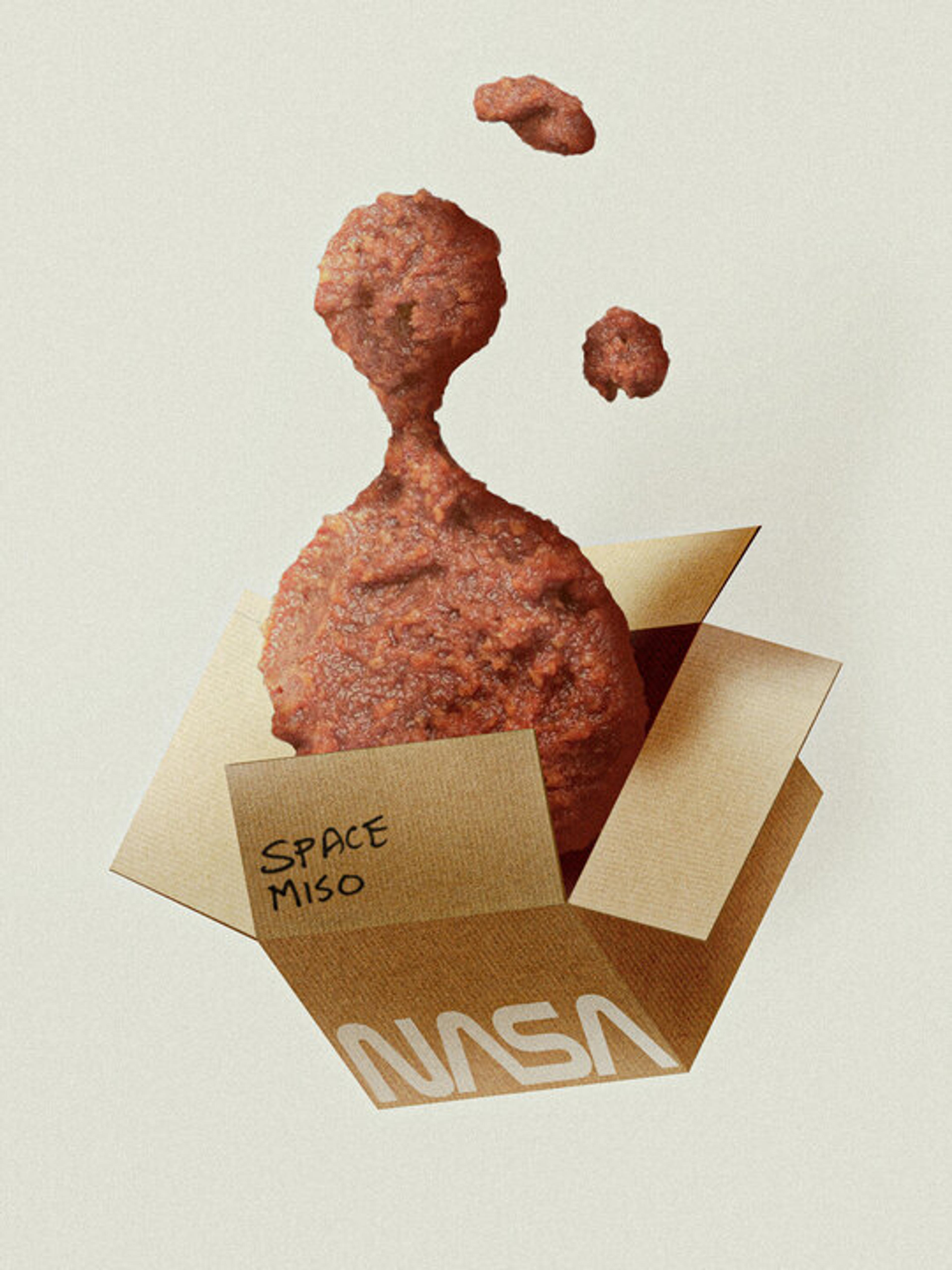
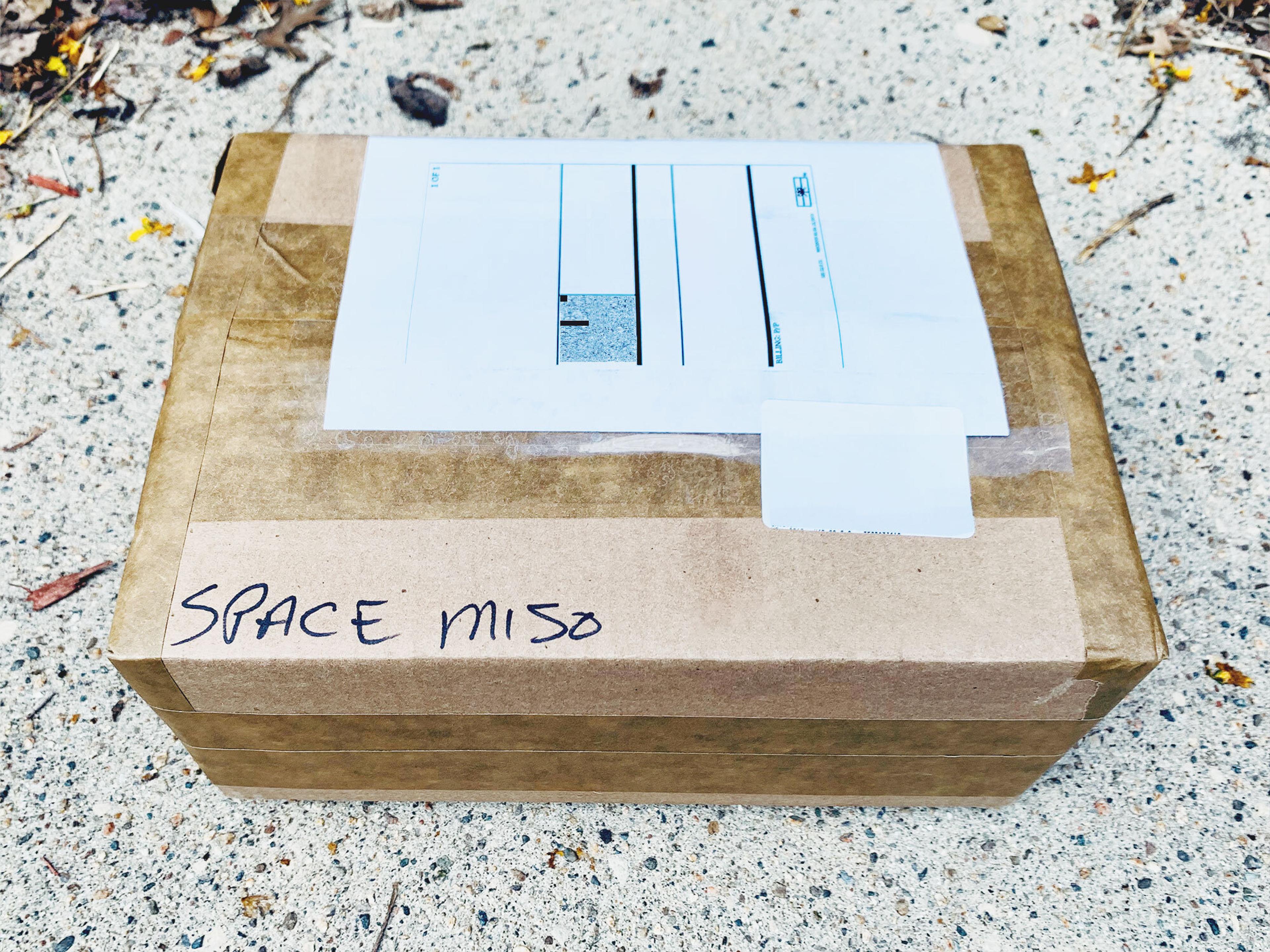
A month later, the capsule splashed down in the Pacific off the coast of California. “They just shipped the space miso right to my house,” Coblentz says. “I have all these photos of this cardboard box on my doorstep. They labeled it with a Sharpie. It just says, ‘Space Miso.’ It was so weird.” The returned sample went into her own freezer alongside her control batch, pint-sized tubs labeled so no one would mistake them for ice cream. Warned by her former boss not to taste the miso until the safety tests were done, she tasted it anyway. “I did, of course,” she says. “I still only have 10 fingers total so far.”
With labs closed due to the pandemic, the formal testing had to wait more than a year. “We definitely lost some scientific integrity along the way,” she says. “That was just the way the world was, but it’s okay.” For her, the value lay elsewhere. When Copenhagen reopened ahead of the U.S., she carried the miso there herself, to the Technical University of Denmark, where she and her co-author Joshua Evans ran the analysis. “I physically brought it with me in a freezer bag. Me and my miso. We go everywhere together.”
Tasting Notes from Orbit
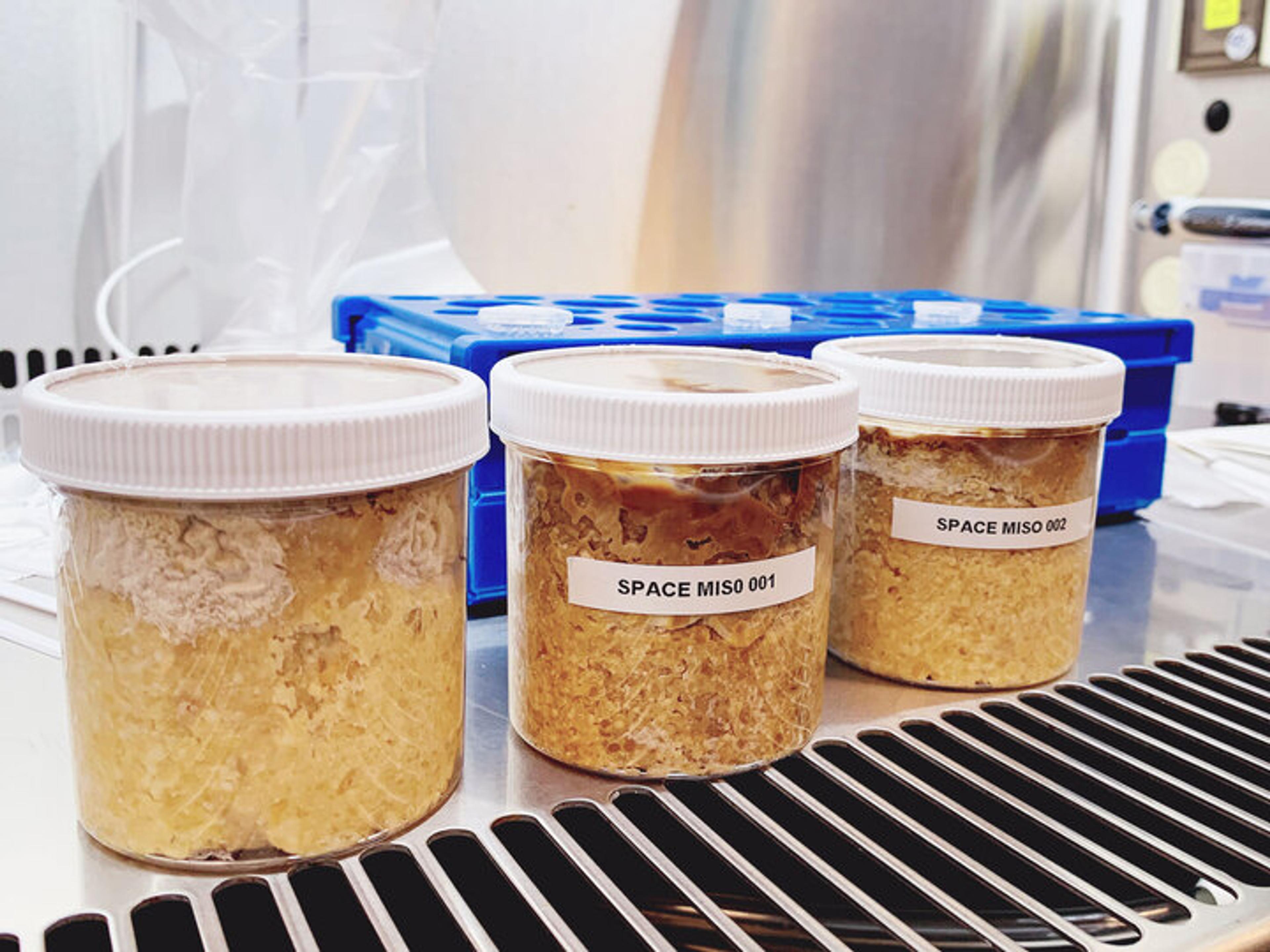
The miso was tasted in two settings, both on Earth. The first was a blind panel: Fourteen tasters, among them miso makers, sensory scientists, and food experts, rated three samples on aroma, texture, and appearance. Two of the misos had fermented on Earth; the third had spent 30 days on the ISS. Flavor molecules alone mean little to a human palate, Coblentz points out, so the panel worked with a shared vocabulary, as in a wine tasting.
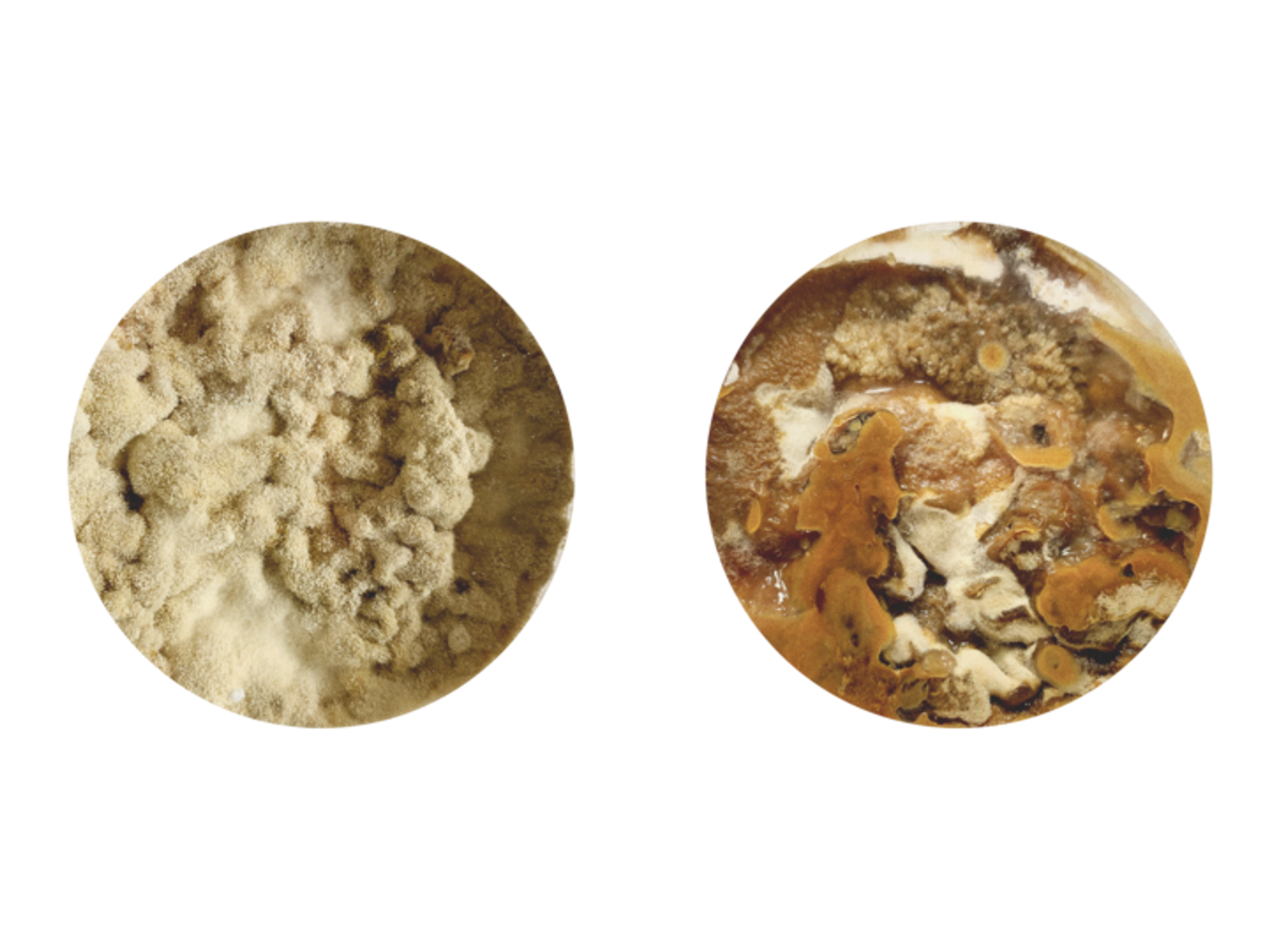
Recognizably, the space miso was still a miso. The lab’s one safety flag was a faint trace of Staphylococcus aureus, a bacterium behind some food poisoning. But it was in the top layer, which is removed and discarded before eating anyway. Everything below came back clean, indicating it was safe to eat. The miso had matured faster in orbit and had come out nuttier and earthier than its earthbound controls. The sensing box ran hot, around 36 degrees Celsius, against roughly 20 degrees Celsius for the Earth jars, because it sat wedged among heat-generating equipment. The warmth sped the fermentation, and the Maillard browning that darkened the sample pushed it toward those roasted notes.
When a Japanese newspaper asked a miso authority about the experiment, he was skeptical: It couldn’t really be miso, he said, any more than sparkling wine can be champagne if it isn’t from Champagne. Miso needs the essential microbes that “make miso, miso,” and he argued that those are found only in Japan. Then he read the study. The space sample carried the microbes that matter, he conceded, so it was still a miso, just slightly different.
In a second setting, a dinner hosted by the research team in Denmark, chef Kim Wejendorp built a menu around the misos, each course its own ritual. Guests arrived to a bowl of miso soup made with the space sample, sipped in silence to consider what it means to eat something fermented at the edge of human travel. Another course grilled a Copenhagen control miso soba-shop style, called yakimiso, with green onion, buckwheat, yuzu, and walnut. Another came entirely from dried ingredients, rehydrated and reassembled, a nod to how astronauts actually eat. The meal closed with miso encased in shells of dark chocolate, painted to look like the stars it had just traveled through.
The Question, Not the Answer
Coblentz now works in the Science division at the National Geographic Society, helping shape their new space work. On the side, she takes on projects and collaborations related to food and the emerging field of gastronomy. “Food is anthropology, food is culture, food is science,” she says.
The work, for her, is to “ask more questions and have more inputs and have more fun and be intuitive and creative, which is really hard in such rigorous environments.” Fermentation experimentation became a central thread because it resists control. Miso is free to “follow its own natural process in space.”
Diets imposed on people, disconnected from what their bodies and cultures have historically eaten, can erase generations of food history, “reshaping people from the gut out.“ The same question follows into orbit. “Even though today it’s just a group of maybe six or so astronauts in space, what does that look like for the future?” While Coblentz doesn’t think humanity’s future lies in space, others are working toward it regardless, which leaves the question hanging: “What does it mean to be designing a person’s gut and a person’s entire body through how we’re growing food and growing people?”
Coblentz reaches for a word from wine, where the grape influences flavor. “So, what is the space terroir? What does food naturally taste like in space?” Her study took the question literally, teasing apart what orbit itself does to a ferment from the heat of the equipment and the jostling of the trip. “We don’t just have to send premade packages to space or grow a tiny green thing in the space station. Rather, what does it mean to ferment and use these slower processes?”
The ISS is nearing the end of its life, with new stations on the way, some bound for the lunar surface, while commercial spaceflight is moving fast. Coblentz expects all of this to bring change, though space tourism holds no interest for her. Food, to her, is “a huge enabler of being able to be present.” Someone raised on a vegetarian diet would sicken on a diet of nothing but meat, and the same could happen to anyone after six months of food unfamiliar to their body. “It will be interesting to see how space agencies can facilitate more dietary options to enable more people.”
“I’m satisfied enough asking a question,” Coblentz says. “Sometimes I just want to leave people with a question, so they can sit with it and reflect.” This is, she thinks, the role of art.