The paniolo predate the Wild West’s cattle wranglers — they continue their practices to this day.
It was never a question for DeeDee Keakealani Bertelmann whether she’d grow up to be a cowgirl. As a fifth-generation paniolo, or Hawaiian cowboy, it’s in her blood.
“It is literally a family endeavor, family journey, family lifestyle,” Bertelmann, 55, said. “It’s not, like, a trend. It’s our life. And for some of us, it’s all we know.”
Before the U.S. was home to its famous Wild West cowboys in the post-Civil War era, the Kingdom of Hawai‘i had paniolo powering its beef industry. And even today, paniolo drive cattle like their forefathers did, with their styles and techniques on display at local rodeos.
They’re also making a splash more recently in contemporary Hawaiian culture, with a burgeoning influence on island fashion, though some paniolo remain protective of their longstanding way of life. They’ve found their livelihoods are increasingly endangered in Moloka‘i especially, where a government-imposed quarantine to prevent bovine tuberculosis threatens the sector’s continuity.
And to think, the industry all started with a gift.
Captain George Vancouver, an English naval officer, introduced cattle to the Hawaiian islands in 1793 as a tribute to King Kamehameha l, according to the Hawai‘i Cattlemen’s Council. The Hawaiian ruler forbade anyone from hunting the animals. Because cattle aren’t endemic to Hawai‘i, they were not an agricultural product at that point. However, they multiplied to around 25,000 by the mid-19th century and became an unruly problem, wreaking havoc on the ecosystem.
In the 1830s, King Kamehameha III invited three Mexican vaqueros, or horsemen, from California to teach Hawaiians how to tame wild cattle and ride horses — in other words, “how to do things cowboy,” Bertelmann said. But while vaqueros and paniolo share similarities, such as saddles and braided rawhide, Kānaka Maoli (Native Hawaiians) ultimately developed and adopted their own identity.
King Kamehameha III invited three Mexican vaqueros, or horsemen, from California to teach Hawaiians how to tame wild cattle and ride horses — in other words, “how to do things cowboy.”
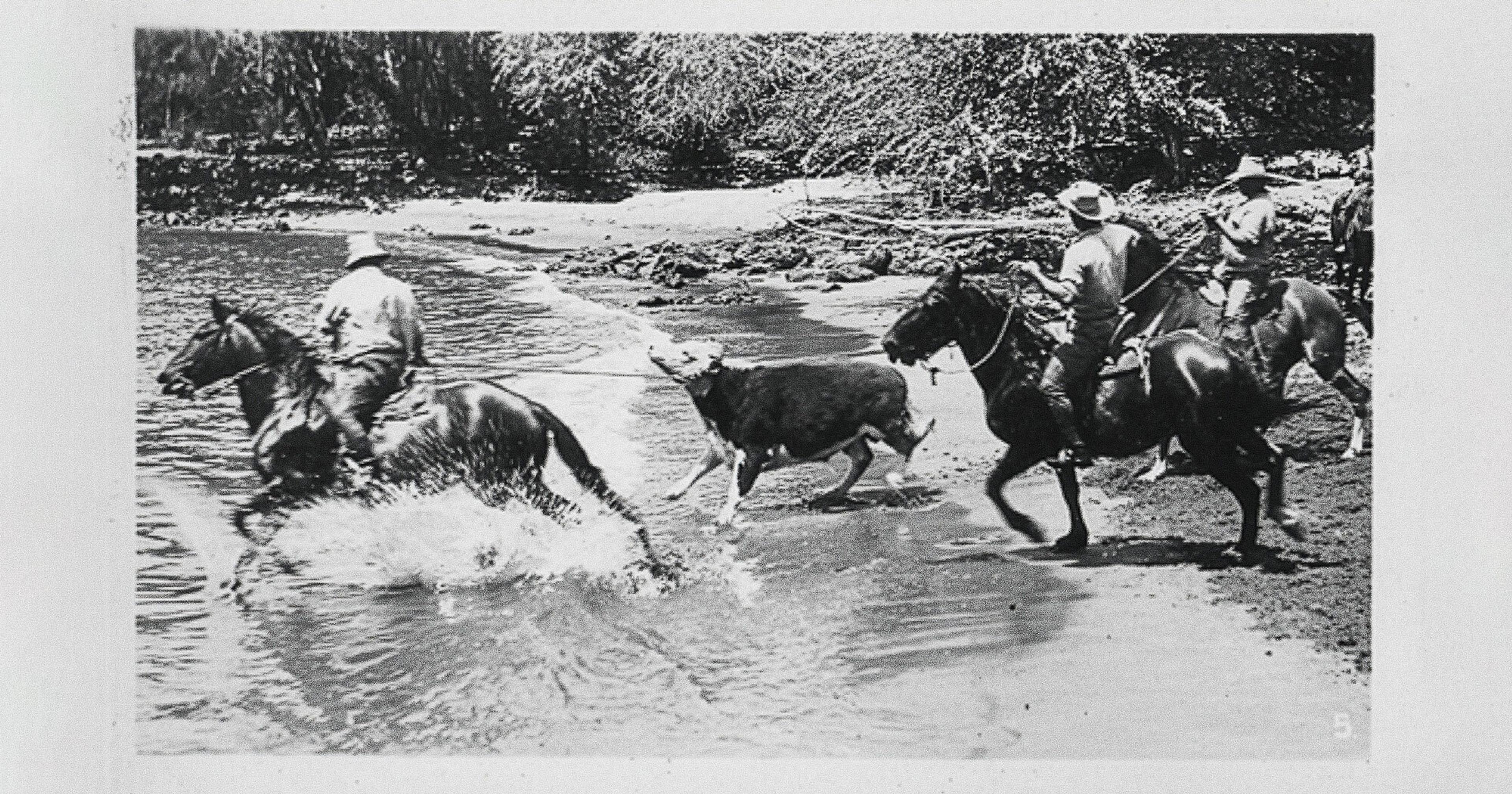
For instance, “Hawaiian ranching originally involved driving wild cattle into pits dug in the forest floor,” according to the National Park Service. “Once tamed (somewhat) by hunger and thirst, they were hauled up a steep ramp, tied by their horns to the horns of a domesticated, older steer which was tractable and could be led to a fenced-in area.”
American sailor John Palmer Parker, who wed King Kamehameha I’s granddaughter Kipikāne, founded a cattle ranch in Waimea in 1847. It’s operated continuously since then, though the ranch leased land to the U.S. military for training during World War II in 1943, per its website. Its ownership has changed hands over time. Today, Parker Ranch calls itself “one of the oldest and most renowned cattle ranches in the United States.”
Bertelmann watched her family’s Kānaka Maoli patriarchs shape Parker Ranch and other storied ranches on Hawai‘i Island. Her grandfather, Robert Lopaka Keakealani, started at Pu‘uwa‘awa‘a Ranch as a teenage “dairy boy” and became a sought-after horse trainer. He was inducted into the Paniolo Hall of Fame in 2003. The nonprofit explained that the distinction is bestowed upon paniolo “who have contributed to keeping Hawai‘i’s paniolo heritage alive, and to honor those who made the paniolo culture legendary.”
The elder Robert raised his son, Robert Kamuela “Sonny” Keakealani, Jr., in the same fashion. Sonny wore several hats at Pu‘uwa‘awa‘a Ranch, working as a ranch hand, straw boss, and foreman, before moving to Parker Ranch. He also has his place in the Paniolo Hall of Fame.
His daughter, Bertelmann, recalls childhood summers spent saddling her horse and working alongside seasoned Parker Ranch paniolo. Now, she serves as its livestock administrator. Bertelmann and her husband Kamuela also manage their own ranch lands. They raise crossbred Angus cattle — around 300 head — in Puʻuanahulu and Waimea, using her grandfather’s brand RK Livestock, and sell to a cattle broker.
“Hawaiian ranching originally involved driving wild cattle into pits dug in the forest floor.”
But ranching, especially on Hawai‘i, is far from easy. The islands are struggling with a water crisis exacerbated by climate change and the demands of the tourism industry. “We live in a place where water is very scarce and very expensive,” Bertelmann said. A broken water line or a dead goat contaminating the source could spell major trouble for her operations.
Then there are the hurdles of securing land leases and satisfying monthly fees. Bertelmann explained that it can be difficult for state and private landowners alike to acquire land leases for raising cattle. While most ranchers practice pasture rotation, she conceded that some don’t, which can lead to overgrazing. As a result, paniolo have to fight the stigma that cattle negatively impact the land.
“Today, a lot of people want to live the cowboy lifestyle,” Bertelmann said. “But it’s a lot of hard work. It’s a lot of time.”
Now, she’s focused on passing the paniolo ways — including speaking ‘ōlelo Hawai‘i (Hawaiian language) while driving cattle — onto her grandsons, ages 11 and 4. Hawaiian cowboy culture is also kept alive through rodeos like the Panaʻewa Stampede Rodeo.
This year’s rodeo, which took place on February 14 and 15 in Hilo, includes classic events, such as barrel racing, team roping and riding bulls, calves, sheep, and more. But a Hawaiian rodeo wouldn’t be complete without a few paniolo-specific events: po‘o wai u, a technique used to round up wild cattle by lassoing and tying them to trees, and double mugging, an act that takes two paniolo “to rope and knock a cow to the ground and tie up three of its legs,” according to nonprofit Hawai‘i Horse Owners, Inc.
As president of Hawai‘i Horse Owners, Robert Sanborn helps put on the rodeo. “We use rodeos as a way to showcase what we do as paniolos,” he said. “Just to keep the Hawaiian culture alive in all aspects.” Among his ancestors are Norwegian whalers who married Kānaka Maoli women. They once ran one of the largest horse ranches on the island.
“Grandpa had to leave the ranch just to survive and make money and get a job in town,” Sanborn said. His ‘ohana (family) resettled in Hilo, but they continued to frequent the ranch in ʻŌʻōkala to break horses and brand animals.
“For us here, it’s part of our culture. There’s other families here on the island that really, really hold onto that.”
In his youth, Sanborn was introduced to paniolo practices by a neighbor, who let him ride his horses and brought him along to work the ranches. His grandfather bought him his first horse. “For us here, it’s part of our culture,” Sanborn said. “There’s other families here on the island that really, really hold onto that.”
Paniolo ways continue to evolve. Technology has changed how cowboys manage herds and pastures, and the cost of essentials like diesel and fertilizer has risen, Sanborn said. But he’s confident that the lifestyle’s most important aspects will withstand the test of time.
“We raise our kids that way. We’re brought up that way,” Sanborn said. “It’s just taking care of the land, taking care of the animals — you know, that’s what it’s all about.”
Paniolo culture is also living on through island fashion. Northwest of Hawai‘i Island, on neighboring Maui, Victor Pula, 44, is paying homage to his Kānaka Maoli kūpuna (ancestors) with his hat-shaping business, Uncle Vic’s Maui. “Hawai‘i had cowboys before the Western cowboys ever existed,” he said.
While Pula’s great-great grandfather worked as a rancher at Kaupo Ranch, Pula is clear that he’s not a cowboy. Still, growing up in Hāna, he rode horses, and, a few years ago, he felt called to reconnect with those roots. “Being Kānaka, we have that,” Pula said. “It’s in our blood.”
One problem: He couldn’t find custom cowboy hats on Maui. “How come I’m struggling to find a store or some place to get a hat,” Pula said, “knowing the paniolo history in Hawai‘i is strong, the community is strong here.”
He decided to fill that void. Pula taught himself how to shape hats, then, in 2023, he ordered his first 50 open crown, or unshaped, hats from manufacturer Master Hatters of Texas. However, once the shipment was ready, disaster struck in the form of the Lāhainā wildfire. The order sat in limbo for months until Pula felt the time was right.
Finally, Uncle Vic’s Maui was born.
“It’s just taking care of the land, taking care of the animals — you know, that’s what it’s all about.”
Pula initially took hat-shaping appointments in the kitchen and garage of his family home at night after his regular workday ended. By 2024, he expanded his operations to a warehouse, with the help of fellow hatter Jayden Kuhaulua, his daughter’s partner. They both committed to the business full-time — and “it blew up” from there, Pula said.
He credits that popularity to the mainstream revival of cowboy culture, pointing to examples like Maui’s country reggae artist Maoli and the TV series Yellowstone. Pula wants the paniolo way of life to stick around — and he wants to teach the art of hat-shaping to others, so it isn’t lost in Hawai‘i again.
“I do feel like it’s a full circle, but I don’t feel like it’s completed,” Pula said. “When you get something, you give back something.”
Author’s note: Writer Megan Ulu-Lani Boyanton identifies as Kanaka Maoli.