When plant breeders get down to work, they’re often negotiating the complex intricacies of nature. Put simply, changing one trait often shifts another.
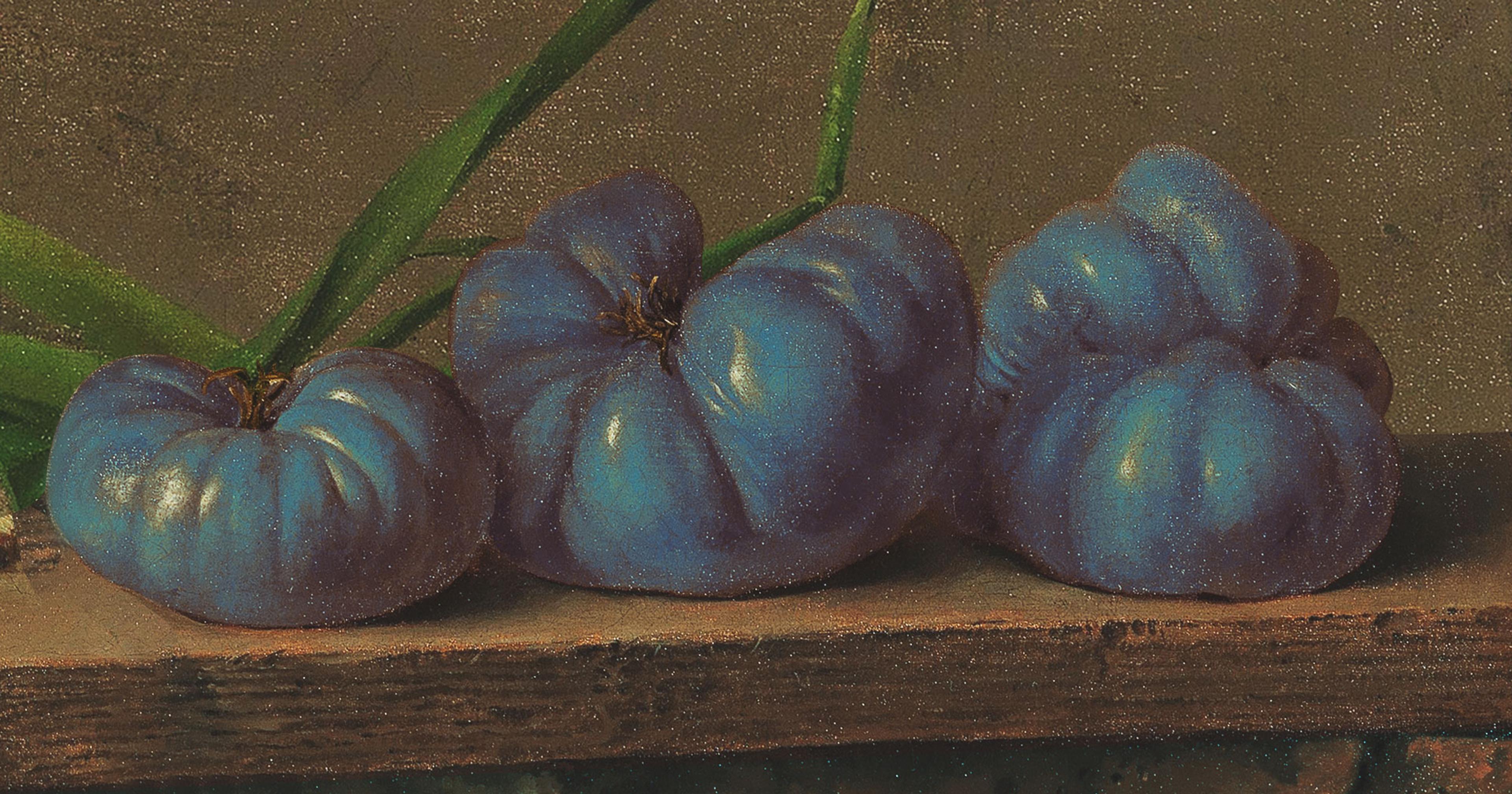
Bradley Gates spent years trying to grow a tasty blueish-purple tomato. He selected for anthocyanin expression in the skin to get the color. And it was beautiful. But the result was gag-inducing.
“It was disgusting, not even edible,” he said. “And there’s too many nice-looking tomatoes that taste like crap already in the world.”
This was just one of many breeding projects Gates has taken on in the past 30 years. As the owner of Wild Boar Farms in Suisun Valley, Calif., he’s become known for breeding heirloom tomatoes into outrageous, delicious varieties spanning rainbow colors, with names like Berkeley Tie-Dye and Porkchop.
Breeding, for him, is less about chasing perfection than navigating trade-offs. Boost flavor, and yield may drop. Improve production, and plants may become more prone to infection. It’s a biological quid pro quo, but Gates tinkers relentlessly, sometimes going back generations to correct a trait.
“It’s an ongoing battle,” he said.
Gates’ fellow breeders know this battle all too well. Evolution is in a constant tug-of-war with competing demands. Growth versus defense. Speed versus durability. Reproduction versus survival. Some of the clearest trade-offs show up early in a plant’s life. For example, across plants and insects, the youngest stages are usually the most vulnerable to infection. Evolutionary biologists call this a “window of susceptibility.” As a survival strategy, this might seem counterintuitive. If an organism dies young, it never reproduces. But research reveals that natural selection is a negotiation process, a series of compromises that plants — and the breeders who tinker with them — can’t avoid.
“You’re trying to maximize the production of a plant, maximize the flavor, the looks of the plant, and then also maximizing for size or disease tolerance,” Gates said. “So it’s not one major obstacle. But there’s small walls in the way that you’re trying to jump over or maybe build a gate in the wall, so to speak.”
The Cost of Resistance
Researchers at the University of Maryland have an answer to why these trade-offs exist. In a 2025 study, a UMD team discovered that plant families which invested heavily in disease resistance as seedlings produced fewer flowers and fruits later on. Basically, putting resources into defense early in life came at a reproductive cost.
Seedling infections are quite damaging, but the vulnerable period is brief and the chances of exposure are low, especially in populations with highly resistant adults, according to study co-author Emily Bruns, an assistant professor of biology at UMD.
“For a small seedling, it’s like being in a big room with one guy sneezing,” Bruns said. “There’s a small chance you might encounter it, but ultimately the cost of resistance is not worth it.”
“If you take enough chances, get lucky and work hard, you can get that magic genetic lineup that will give you what you want.”
The team tested 45 genetic variations of a wild plant called Silene latifolia (white campion), measuring resistance to a fungal disease called anther-smut, which Bruns describes as a “plant STD.” The results were consistent: Strong seedling resistance is costly, so plants are better off staying vulnerable early on and growing into resistant adults. But this evolutionary maintenance of susceptibility in the host allows the disease to persist, Bruns added.
Breeders cannot eliminate this trade-off, so they work around it. For Gates, that means playing the numbers game. He grows thousands of plants, keeping seeds from the ones that survive disease, produce well, and still taste good.
“If you take enough chances, get lucky and work hard, you can get that magic genetic lineup that will give you what you want,” he said. “Because really, when you’re growing plants, everything about disease tolerance, the looks, the color, the flavor, the habitat of the plant — that’s really all written into the DNA of the seed.”
Complicated Genetics
Modern genetics helps explain why many breeding trade-offs persist, but it also highlights why they’re so difficult to escape, said Logan B. Smith, associate professor of animal science and agricultural genetics at Chico State.
Research shows that no fixed percentage of a plant’s final performance is determined or “locked in” at the seed stage. Instead, scientists use statistical probabilities. Early development involves rapid cell division, but yield later in life is shaped by environmental cues, stress, and resource limits. Even when specific genes are identified, traits don’t always show up consistently in breeding programs.
Modern genetics helps explain why many breeding trade-offs persist, but it also highlights why they’re so difficult to escape.
“Just because a gene is present doesn’t mean that it will be abundantly or consistently expressed,” Smith said.
An early theory of genetics focused on a relatively simple chain: DNA makes RNA, RNA makes protein, protein produces a trait. That framework stands, but it now sits within a more complex system. Traits can be influenced by epigenetic changes, regulatory RNA that doesn’t code for proteins, and polygenic effects, where more than one gene contributes to a trait.
“Humbly, we don’t know a lot about trait variation causes,” Smith said. “Traditionally, science uses a reductionist approach to simplify and minimize confounding variables. Thankfully, a holistic ‘systems’ approach is becoming more popular.”
Hybrid Hacks
One way breeders try to stack the odds in their favor is by making hybrids, crossing two inbred varieties to produce a heterozygous seed that combines traits from both parents. As a result, they get what’s known as hybrid vigor, where the offspring outperforms the parents with benefits such as higher yields, more consistency, and a greater stress tolerance.
But again, there’s a catch: The advantage usually lasts only one generation. Seeds saved from hybrid plants don’t reliably reproduce the same traits, forcing farmers to buy new seed each season.
New approaches aim to extend those benefits. One project underway for crops such as rice, sorghum, and cowpea involves engineering plants to reproduce clonally, which means producing seeds that are genetic copies of the parent plant instead of the result of sexual reproduction. The idea is that this method could allow farmers, particularly smallholders in Africa, to retain hybrid advantages year after year without additional inputs.
Seeds saved from hybrid plants don’t reliably reproduce the same traits, forcing farmers to buy new seed each season.
“Clonal [reproduction] means the progeny looks exactly like the parental plant,” said Luca Comai, distinguished professor of plant biology at the Genome Center at UC Davis. “That would preserve the hybridity and enable these farmers to have high yield increases of 30, 40, maybe 50 percent.”
Even if breeding systems preserve the parental genome, hidden constraints still limit how consistently high-performing plants thrive in the field. Hossein Zakeri, associate professor of plant science at Chico State, and Kyle Brasier, legume researcher and instructor, highlighted these trade-offs in pea cultivars crossed with nodulation mutants. Their 2025 paper reported that selecting for enhanced root traits and nitrogen-fixing nodules often came at the expense of above-ground biomass.
“To put this into perspective, increasing grain size seems like a very promising approach to improve yield,” Zakeri said, “but such changes often result in fewer grains per plant because plants have a limited carbohydrate supply.”
Hidden constraints still limit how consistently high-performing plants thrive in the field.
In recent work, Comai and his colleagues showed that mutations in plants aren’t evenly distributed. Outer tissue layers mutate more, designed for rapid adaptation. Inner layers remain stable, built to protect lineage. When breeders cross elite varieties with wild relatives to add disease resistance, unwanted traits might hitch a ride, Comai said. This is called “linkage drag.”
Gene-editing tools like CRISPR point to the possibility of bypassing the trade-offs breeders often bump up against. Scientists can tweak specific genes to improve flavor, yield or disease resistance while leaving unwanted traits behind. The reality is much more complex. Different species require different methods to deliver CRISPR machinery into cells. And reliable methods don’t yet exist for many staples, such as legumes, grains, and root vegetables. Even successful edits face biological hurdles. Plants must be regenerated from tissue culture, a slow and inconsistent process. On top of that, global regulations vary, so even a lab-grown, fully edited success may not be legally sold or planted somewhere else.
“CRISPR, in theory, will work,” Comai said, “but delivering it, manipulating it, and getting all the right things to line up — it’s not simple.”
The Next Generation
At UC Davis, E. Charles Brummer, director of the Plant Breeding Center, teaches students to expect limits and trade-offs long before they encounter them in the field.
Some are basic math. For example, seed oil and protein content compete for the same resources. Oil requires more energy to produce than protein, and nitrogen, sunlight, and photosynthesis impose hard ceilings.
“In alfalfa, there’s a trade-off between winter survival and productivity in autumn,” he said, “and you can only push it so far. You can get plants that grow like mad through autumn, but as soon as they get hammered with a freeze, they’ll probably die.”
Understanding these constraints shapes how Brummer runs the SCOPE breeding program. When he launched it a decade ago, one goal was to give students hands-on experience dealing with those trade-offs: making crosses, running field trials, and seeing firsthand how gains in one trait can come at the expense of another. The program has worked with a variety of crops, including zinnias, tomatoes, wheat, peppers, and spinach.
“Typically, what I’ve found is Mother Nature will have more surprises than you knew of.”
“Some crops grow over winter, some are just in the summer, different fruits or flowers or grain,” Brummer said. “It gives students a variety of crops to look at and what the different breeding goals and methods and how stuff might be with different species.”
This is why Gates, with his wild world of unique tomatoes, doesn’t see breeding as something to master so much as work with. He knows who’s ultimately in charge.
“Typically, what I’ve found is Mother Nature will have more surprises and a lot of different variants that you never knew of, and more surprises than you knew of,” Gates said. “I think she constantly reintroduces new things, new traits. That’s at least like what I’ve found through experience.”