The strange reproductive science behind the invention of modern corn.
A few years back I started joining the New Haven Road Runners for a weekly Wednesday run. The 5k route took us through East Rock Park, past colorful Victorian homes rented by Yale graduate students and professors, over a bridge, and behind the tiny Connecticut Agricultural Experiment Station. Each time I wondered idly what could possibly be growing on such a miniscule plot of land in one of New England’s classic post-industrial cities.

It turns out, as I learned last spring from a Yale archaeologist, that this was the site of a discovery made in 1918 that revolutionized American agriculture—the corn double hybrid cross. Today, 95% of the corn planted on U.S. farms is hybrid corn, and the innovations made in Connecticut set the stage for later advances: everything from patented genetically modified seeds to bio-ethanol production.
The corn we know and love didn’t happen without a whole lot of human tinkering, and some of it was, well, sexy. Those endless rows of erect stalks, militantly populating the Midwest in waves of orderly glory, heavy with juicy, herbicide-resistant kernels, aren’t the result of some happy evolutionary accident. Corn as it exists today is a human creation: a miracle of scientific progress (or a freak of nature, as others would have it).
It wouldn’t exist without Donald F. Jones, a young scientist in Connecticut who realized that by crossing two hybrid strains he could elegantly solve a simple problem: how to grow more corn on less land. His seeds were easy to produce and gave ears with enormous yields. Most important of all, the magical seeds would not reproduce the following spring (or rather, what they produced was no longer the desired variety). It was the plant equivalent of a patent, and seed companies loved it—and still love it.
Of course, this breakthrough took more than gentle coaxing. Corn had to be forced to inbreed by manual pollination, its male tassel snapped off to render the plants sterile, female silks protected in glassine bags. Corn sex had to be manipulated with a Victorian rigor and a disregard for anything we might call “natural.”
Humans have had their fingers in corn’s biology for at least the last 9,000 years, but never like this. Born from a wild grass in the highlands of Central America, corn was worshipped in various forms as a god by the Maya. The Aztecs, who performed human sacrifices to their maize gods on blood-soaked pyramids, would certainly have thought twice before snipping off corn tassels. Early 20th century America, on the other hand, worshipped scientific progress. Corn needed to bow to a new god.
Humans have had their fingers in corn’s biology for at least the last 9,000 years, but never like this.
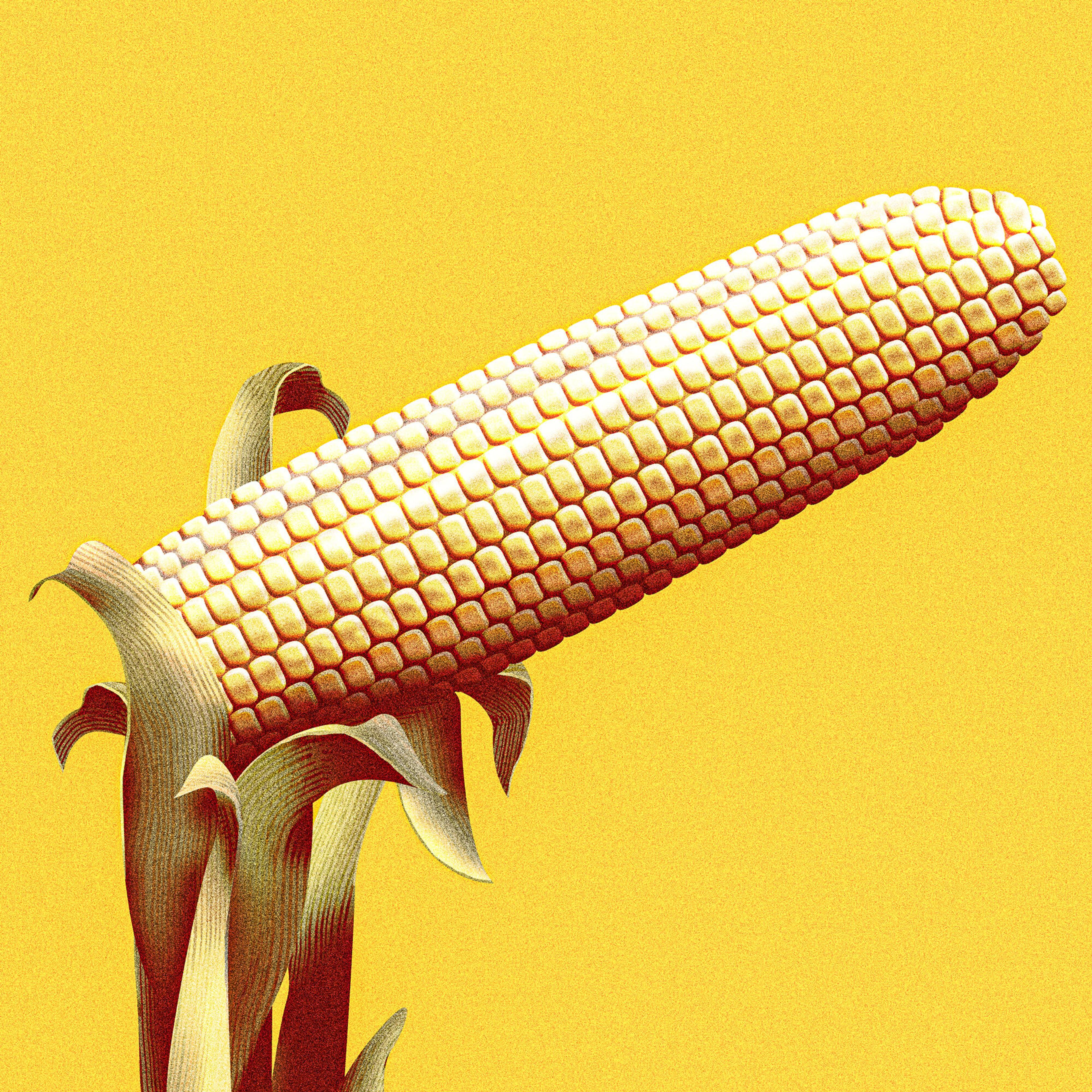
In theory, the mechanics of corn reproduction are relatively straightforward. Imagine a cornfield in spring. At the top of each stalk is a brownish feathery tassel—that’s the male part of the plant. Along the stalk are small, tightly wrapped ears full of “silks”: Those are the female parts. [can we get an illustration for this please?] Pollen from the male tassel lands on the female silks and given some sun and a little time, creates the kernels on the cob.
“Maize is self-fertilized and wind-pollinated,” writes Michael Pollan in The Omnivore’s Dilemma, “terms that don’t begin to describe the beauty and wonder of corn sex.” I’m not so sure about beauty, but there’s plenty to wonder at. In any given field, wind will blow pollen from the male flower of one stalk to the female silks of its neighbors, which peek out of the future cobs to catch what drifts by. Because of this quirk, corn (unlike wheat or rice or quinoa) kept receiving new genetic material from its neighbors. Even in the Inca and Aztec Empires, corn was always changing, like a half-wild dog that keeps wandering away to breed with a passing wolf pack. But here was also its strength—corn was endlessly adaptable, like a coyote, spreading all the way up the North American coast long before European settlers arrived in the New World.
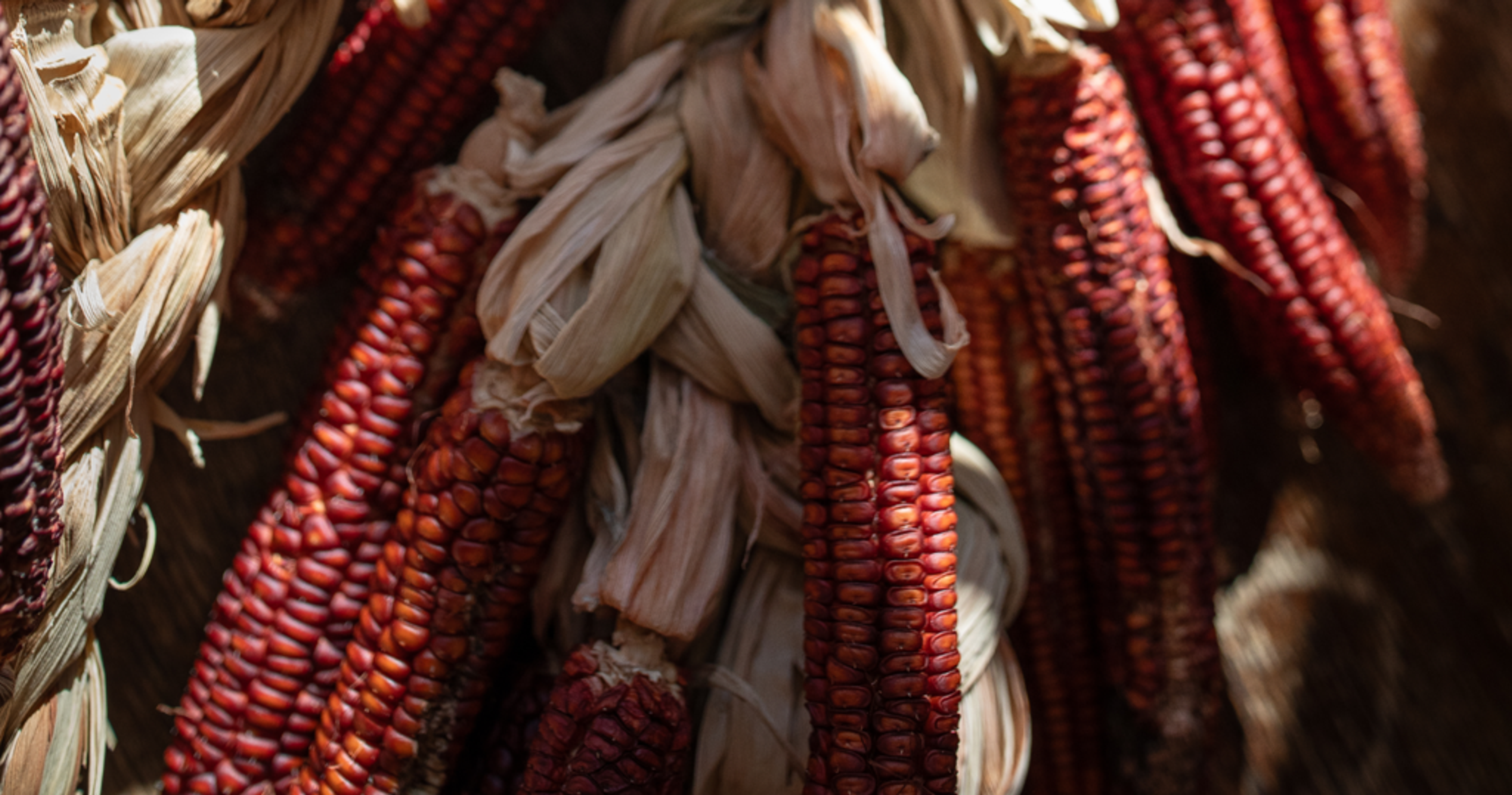
Like its Central American ancestor, a wild grass called teosinte, corn cross-pollinates. Unlike teosinte, though, corn anatomy is uniquely suited to human intervention in its reproductive process. In fact, the latest research indicates that the efforts of Indigenous farmers for over 9,000 years were directed specifically towards making maize reproduction easier to control, by moving the male and female organs onto separate parts of the plant. That’s how corn ended up with a male tassel up top and female ears of corn down below (on most grasses—think of wheat—everything is combined into a single seedhead up top). But genetically speaking, corn always had the last laugh. Multicolored “Indian corn” was evidence of corn’s chaotic and playful nature.
Fast forward to the 20th century. The behavior Pollan calls “free corn sex” was a big problem for American agriculture. Corn was too unpredictable. And, like Henry Ford, American farmers at the turn of the century valued uniformity. Early efforts focused on selecting the best seeds, a process that was slowly gaining ground, but not fast enough for seed companies.
Enter Donald F. Jones, a young graduate student from Kansas, who grew up at the turn of the 20th Century, tinkering in his parents’ garden. The outgoing director of the Connecticut Agricultural Experiment Station, noticed Jones as a Harvard graduate student in applied biology and convinced him to move to Connecticut to take charge of the corn breeding program there.
In a way, the history of corn sex in the 20th century is sort of like the sexual revolution in reverse.
The goal, as Jones learned when he arrived, was simple. Connecticut’s dairy industry needed more corn, but New England was running out of land. This meant more corn needed to be grown on fewer acres. Jones’ job was to figure out how to make corn more productive than ever before.
Scientists at the station had already figured out how to circumvent corn’s freedom-loving nature, tricking their corn plants into producing bigger and bigger kernels. The first step was to get a plant to inbreed, making sure its pollen landed on its own silks. This usually resulted in bizarre, stunted, weedy-looking plants. But there was a hidden purpose to the madness.
Crossing two inbred parents made a whole that was greater than the sum of its parts: a healthy, towering specimen with bigger kernels than even its grandparents had. Manual pollination was the secret method that Jones and his colleagues practiced, day after day. Since corn plants are willing to breed with anyone and everyone, designating two specific plants to cross with each other was hard work. This involved removing the male tassel from the plant about to be bred, or, as the Harvard geneticist Paul Mangelsdorf referred to it, “emasculation” of the corn plant. The female silks of the same plant had to be gently dressed in translucent glassine bags (called “shoot bags”) for protection. A paper bag wrapped around a neighboring “male” plant collected pollen, which researchers sprinkled the next morning on their chosen candidate (after removing the shoot bags, of course).
Jones quietly kept his predecessors’ experiments going. He snapped off tassels, put on shoot bags, and collected pollen. Then, three years in, he made his move. It was a discovery as simple as it was momentous. As Mangelsdorf later wrote, it ought to have earned him the Nobel prize in Agriculture, if one existed. Two inbred parents of a variety called Chester’s Leaming had produced a high yielding plant. Two inbred strains of Burr White had given another marvel. Neither variety was commercially viable.
Jones simply took the two crosses and crossed them again: the double cross. This hybrid of hybrids was as vigorous as the parents, a majestic plant with big golden kernels. Since the parents (Burr and Chester) had plenty of seed and were easy to grow, it was now possible for seed companies to cheaply manufacture new varieties. Most crucially of all, the double cross hybrid produced seeds that would not reproduce the same plant again. This was a defect with enormous potential. Farmers who wanted the superior plant would have to buy new seed every spring: a seed company’s dream come true.
Farmers who wanted the superior plant would have to buy new seed every spring: a seed company’s dream come true.
In a way, the history of corn sex in the 20th century is sort of like the sexual revolution in reverse. Scientists took polyamorous, freedom-loving corn, and turned the plant into a buttoned-up Victorian. Marriage between male tassels and female silks was arranged by experts. Emasculated and robbed of its tassel, no longer free to choose its lover, corn was forced to inbreed into a kind of plant aristocracy. Its kernels swelled unnaturally to an enormous size, like the royally inbred Habsburg nose, found on Renaissance portraits of Europe’s longest-ruling noble house.
The rest, as they say, is history. By 1959, more than 95% of U.S. corn acreage was planted in hybrid corn, and average yields were double what they had been 30 years before. Already by mid-century, it was clear that something extraordinary had occurred in terms of corn’s biology. In a self-congratulatory circular published in June of 1956, the Connecticut Agricultural Research Station praised Jones’ “revolutionary” method. The small brochure, subtitled “a story of small plots and big men,” lauded Jones as a “benefactor of mankind.”
James Horsfall, station director at the time, was especially effusive. The young Jones “was bold: he trod where the geneticists had feared to tread. He took the corn plant, a pliable piece of clay,” (surely Horsfall’s listeners recognized the allusion to God’s creation of Adam in the Book of Genesis?) “and molded a new industry in America —the hybrid corn industry—a new source of wealth.”
Wealth was the key term. But lurking behind the celebratory remarks was something more sinister, hints of repressed violence that seemed to linger uneasily in the presence of the corn which had been forcibly inbred. The triumph of scientific progress had cast a long shadow. Like Pandora’s box, hybrid corn, unleashed on America’s farmland, outpaced even the wildest dreams of its creators.
The keynote speaker of the day, Henry Wallace, praised Jones’ achievement—but then turned to the future. “It is high time, it seems to me, for those of us who have played a part in making hybrid corn so universal, to prepare for the judgments of the corn geneticists of the year 2000.” Wallace was Roosevelt’s vice president and the founder of Hi-Bred Corn, later Pioneer (Monsanto’s arch-nemesis). He had become worried by his own success. In the Corn Belt, said Wallace, “literally hundreds of different types of open-pollinated corn have been swept into oblivion.” Heritage varieties had vanished at an alarming rate in only two decades. “It was far more devastatingly rapid and complete than the replacement of Indians by the white man.”
A 1903 seed catalog listed 307 varieties of sweet corn. By 1983, only 12 were still commercially produced.
Even Horsfall, the epitome of 1950s optimism, made a Freudian slip. “Hybrid corn earns for the citizens of America enough new wealth every year to pay half the staggering cost of the first atomic bomb,” said Horsfall. It’s hard to tell, so many years later, whether he meant to raise eyebrows with that remark. Wallace, speaking after Horsfall, may have thought of the connection between the destruction wrought by the atomic bomb and the massive loss of genetic diversity in corn. A 1903 seed catalog listed 307 varieties of sweet corn. By 1983, only 12 were still commercially produced. Of the thousands of Indigenous landraces of maize, many have vanished forever.
Wallace and Horsfall never lived to see the 21st century, but if they had they might have been pleased to see the resurgence of heirloom corn in Mexico. Still other developments might have made them think their fears had come true. By the year 2000, Wallace’s company Pioneer was pitted in a cutthroat struggle against a new corporation in the seed business, called Monsanto, which had made its reputation as the largest producer of Agent Orange during the Vietnam War.
Bayer Global, whose recent acquisition of Monsanto is widely regarded as one of the worst corporate mergers in history, has rebranded its portfolio of Monsanto products as “regenerative agriculture.” The German pharmaceutical company known for inventing aspirin and also for its part in the manufacture of Zyklon-B for the Nazi gas chambers has so far successfully elided responsibility for the cancer allegedly caused by the glyphosate it sells along with modified hybrid corn seeds. Meanwhile, the fertilizer those seeds require is still draining into the Gulf of Mexico, causing a dead zone in 2025 roughly the size of the state of Connecticut.
Maybe it’s always been this way, ever since wild teosinte first mutated to become the oddly beautiful, enormous grass we all know and love. In the 11th month of Ochpaniztli, the Aztecs would sacrifice a woman to the maize god Tzinteotl, and use her skin to make a mask for the maize god’s priest. Where maize is concerned, life and death easily go hand in hand—the Aztecs knew this long before Monsanto created glyphosate-resistant corn. One can only imagine what nightmarish god they would have dreamt up for Roundup-ready seeds.