“Short corn” varieties are gaining traction around the U.S. and beyond. Seed companies expect big returns, but farmers still reserve judgement.
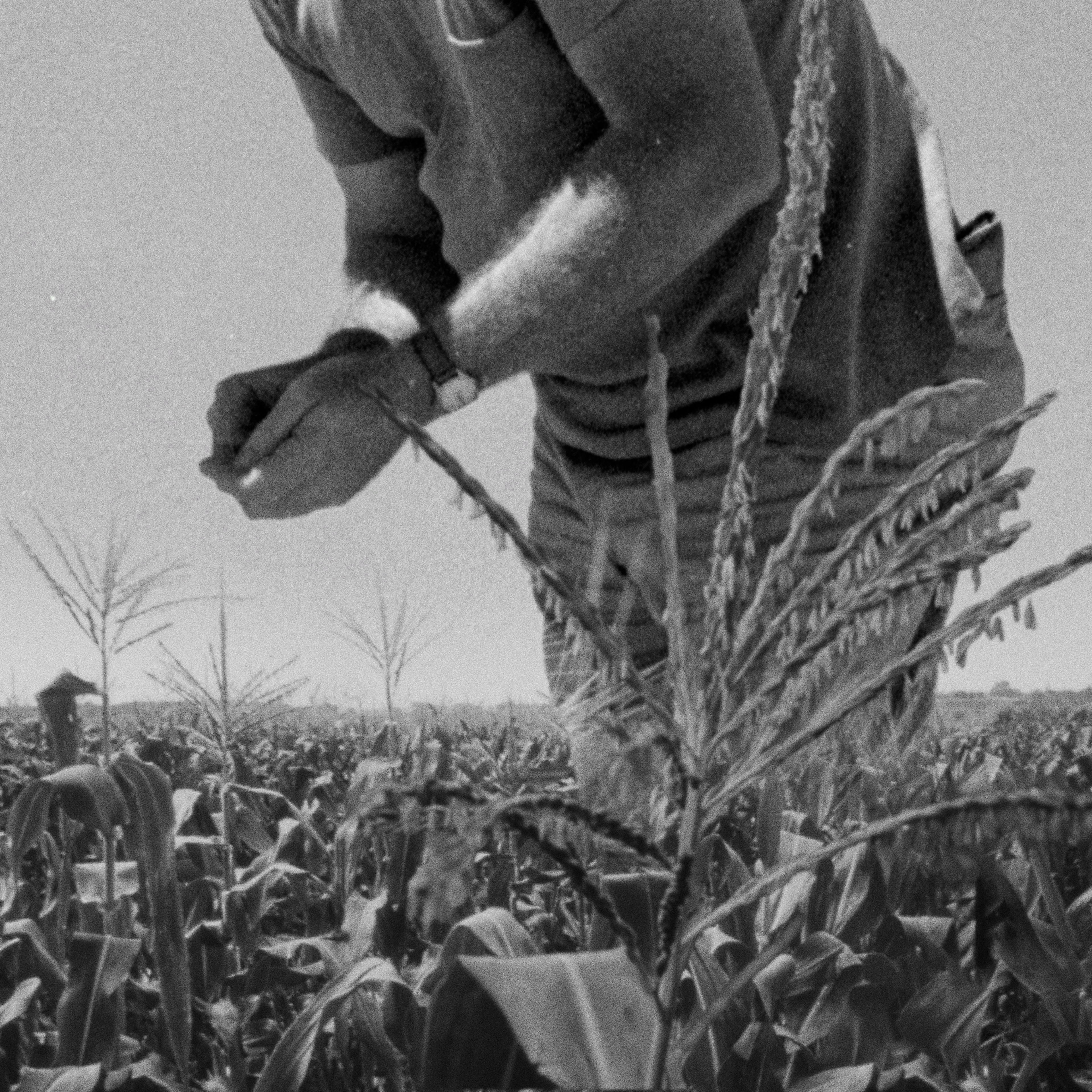
For years, Jason Webster has pushed up corn yields, ear by ear, on an experimental farm in Pontiac, Illinois. He’s meticulous in his research, evaluating everything from chicken litter as fertilizer to ideal tractor tire pressure.

Four years ago he got his hands on an unusually promising science experiment—specially engineered “short corn,” which taps out five or so feet shorter than traditional varieties. It’s not perfect, said Webster, lead commercial agronomist at Precision Technology Institute, a research farm. But, he said, “growers are going to want it.”
Seed companies are buzzing with big plans for little corns, which they see as the most promising modern evolution in a long history of dwarf crops—one that would change the look of the world’s second biggest crop by planted acres. Short cornstalks grow from 5 to 7 feet instead of the traditional 9 to 13 feet, though the cobs remain unchanged. Its smaller stature means it won’t topple as easily in strong winds and, at its tallest, it can be fertilized with standard equipment instead of by flyover. It leaves less bulk on the ground after harvest, and doesn’t sacrifice yield.
The biggest seed sellers are throwing their weight behind petite corns. Corteva is readying to launch its own varieties in 2027 after years of testing. Meanwhile BASF is developing a short corn with Bayer, which has so far outpaced the competition. But despite promising returns on his 30 or so acres of Bayer-engineered short corn in Illinois, Webster remains practical.
“Well, I don’t know what grower adoption is going to be,” he said. In order to maximize yield on short corn, “there’s a pretty good change in operation that has to happen. Some are willing to do it, some are not.”
If the short corn tide is rising, it would not be the first dwarf crop to have taken the agricultural world by storm. In the 1950s, scientists cut wheat at the knees and also came up with a diminutive “miracle rice.” Those crops spurred a Green Revolution that helped stave off famine in Asia and Latin America.
“People realized that height is not really that important in grain crops.”
“People realized that height is not really that important in grain crops,” said Ted DeJong, distinguished professor of plant sciences and pomologist emeritus at University of California, Davis.
When a plant is grown next to a variety of species, it benefits from height by capturing sunlight first. When a single, stalky species like corn is grown without competition from other species, it is no longer necessary to devote energy towards height. “When we grow [plants] as monocultures,” said DeJong, “the primary thing they’re competing with is each other. And so the drive for height, evolutionarily, is not there.”
Meanwhile, fruit crops had their own dwarf revolution, said DeJong. Growers figured out a century ago that apple trees would be much easier to harvest without a ladder when grafted to dwarf rootstocks. Virtually all commercial apple trees today are grafted onto roots of petite varieties, said DeJong. He and a small team designed their own semidwarf rootstocks for peaches, called the “Controller” series.
Today, dwarf crops are in abundance. There are short coconut trees, Brussels sprouts, barley, and cotton plants. Dwarf sorghum was developed for Nigerian farmers banned from growing tall crops that might shield insurgents. There are dwarf crops in space. Bayer is exploring whether soybeans could be taken down a peg.
But where miracle rice and semidwarf wheat substantially increased yield per acre, short corn’s biggest strength may be in its wind resistance.
Erin Sparks, a researcher and associate professor at University of Missouri’s College of Agriculture, Food and Natural Resources, invented a shoebox-sized machine, the SMURF (Sorghum and Maize Under Rotational Force), in her lab to test the toughness of corn to wind forces and to better understand the plant’s root systems. She velcroed the outstretched arms of her device near the base of short corn stalks and pressed go.
In the next 10 years, she said, Bayer wants short corn to be the primary option for 80 percent of cornfields everywhere.
The SMURF applies force in the same way a strong wind might to measure the springiness of corn roots. Short corn, which has deeper, narrower roots than traditional corn, is indeed great at standing up to winds, the machine confirmed. “Farmers know their fields better than anyone,” said Sparks. So in those areas where their corn is prone to toppling year after year, “short corn is an excellent solution for that.”
When a corn’s roots lose its grip in the soil, the plant leans or can fall over. It’s called “lodging,” and is a real issue for farmers especially in the Corn Belt, where punishing derecho winds are a summer staple. In August 2020, almost 40 million acres of corn and soybean fields across the Midwest crumpled under a derecho.
Lodging is more likely to occur when a plant’s roots are either too wet or too dry, according to a 2026 study from Northern Illinois University. Farmers in the U.S. will have to deal with increasingly intense derechos, droughts, and rainstorms as the effects of climate change ramp up, the study states, which means strong roots are in demand.
That’s not as compelling for silage operations, especially those outside of the gusty Midwest. Silage uses the stalk, not just the cob, so short corn equals less product. Researchers are starting to evaluate short corn versus traditional corn versus specialized silage corn for quality—a measure of fiber digestibility which can mean more milk production from the dairy cows eating the silage.
Preliminary research from The University of Wisconsin suggests that short corn silage digestibility falls somewhere between the traditional corn and the specialized silage corn, which could make up for loss of tonnage. Another lingering question is whether farmers will be willing to change their operations for a nascent crop. “The science is there,” said Sparks, “but it requires that farmer buy-in.”
Webster found that with some tinkering, short corn could reap a higher profit by $50 an acre.
Farmers are a “word of mouth community,” Sparks explained. If one has a bad experience with a new corn, or there’s a loss in yield, that’s a ding on short corn’s reputation and desirability for everyone else. Recognizing this, Bayer has rolled out its short corns slowly to farmers in the company’s “Groundbreakers” program, whose gear is equipped with its own precision agriculture technology.
Bayer’s “Preceon” short corn has been commercially available to those growers in the U.S., Turkey, Italy, Spain, Mexico, and Argentina for a few years. Now, they’re ramping up. In 2026 the company seeded 185,000 acres across the U.S., and next year they expect to seed 400,000 acres, according to Lindsey Battle, Preceon strategy and launch lead for North America. In the next 10 years, she said, Bayer wants short corn to be the primary option for 80 percent of cornfields everywhere.
Preceon’s corns promise the same yield per acre but only when planted at higher densities—something traditional corns don’t handle well. But that means farmers have to buy more seed, Sparks notes. Right now, Bayer’s short corn is priced comparably to traditional corn, but Preceon could eventually be sold as a “premium” product, said Battle.
On his field in Illinois, Webster found that with some tinkering, short corn could reap a higher profit by $50 an acre. And margins are beyond tight in 2026. On average, it cost $897 to grow an acre of corn in the U.S. in 2025, according to the National Corn Growers Association. That’s below market value, which means farmers are losing money on corn, confirms Perdue University.
Short corn’s extra returns show up in its per-acre density. As opposed to the traditional 30-inch rows, short corn does really well in 20-inch, even 15-inch rows where traditional corns would be too crowded. That configuration produces more grain per acre to make it worth a farmer’s while, said Webster.
Ultimately, short corn’s wind hardiness is “probably the number one value proposition in most farmers’ minds.”
Bayer Crop Sciences found that dripping another 30 pounds per acre of nitrogen on short corn roots in its late growing stages would sprout an additional 4.8 bushels per acre compared to traditional corn. With standard corns, late-stage nutrient or fungicide applications require a drone or a plane, since standard high-clearance ground sprayers can’t clear the top of fully grown corn and risk breaking the stalks. But short corns don’t have that problem—they can be tended to with normal ground equipment.
Late-stage access is important, since growing corn plants really start sucking up nitrogen once they are knee-high, said Daniela Carrijo, assistant professor and extension specialist in grain crop production at Penn State. Corn keeps aggressively absorbing nitrogen until the seed is growing in the cob. With short corn, it’s easy to apply fertilizer when it’s at full height. “You’re spoon-feeding that crop whenever it needs it most,” said Carrijo.
Ultimately, short corn’s wind hardiness is “probably the number one value proposition in most farmers’ minds,” said Webster, especially as erratic wind events only increase with climate change. “I see no reason why a grower would not want to make it a part of a diversification package in regard to choosing genetics on the farm. I mean that just makes sense.”
But if there’s even a hint of yield loss, said Webster, “it’s going to be hard to get large grower adoption outside of those high risk wind areas.”