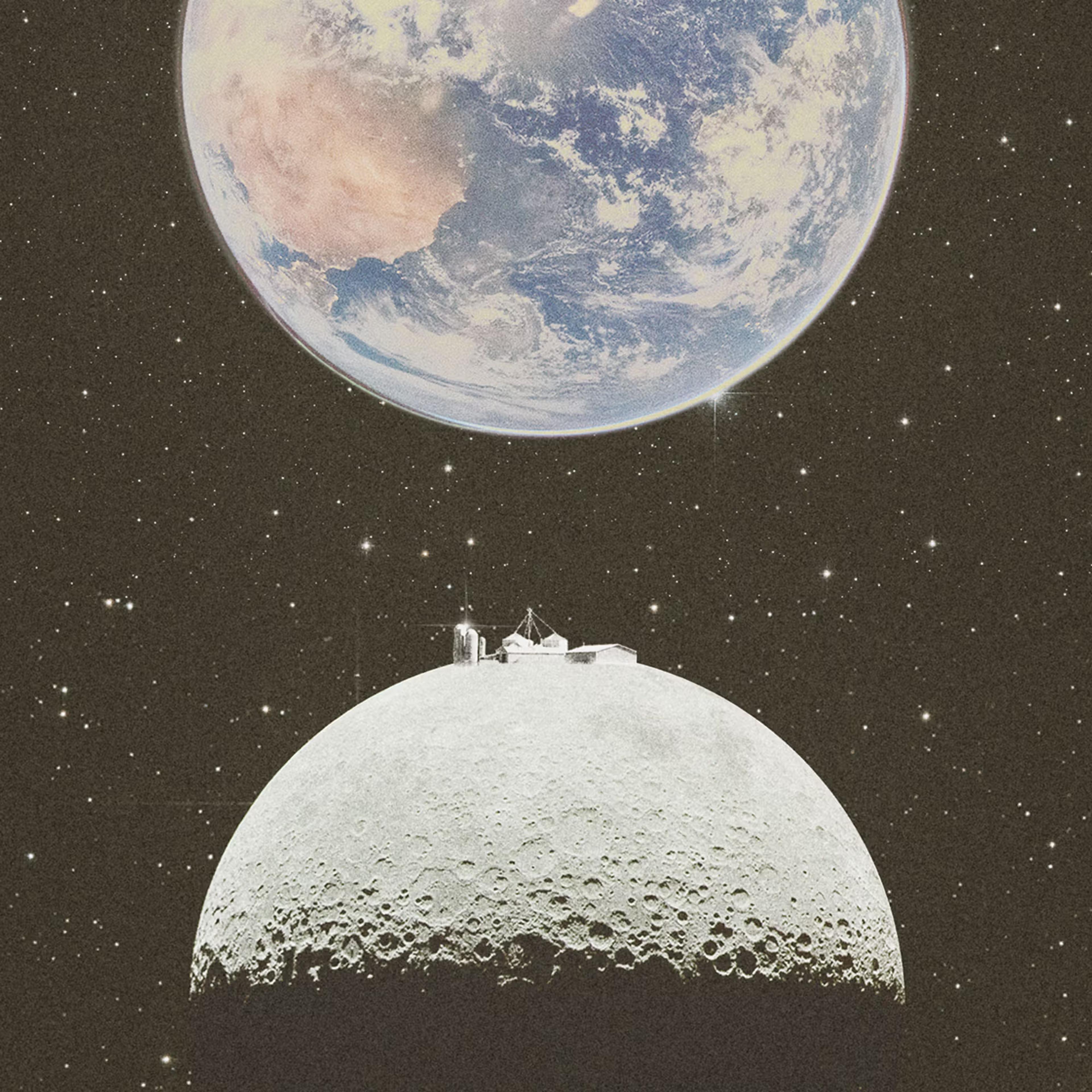
As we get ready to feed astronauts on the Moon and Mars, NASA scientists are figuring out how to build soil from scratch.
“That land was dead. Dead as Christopher Columbus. Bare rock, sterile, no life of any sort — and there never had been any life in it. It’s a far piece from dead rock to rich, warm black soil crawling with bacteria and earthworms, the sort of soil you have to have to make a crop. It was the job of the homesteader to make the soil.”
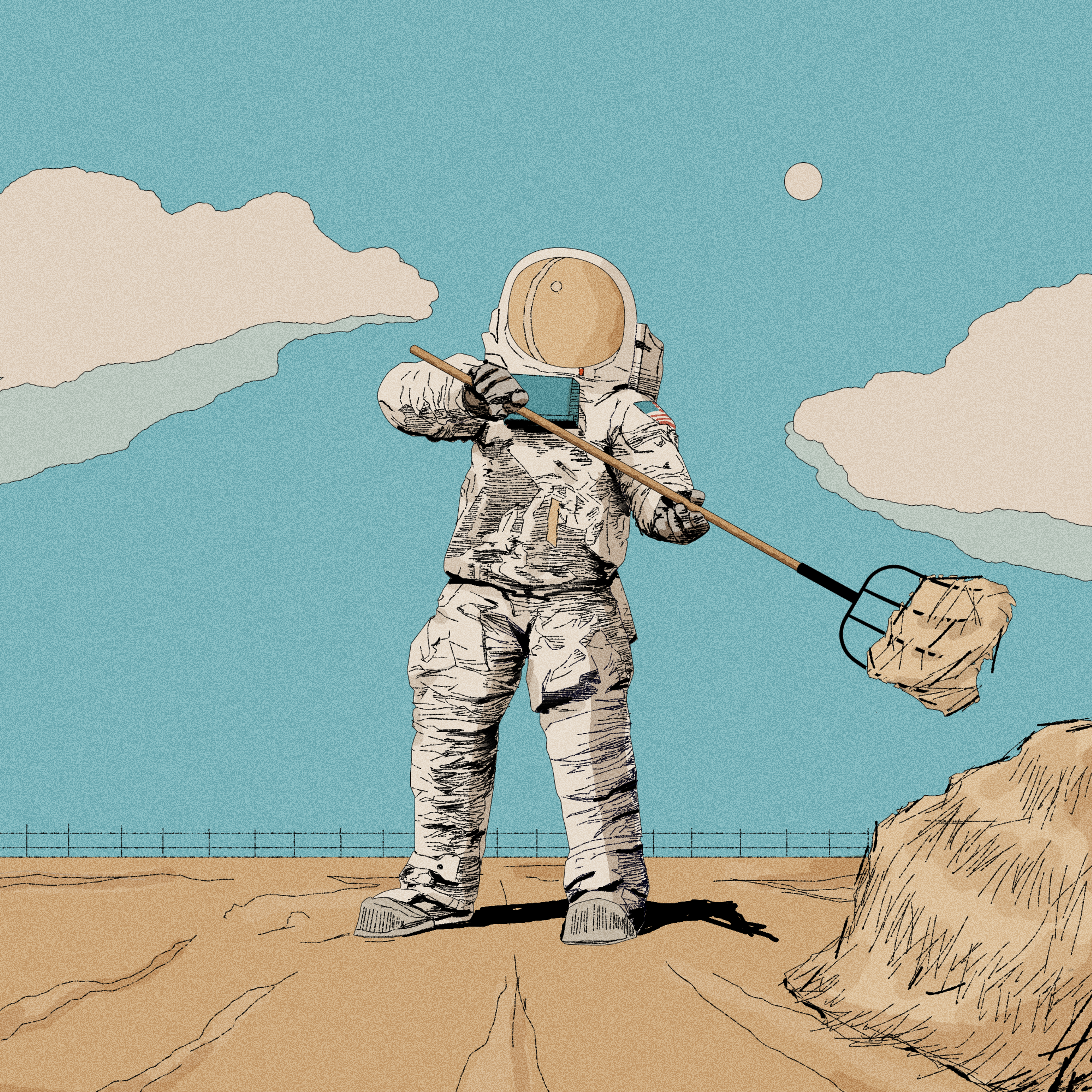

This quest for a fertile medium in which to grow food undergirds Robert Heinlein’s 1950 sci-fi classic Farmer in the Sky, in which starving Earthlings decamp to Jupiter’s moon Ganymede. It also presages some of the work currently being done by the National Aeronautics and Space Agency (NASA) to provision eventual human-populated outposts on the Moon and Mars. Heinlein envisioned a simple and familiar (if backbreaking) system of agriculture on Ganymede, starting with pulverizing “granite boulders melted out of the ice, frozen lava flows, pumice sand, ancient hardrock … [Then] infecting the topmost part with a bit of Mother Earth herself — then nursing what you had to make it spread.” Add imported worms and honeybees and voilà: space farm.
If only it were that straightforward in real life. “We want to grow plants for food, for biological life support, recycling water, providing oxygen,” said Elison Blancfor, space biology program scientist for NASA’s biological and physical sciences division. “But before we can use them for these purposes, we need to understand the fundamental mechanisms underlying how plants respond to an environment that they’ve never seen before.”
Years of experiments, on the International Space Station (ISS) and elsewhere, means we’re not quite starting from scratch as NASA prepares for both a Moon base and a manned Mars mission in the 2030s. We know that plants will germinate in space, even if their roots and shoots sprout in weird directions without full Earth gravity. And we know that space crops are often less nutritious than their Earthly counterparts. But even with these useful bits of information, scientists are far from clear about how to build a complete and workable ag system without the 24-hour days and air and microbes we take for granted on our home planet.
Ralph Fritsch, a NASA retiree and lead subject matter expert for the Mars to Table challenge, which seeks to identify plausible “surface habitat food systems,” believes space ag will probably start with hydroponics. Hydroponic systems can maximize growth in small areas and we already know they work on Earth and in a demo on the ISS.
“We need to understand the fundamental mechanisms underlying how plants respond to an environment that they’ve never seen before.”
Another plus: there’s water on the Moon and Mars even though “it is not pure water,” said Fritsch. “It’s frozen down a certain number of feet under the top surface of the regolith” — the rocky layer that blankets the surface of these bodies — “so how do you extract it and purify it for use? That becomes a whole ‘nother set of technologies.” As does figuring out how to meld a reliable and safe food-growing system with other necessary and as-yet undeveloped systems: harvesting, processing and cooking, plus some kind of storage that possibly involves freeze-drying. And perhaps most vexing is keeping the extensive lunar and Martian dust out of the works.
Although Fritsch believes dirt-based space greenhouses are years from fruition, there’s still been heavy investment in research — testing regolith-simulant systems in the Antarctic and in Arizona’s Biosphere II, for example. Soil-based systems — which, if feasible, would eventually be put to the test against hydroponics — would have certain advantages, said Morgan Irons, a doctoral candidate in soil and crop science at Cornell University.
“You don’t have to bring as much [starter material] from Earth. If a hydroponic system breaks down, you have to turn it off entirely [to fix it], while a soil system can be self-sustaining. And you could potentially have a greater biodiversity of plants” than in a hydroponic system, they said. But off-Earth challenges start with the fact that lunar regolith is fine as powder and sharp as glass while Martian regolith is loaded with iron-rich oxides and turns to cement the instant it touches water. Both regoliths also contain zero organic matter.
To build viable soil, first you have to weather the regolith to make it less abrasive, as well as unlock some of the beneficial, mineral-based nutrients it contains, like calcium and magnesium, so they’re available to plants. One research project tackled weathering by mixing regolith with recycled human feces and urine — the inevitable, bountiful waste products humans produce no matter where they wander.
Jacob Scoccimerra, a former mission manager for a company that helped launch research projects to the ISS, is also thinking about what to do with human waste in space habitats. Everything from ventilation and atmospheric pressure to water supply and waste management in any space settlement is managed by an environmental control and life support system. The one currently on the ISS, Scoccimerra said, “can recycle like 98 percent of the wastewater. It’s amazing but it fails frequently.” He founded a company called Monolith LLC that’s working on a fix: bringing in mollusks to purify wastewater in a more bioregenerative system that doesn’t need filters that peskily need replacing; the resulting grey water could then be used on crops (and some mollusks could be part of the food supply). Although Scoccimerra admitted, “We have no idea if mollusks can survive” in space.
Farming the Moon and Mars means having to rethink and relearn many small details of agriculture, with little room for Earthly intuition.
Irons envisions having to import some kind of organics-rich starter material from Earth, to at least partially account for some of the trillions of different microbes that exist in our soil. “They all do different things; are we selecting just a few, to try to inoculate our soil systems? What are the chances of them surviving?” they said. Starting from Soil Zero means figuring out a pioneer species — what to plant first in that weathered, inoculated regolith — then what follows after. This could include a post-volcanic landscape that might rejuvenate first with mosses and algae, then lichens and ferns, then woody seed plants, then grasses, then flowering plants.
Another concern around off-Earth biological habitats is the atmosphere. “With plants, when they are in lower-pressure environments, their water evaporates really quickly on their leaves and stems and so it can lead to them pretty much becoming hypoxic and having water stress,” said Irons. That makes establishing an (indoors) Earth-like atmosphere essential. There’s also the matter of the warmth seeds need to germinate, and for stems and leaves to grow. “Here on Earth, we have geothermal energy that naturally comes from our core and rises through the soil,” Irons said. “The Moon doesn’t have that and Mars has minimal geothermal energy. How does that impact your system? Where do you get that additional energy from? Do you need to put heating systems underneath the soil?”
At the moment, the list of still-to-knows for making a soil-based space farm is long. There’s deciding the best way to add nitrogen into the system and understanding how to introduce the bacteria necessary to fix it. There’s identifying the most important traits in the space crops hungry astronauts will need to survive, like tomato plants that grow more fruit than leaves. There’s determining the best way to grow multiple crops with different needs all in the same confined area, and how to keep nutrients from leaching out of the wonky regolith. Farming the Moon and Mars means having to rethink and relearn many small details of agriculture, with little room for Earthly intuition.
Still, there’s something even more fundamental that niggles at Fritsch. “We have to get to a point where we’re producing things that result in a meaningful menu that the crew can consume and enjoy. Very little thought has been put into that aspect,” he said. “There are people proposing certain crops” — wheat, sorghum, amaranth, mustard. “There are people proposing fermentation systems for microbial proteins. There are people talking 3-D printed mushrooms, and insects. [But] how do I make it something that’s a real solution, that astronauts actually want to eat?”