How patience, passion, and purpose have shaped a gentler model of caretaking for Alaska’s last prehistoric megafauna.
Despite their intimidating size, musk oxen never forget that they are prey. At the University of Alaska-Fairbanks’ Large Animal Research Station (LARS), animal care staff will navigate around the fuzzy, quarter-ton beasts carrying large boards that they can quickly wield as a shield, just in case the antsy creatures opt to make their anxiety known through headbutts.
“They’re like little goats,” said Jamie Luce, an animal care technician (and musk ox socialization specialist) at LARS. Musk oxen are, their bulk aside, more biologically akin to goats and sheep: “They get into things all the time, they’re breaking fences, climbing things. They’re just supersized,” Luce said.
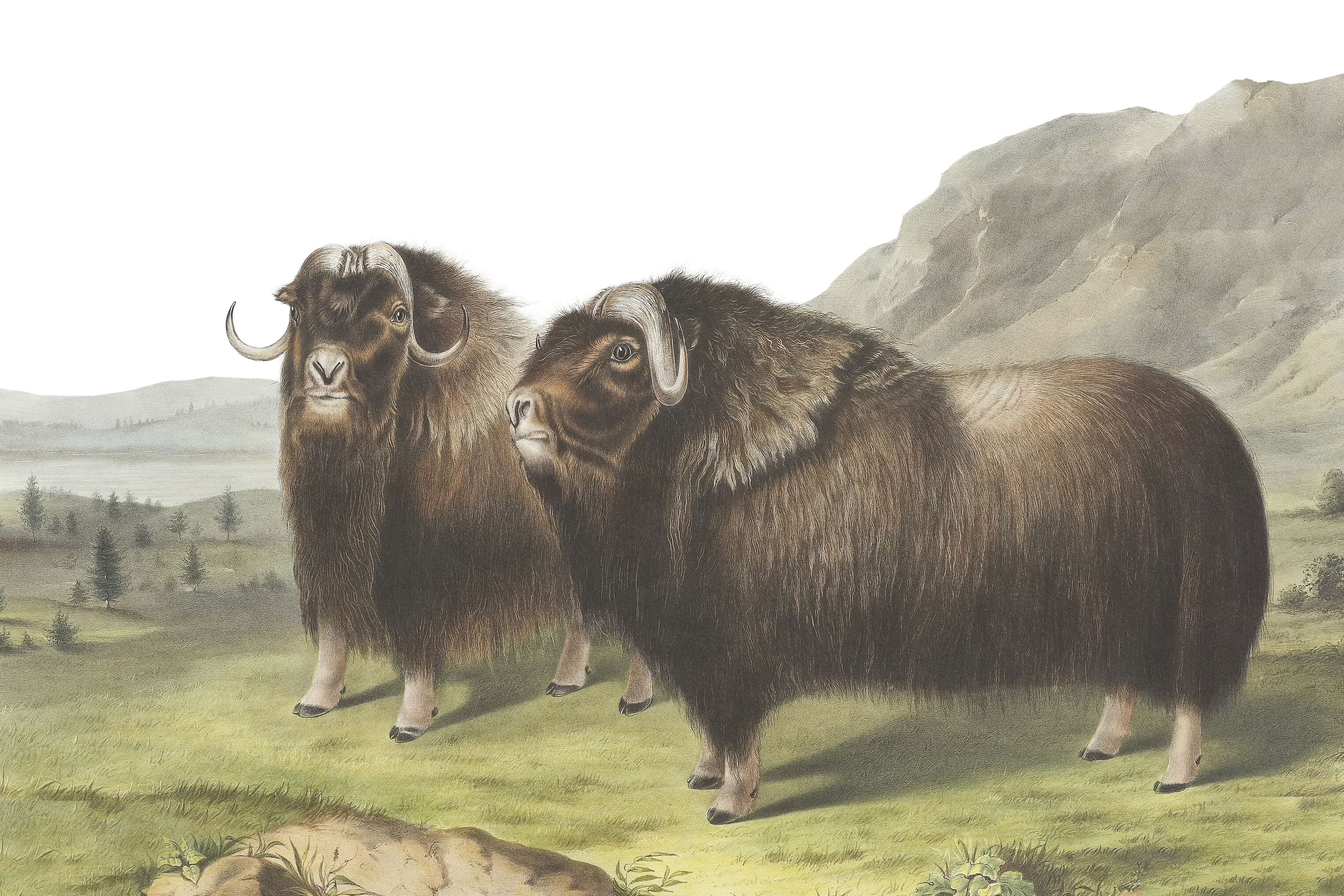
Once hunted nearly to extinction, musk oxen have managed to endure into the modern era in a way their fellow Ice Age megafauna, the wooly mammoth and Irish elk, have not. No longer viewed as an untapped agricultural resource on the American frontier, these evolutionary elders now inspire a community of Arctic caretakers who advocate for a gentler approach to animal husbandry.
Of the few thousand musk oxen that call Alaska home, none actually trace their roots back to the 49th state. Locally hunted to extinction by the mid-1800s, the U.S. Congress allotted $40,000 in 1930 to reintroduce the species “with a view to their domestication and utilization in the Territory.” Norwegian sealers captured 34 calves and yearlings in Greenland (shooting the adults protecting them), before delivering them across the Atlantic to a 33-day quarantine in Clifton, New Jersey.
The transplanted herd survived a balmy East Coast autumn before traversing the continent by train to catch a seven-day steamship journey to Seward; by the time they arrived (via leaky barge) to Nunivak Island, a permafrost-covered volcanic expanse of tundra in the Bering Sea, the beasts had traveled 8,000 miles. Decades later, biologists transplanted hundreds of their descendants across the Alaskan mainland, from the Arctic National Wildlife Refuge to the Seward Peninsula. (Even after domestication failed to take, the beasts had value elsewhere, like in diplomacy: In the thick of the Cold War, the U.S. both traded them to China for pandas, or airlifted them to the Soviet Union.)
The three to four dozen shaggy creatures at LARS, however, do not constitute the largest captive herd in the state. That distinction goes to a similarly storied institution known as the Musk Ox Farm, three hundred miles south of Fairbanks, where Luce previously spent five years as herd manager.
This matte, downy textile gave rise to the musk ox’s vastly more fitting Inuktitut name: Oomingmak, or “the bearded one.”
Founded in 1964, its founder, anthropologist and former WWII bomber pilot John Teal, wrote an article in 1958 for The Atlantic in which Teal described what it was like raising musk oxen on his farm in Vermont. The article’s mythologizing title, “Golden Fleece of the Arctic,” refers to the creature’s most luxurious biological feature: its superfine underwool, known as qiviut.
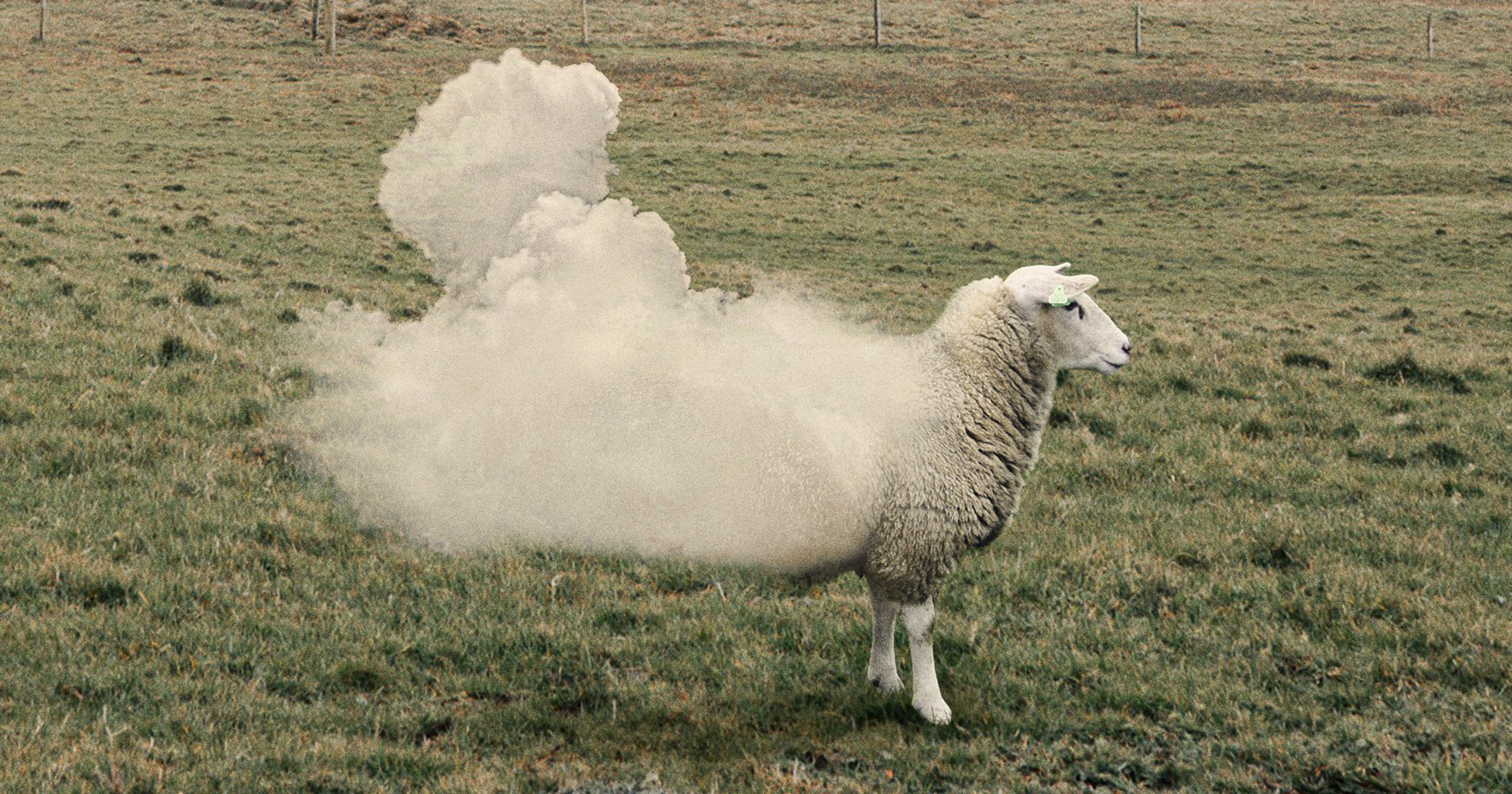
This matte, downy textile gave rise to the musk ox’s vastly more fitting Inuktitut name: Oomingmak, or “the bearded one.” Evolved to conserve heat in climates that, in the ice age mammal’s native range, careen as low as 40 degrees (or more) below zero, the insulating hairs clock in as much as eight times warmer by weight than sheep’s wool. An adult sheds as much as five to eight pounds of the fiber upon the arrival of spring—in his Atlantic article, Teal described “mysterious bundles of gossamer tumbling across the tundra, small fibrous clouds blown by the summer arctic winds.”
The Musk Ox Farm’s executive director, Mark Austin, joined the herd at a perilous time in the organization’s existence, in which John Teal’s granddaughter provided the deciding vote on whether the program should soldier on at all. But in the last 15 years, the non-profit has undergone a remarkable renaissance, in which they’ve embraced “gentle” musk ox husbandry and qiviut production. It’s a principle that—in stark contrast to the margin-maximizing pressures of late-stage capitalism—accepts certain inefficiencies in exchange for the fluffy megafauna’s well-being.
“It’s a very, very, very good place to be a musk ox,” Austin said. “A lot of people work really, really hard to give them that. And we’ll add that there’s never once been a single thank you from any member of our herd, either. Rather ungrateful.”
These loving inefficiencies include hand-combing each musk ox only when both the qiviut and its host are good and ready. In ideal circumstances, the eagle-eyed staff might muster a willing herd member into the barn and shepherd a year’s worth of fiber off the animal’s hide in an hour and a half. More nervous nellies, on the other hand, may require a gentler touch.
For those who love and extol the animals, it can be a tall order to thread the needle between promoting their virtues and preserving their wild sanctity.
“Combing can be relatively quick, or slow down considerably depending on the temperament of any given individual and how they are releasing their fiber,” Austin explains. “One may come into the barn, enjoy some snacks while our team goes to work with hair picks. Another may be a little more antsy and we will have short combing sessions to get them back into the pasture.”
For all the time and labor involved, the fiber fetches a pretty penny: Knitters can purchase a 2-oz bag of unprocessed, raw qiviut for $65, or $115 for a pure 1-oz skein. (The fiber-curious can acquire a thumb-sized sample of mixed qiviut and guard hairs for a mere $2.) Completed garments, like a smokering, aka “nachaq”, can run north of $200. Both LARS and the Farm actually have their mittens, scarves, and hats crafted by knitters in Texas, Washington, and Alaska.
Approximately 250 Native Alaskan women also knit these downy fabrics through the collectively owned Oomingmak Musk Ox Producers‘ Co-operative. The collective was “born of the same father” as the farm, as part of Teal’s efforts to provide Indigenous community members with a homegrown source of income while still allowing them to maintain their subsistence lifestyle.
After decades of state-sponsored efforts to impose extractive livestock management on Native Alaskans, this approach could be considered somewhat enlightened for the time. After Teal’s death in 1984, however, the organization slowly proceeded to bifurcate, with the farm focusing firmly on husbandry. The groups have since formally parted ways, and maintain only a shared history.
Outside of the Arctic, musk oxen do not enjoy a large public profile—and this obscurity spills over into scientific literature. LARS’ veterinarian, Nina Hansen, aims to spearhead work to gather critically needed guidelines that could significantly bolster musk oxen welfare.
“One frustrating thing as a veterinarian working with them is we really don’t know a lot about their normal clinical parameters,” Hansen said. “If your dog is sick, and I do blood work, I can just look in a book, and it’ll tell me the normal number of white blood cells for dogs. We don’t know that for musk oxen … So a lot of it is educated guesses, based on what we know of other similar species.”
“If your dog is sick, and I do blood work, I can just look in a book, and it’ll tell me the normal number of white blood cells for dogs. We don’t know that for musk oxen.“
“Some of our greatest successes in husbandry have been attained through our gentle and sustainable approach to our agriculture. Whether it’s processing micronutrients, parasite loading, or a trauma-related issue, we can achieve fantastic results for our herd by simply reducing stress.,” Austin explained. “We work so hard to let these guys enjoy their lives on their terms.”
One way the farm and LARS exist entirely on the same wavelength is in their naming practices. Each year, staff settle on themes for all newborn musk ox calves born. In 2024, for example, egg-themed Frittata was born on the farm to her cheese-themed mother, Gouda, who herself was born in the same year as Muenster. This year, Story. Saga, Novel, Fable, and Sonnet have ushered in the era of “Literati.” The farm regularly celebrates the creatures’ myriad birthdays on their Instagram.
For those who love and extol the animals, it can be a tall order to thread the needle between promoting their virtues and preserving their wild sanctity. Contrary to livestock domesticated for thousands of years, musk oxen remain gratefully untamed—even as the staff provide them with lovable monikers and learn their individual personalities, they’re careful not to showcase human interactions that imply domestication. This prehistoric bovid does not yearn for pets.
That’s not to say that human-wildlife interactions don’t happen, especially on the frontier. Hansen recounts how musk oxen are particularly fond of the airport in Nome, because the cleared runway allows them to conserve energy; locals also sometimes contend with musk ox literally butting heads with their sled dogs. “If I were to ask any of my herd what they thought of a sled dog, they’d say, ‘What’s that? It’s a wolf,’” Austin said. “Instinct kicks in: Solve the wolf problem in front of me.”
Throughout the state, musk ox hunting remains largely illegal, outside of federal subsistence hunting permits. Occasionally, a tale of charming animal rescue will make news: In 2019, oil workers in Prudhoe Bay discovered a calf separated from its herd during a grizzly attack, and relocated her to the Alaska Wildlife Conservation Center, where she’s now a one-eyed cutie known as “Artemis.”
But Luce stresses that musk oxen—despite their high-value fiber—are not ideal subjects for a kind, animal-loving hobbyist. Responsible care requires an absolute abundance of specialized, hard-won resources, and carefully considered ethics—even if they are, fundamentally, loveable.
“I have definitely put myself into a little niche with my career. I’ll probably be here for quite a while. I love musk ox,” Luce mused. “It’s hard to leave them.”