Farmers in Rwanda and across Africa are scrambling to find new lifelines in the wake of last year’s DOGE cuts.
This piece was published in collaboration with Egab.
Jean-Claude Mukantabana was accustomed to monthly visits from extension agents who helped him select fertilizers, test soil, and connect to buyers for his maize and rice. By February 2025, these visits stopped. “It’s like someone switched off the light,” said Mukantabana, a small-scale farmer from Rwinkwavu in eastern Rwanda.
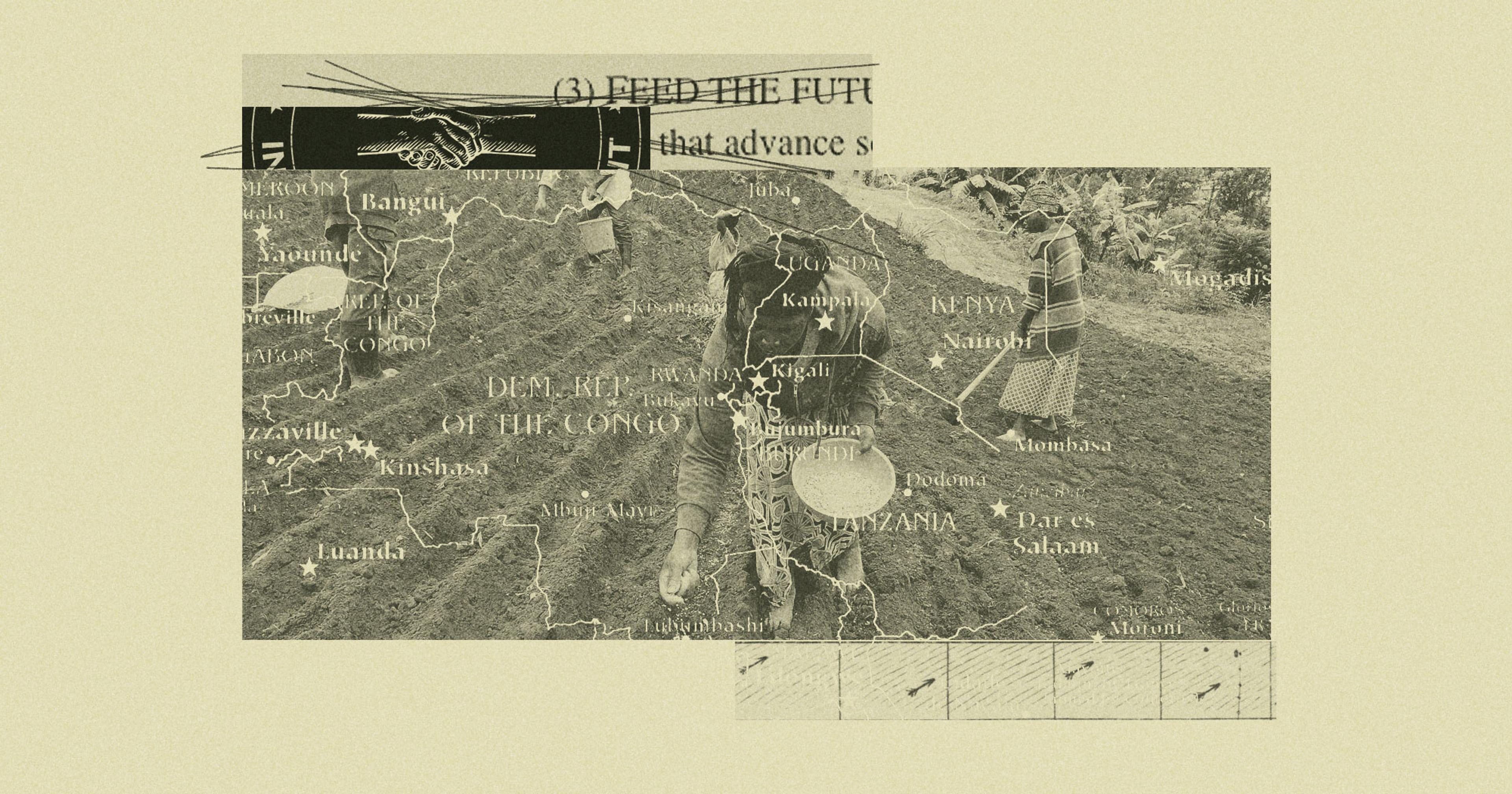
Until early 2025, agricultural programs backed by the support from the U.S. Agency for International Development (USAID) shaped Rwanda’s farming economy. The Feed the Future Rwanda Hinga Wunguke project, a $30 million program designed to improve nutrition among Rwanda’s general population by incentivizing farmers, was particularly impactful. The project had reached 39,554 individuals across thirteen Rwandan districts.
The USAID-backed program facilitated training, seed access, financial services, and market linkages, contributing to more than $5.3 million in producer sales and $2.6 million in facilitated finance. Of those engaged, 21,444 farmers adopted improved practices, aimed at boosting productivity and resilience.
The U.S government abruptly halted that support in January 2025, issuing stop-work orders as part of a federal freeze on USAID contracts, tied to a broader review of U.S foreign assistance. After a little more than a year, the downstream effects of these cuts are starting to become clearer.
Fertilizer and Seeds
Between August 2023 and January 2025, costs for fertilizer spiked, Mukantabana said, with diammonium phosphate (DAP) rising by 44% and nitrogen-potassium-phosphorus blend rising by 40%.
He also noted that seed prices increased sharply, with hybrid maize seeds rising by 53% and rice seeds to 58%. This jump in prices forced many farmers to reduce cultivation areas which impacted overall production and income.
For Charles Kwitonda, a potato grower from Rwinkwavu, the difference has been crippling. “With subsidized mineral fertilizer combined with manure, we could harvest 15 to 20 tons per hectare,” he said. “Without [subsidies], relying on manure alone, yields dropped to seven or eight tons.” The income difference has made him question whether farming is financially feasible.
Kwitonda’s experience illustrates wider economic pressures. Maize and rice farmers have experienced net income losses ranging from $171.71 to $274.74 per hectare, according to Emmanuel Mwizerwa, an agronomist based in Kayonza District. He attributed the decline to a sharp rise in input costs, particularly fertilizers and pesticides, combined with stagnant market prices and unpredictable weather patterns.
“Farmers are spending more to produce the same or even lower yields, and many are scaling back their operations or switching crops altogether.”
“These figures reflect what we’re seeing on the ground,” Mwizerwa said. “Farmers are spending more to produce the same or even lower yields, and many are scaling back their operations or switching crops altogether.”
Rice farmer Jonathan Muhire, 46, from Kayonza district, reiterated these challenges: “When subsidies stopped, input costs soared, and loan repayments consumed most of our revenue,” he said. “Even if the harvest was good, our net income fell sharply.” He added that some farmers have reduced fertilizer or planted smaller plots, which has reduced yields.
Dealing with these pressures, farmers and cooperatives are developing their own solutions.
Cooperatives Adapt to New Realities
Starting last year, as extension services — field-level technical support — were all-but-eliminated, seed distributions lagged, and market linkages became unreliable.
Mukantabana said that before the funding halt, USAID project trainers would come monthly and offer their support. “We know how to farm, but without guidance, we are unsure whether we are applying the right methods or selling at fair prices,” Mukantabana clarified.
The absence of extension services forced farmers to restructure their daily routines. Local farming cooperative leaders reported that USAID canceled scheduled visits from agronomists who had conducted soil testing, pest scouting, and fertilizer guidance.
Several local cooperatives responded by hiring private agronomists on short-term contracts, dividing extension duties among their members and using mobile applications to track pests and fertilizer applications. Members now spend an average of one to two additional hours of manual inspection and soil testing.
Coffee farmers also felt the impact. For the Abakundakawa Rushashi Cooperative in Gakenke, reduced technical guidance for seedling management, pest control, and market linkages resulted in additional work for their members.
Cooperative leaders stepped in to share knowledge, but costs increased and managing export standards remained a challenge. This vacuum left by USAID has opened a pathway for new international partners, primarily China and the UAE.
New Partnerships Forged
In the absence of U.S. funding, Chinese-backed initiatives have upgraded irrigation systems and introduced mechanized planting to replace manual labor in districts such as Gisagara in Rwanda’s southern region. This has expanded water access for households and supported climate-resilient farming.
The $47 million Giseke Dam and Irrigation Project in particular will irrigate 2,640 hectares and benefit roughly 915 households.
Rashid Niyozima, a 58-year-old potato farmer in Gisagara district, deeply depends on irrigation for earlier planting, reducing drought losses, and enabling multiple crop cycles per year. He noted that emergency water pumping costs dropped by roughly 30% since July 2025 and labor hours for manual watering were reduced by 25-40%.
In Gakenke, China has also donated tools and 5,200 coffee seedlings to the Abakundakawa Rushashi Cooperative. “We are grateful for China’s support,” said Gakenke District Mayor Vestine Mukandayisenga. “We encourage youth to seize these opportunities and join coffee farming, because their participation remains low.”
China is not the only country stepping in to fill the gap left by U.S funding. Rwanda has also expanded partnerships with Middle Eastern markets, particularly the United Arab Emirates (UAE). Farmers like Claudine Niyonzima grow avocados for export to the UAE, managing small tree counts while facing pressure to meet strict size and quality requirements.
“Although USAID funding has been important, we are not solely reliant on it.”
“Export standards are strict,” she said, holding a small basket of avocados from her Hass fruit tree. “If our fruits are too small or damaged, they reject them,” she said.
Over the past four years, Rwanda’s agricultural exports to the UAE have grown significantly. In 2024-25, avocado exports reached 4,200 tons, generating over $8.6 million in foreign revenue, with 90% shipped to the UAE.
In November 2025, Rwanda finalized regulatory approvals to allow exports of avocados to China, opening access to a market of 1.4 billion consumers. Government officials describe these changes as part of Rwanda’s need to diversify beyond U.S aid.
Ministry of Agriculture (MINAGRI) officials state that changes in funding structures have been significant but not devastating. “Although USAID funding has been important, we are not solely reliant on it,” Chantal Ingabire, MINAGRI’s Director General, told Offrange. She added that Rwanda continues to work with multilateral partners including the EU, the International Fund for Agricultural Development, the World Bank, and the African Development Bank.
These partnerships support irrigation, value chain development, and climate-smart agriculture. However, rebuilding extension systems disrupted by abrupt pauses could take several seasons, Ingabire stressed.
As Rwanda manages this shift, a new generation of farmers shaped by different expectations is emerging.
“We Can’t Depend on Aid Forever”
Younger farmers are entering agriculture through training tied to new foreign partnerships. Didier Habumugisha, 24, participates in a Qatari-supported greenhouse program, learning high-tech growing methods and pest management.
Local NGOs such as the Rwanda Youth in Agribusiness Forum provide training, mentorship, and links to finance and markets, aiming to build a pipeline of agribusiness-equipped youth.
However, expectations are shifting as “the new investors want perfection,” Mukantabana said, raising the bar for smallholder farmers. Contracts tied to export markets require high-quality output, and farmers with limited resources risk losing buyers if standards are not met.
Independent economist André Nshimiyimana noted that new foreign investment introduces infrastructure and market access but also comes with expectations smallholders may struggle to meet. “Rapid shifts away from predictable aid can destabilize communities,” he said. “New partnerships must build local capacity, not replace it,” he added.
“We can’t depend on aid forever,” Mukantabana said. “But if the partnerships are fair and we keep learning, maybe this change will help us grow stronger.”