
In the woodlands of the Northeast, Indigenous women are reawakening the corn their ancestors grew before settler contact.
Lauren Peters was folded in half, black hair falling in a sheet from the nape of her neck to the dirt. With precision, she wrapped the tendrils of a Mashpee Methodist bean around a metal pole staked in the sandy Cape Cod soil. Usually the beans in this Three Sisters garden grow vertically up a corn stalk, while squash—the third sister—grows below.
But a summer of erratic weather and hungry woodland critters at Maushop Tribal Farm meant this grouping of corn seeds—planted in a small mound, Three-Sisters-style with beans and squash, the way Peters’ Wampanoag ancestors did—didn’t take. So she worked the beans around a surrogate stalk, hoping to salvage at least one of the crops in the cluster.
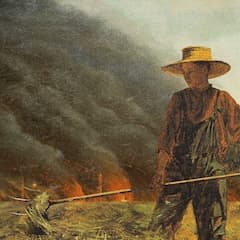
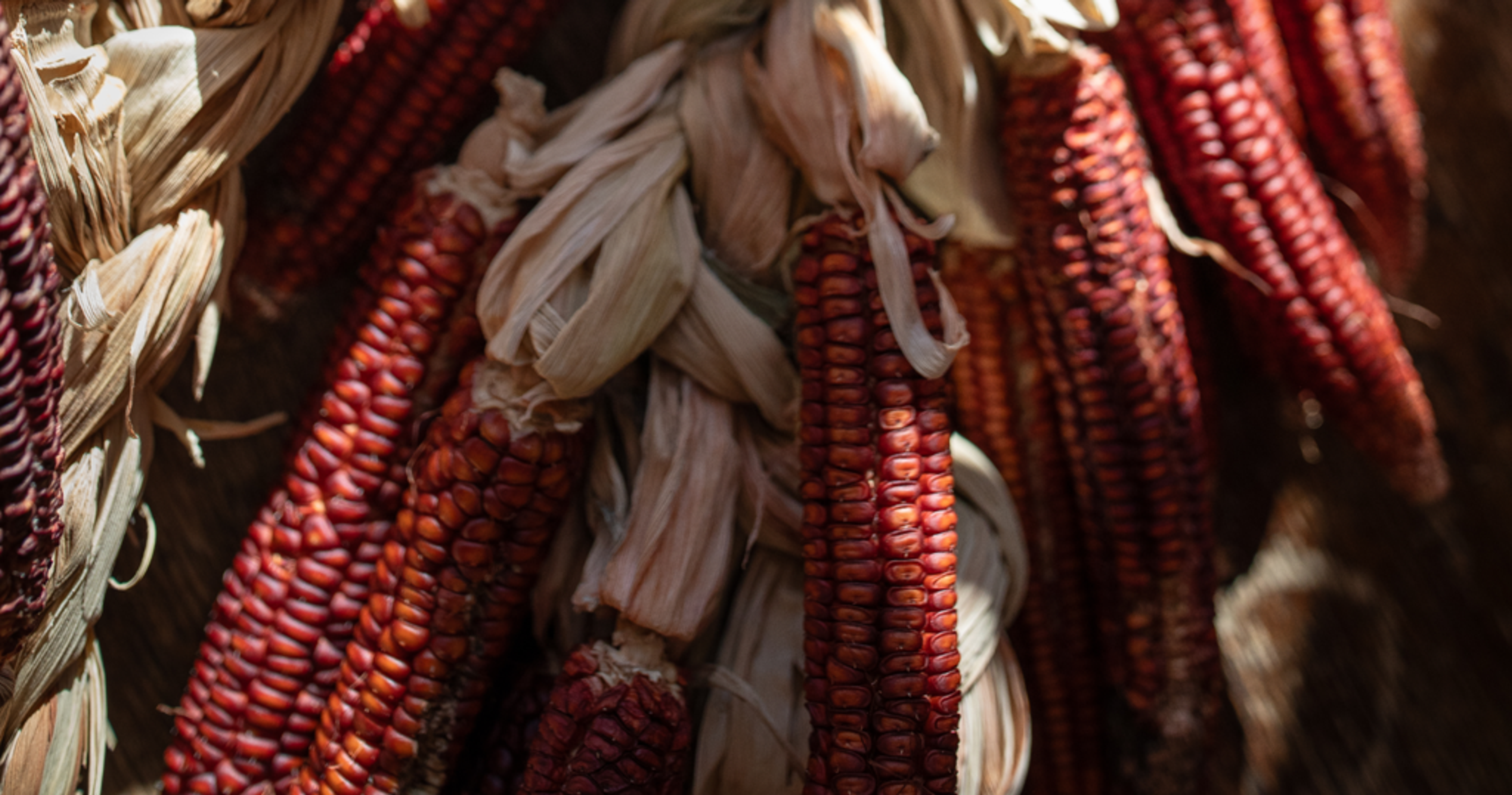
Luckily not all her garden experiments required so much triage (though she hasn’t figured out exactly why). It’s a relief for Peters, 37, who’s been instrumental in stewarding the return of a corn varietal that hasn’t been planted on Wampanoag land in roughly 350 years, after it was burned, slashed, and stolen into extirpation during the King Philip’s War.
To hear Peters say it, the seeds—named King Philip corn, or Metacom corn, after the slain 17th-century Wampanoag chief—chose to make their return in 2020, and she’s been honored with the task of helping “reawaken” them on their native land.
Non-Indigenous farmers and chefs, like Southern food evangelist Sean Brock, have helped popularize the rediscovery of heritage seeds over the last decade. But for many Native Americans, the work is more urgent, the roots much deeper. In particular, a movement known as rematriation, or the welcoming of seeds back to their homelands by the hands of Indigenous women, has been rippling through the Eastern woodlands (modern-day New England and New York). It’s gaining attention now thanks to groundwork laid by elders who spent years advocating for the return of Indigenous land and the preservation of their foodways. And it comes at a time when landback has been embraced on a scale that’s never been seen before.
But the broader landback movement doesn’t always allow space for the immense learning curve of reestablishing a bond with lands that have been broken by both the distant colonial past and the current scourge of climate change, corrosive chemicals, and industry.
Rematriation offers a framework for a slow, intentional return. Ancestral wisdom provides guidance, but some modern problems need modern answers. Where ancestors would use two whole herring as fertilizer for their Three Sisters mounds, today’s threatened herring population can’t be spared as freely. So how should these plants be fertilized? Sometimes rematriation means admitting you don’t know.
“We thought this corn was burned, destroyed, stolen during the King Philip’s War. We thought we’d never see it again.”
In 2023, after a couple growing seasons, Peters had more questions than answers, so she founded the Corn Sister Circle, a group for women, children, and Two-Spirits to garden and share knowledge as they get reacquainted with long-lost corn relatives.
The group has planted these seeds in a few different ways, testing to see what makes the corn happiest. In past years, they’ve tried spirals, rows, and different sized mounds. The most traditional of the planting styles, the small mounds, have struggled this year. On the other side of the garden, rows of corn are growing, but slower than in past seasons. The proudest corn is shooting up from big mounds in the back corner of the plot—7- or 8-foot stalks with long, elegant leaves locked in a green embrace. Peters wondered aloud if the taller mounds help protect the corn from weeds and scavengers, which have gotten more aggressive as their woodland habitat on Cape Cod shrinks.
She walked from the garden down a small hill, to a mildew-splotched picnic table on the lip of a brook that runs along the outer edge of the farm out to the sea, invisible through the woods. “I come here to pray to Creator before entering the garden,” she said. “I give thanks for another day, for protection and for getting me here. And I really ask for guidance in the garden, you know—what needs to be done?”
***
Peters is not ready to hear all the details of how these seeds made their way back to Mashpee. “I try not to ask too much because I know these seeds have been through a lot,” she said. “We thought this corn was burned, destroyed, stolen during the King Philip’s War. We thought we’d never see it again.”
The little she does know she’s understandably cautious about publicizing, fearful that it might encourage “pretendianism” (faking Indigenous heritage) or put particular seedkeepers in danger. After all, seed destruction as warfare didn’t end in the colonial era: Just last year Israeli forces bulldozed a seed bank in the West Bank, “destroying equipment used to reproduce heirloom seeds,” per Yale 360. And in other conflict zones like Ukraine, Yemen, and Sudan, seed stores are regularly ransacked.
Certain details about how these heritage seeds got back into the hands of Eastern woodlands tribes have been omitted. But generally speaking, seeds come back from multiple sources and are verified through a mostly unofficial means, connecting the dots of their stories.
Bill Braun, director of the Freed Seed Federation in South Dartmouth, Massachusetts, has become a trusted ally and resource for Eastern woodlands tribes, and has helped return heritage bean and squash seeds in addition to Metacom corn. Braun received Metacom corn through different channels, including by way of some other white farmers in the western part of the state who had grown it out themselves and recently decided they wanted to return some of it to its native homelands.
“There is something to be said about when seed has been in relation with its people so deeply for so long.”
“There is something to be said about when seed has been in relation with its people so deeply for so long,” Braun told Offrange. For perspective, he compared it to something like a French heirloom squash: Beloved and cared for by the French, those heirloom seeds undoubtedly figure into family stories, and are, as he said, “their ancestral seeds, in a way.” But those seeds have likely only been in France since the Columbian exchange, a period of biological globalization kicked off by Christopher Columbus’s 15th-century ocean voyages.
Meanwhile, something like Metacom corn likely has thousands of years of connection to Mashpee. “It’s some next-level shit when it comes to the seeds knowing place and knowing home,” he said.
When Eastern woodlands tribes refer to these seeds as “relatives,” they mean it literally, ethnobotanist Rosalyn LaPier, an enrolled member of the Blackfeet Tribe of Montana and Métis, explained.
Rematriation is a spiritual reawakening that reverberates far past the chicken wire edges of Maushop garden. “It’s a different kind of relationship that Indigenous people are reestablishing and revitalizing,” LaPier said. “It’s not just creating a garden or reintroducing a plant. It really is kind of reintroducing this whole world, this whole cosmology, that then gets reconnected and revitalized within a community.”
What Western science calls “genetic coding,” Indigenous science calls “memory.” The seeds themselves hold both. “Plants have very complex inner workings, and they know where they are,” LaPier said. “They know what kind of habitat they need to have. You can’t just throw a seed anywhere and it will work.”
“It’s not just creating a garden or reintroducing a plant. It really is kind of reintroducing this whole world, this whole cosmology.“
In Mashpee, Peters observes how the heritage seeds have responded to their homecoming, sometimes struggling to grow in soil that has undergone many changes. The rapid development of the town from a sleepy, majority-Indigenous village in the 1970s to the densely populated enclave it is now—with half a dozen golf courses and many more turf lawns, treated with pesticides and fertilizers—has resulted in a well-documented collapse of local ecosystems.
But the corn “is very resilient,” Peters assured, “and these seeds are recording all of this and becoming stronger.” Each planting is an opportunity for the seeds “to read the climate of today, so that it can be stronger for next year.”
That way, there are no “failures”—not even the stalks that don’t come up. The focus for now is to get the seeds in the ground and relearn what they like and need, to support a reciprocal healing between lands and humans that will ideally unfold over generations.
Despite the challenges, women of the Eastern woodlands tribes can feel the once-severed bonds regenerating under their feet, like a limb growing back. “My blood and my bones are from this land,” Peters said. “I feel this land’s hurt, but I also feel it celebrate when we bring these seeds back.”
***
Less than two hours northwest of Cape Cod, Kristen Wyman, 47, is growing a different heritage corn seed native to Nipmuc lands.
Wyman, a member of the Hassanamisco band of the Nipmuc, co-founded the Eastern Woodlands Rematriation Collective in the 2010s, and in 2018 helped organize a multinational meeting through the People’s Agroecology Process that brought farmers to the Eastern woodlands to learn about Indigenous land stewardship. She credits that encounter as an inflection point that helped bring heritage white flint corn back to her people, under the leadership of Nipmuc farmer Keely Curliss.
Wyman manages the garden plots at Deer Run Farm in modern-day Millis, Massachusetts, on a piece of land known as P8guaso (buh-gwa-so) and lives up the road with her daughters. Potatoes, peppers, alliums, and blueberries grow there, plus three or so rows of white flint corn, which has grown up tall this season, reaching close to 9 feet with its mop-top of tassels.
Wyman feels intense pressure as she welcomes back these relatives. “Even if we had [all our] land back, I feel like we’ve been displaced from the cultivation of the land intentionally,” she told Offrange. It’s hard to “know how to manage it in today’s context or have the capacity and resources to do so.”
And she doesn’t always have people to turn to for guidance. Once, when she found a fungus growing on the corn, she sought answers from ChatGPT, not knowing what else to do. She wasn’t proud of it. “Intertribal politics make it seem like we can’t collaborate or work together,” she said, “but that collaboration is what’s sustained us for so many years.”
“They know what kind of habitat they need to have. You can’t just throw a seed anywhere and it will work.”
Sitting on her patio in a blue and yellow Boston Marathon jersey, Wyman rinsed and chopped potatoes from Deer Run. “Indigenous foodways are not static,” she said as she massaged the dirt from a potato’s rusty skin. “We can’t survive or rematriate our land if we’re siloed.”
Planting heritage corn, she said, helps “facilitate solidarity and connectivity” between individuals and plants, which can then be transmuted into wider community networks. “The more we get our people to put our hands on this corn, the better.”
That’s why corn was so dangerous to settlers all those centuries ago: It brought people together from different tribes and backgrounds. It was a foundational bond, a shared language.
True rematriation happens when people pool together their individual knowledge and gifts. Just as sisters within the same family can have their differences, rematriation doesn’t have to mean unity, Wyman said, just cooperation. For her, that cooperativism remains aspirational. But on the corn’s timeline, less than a decade back in its native soil is barely a blip. The transformation is just getting underfoot.