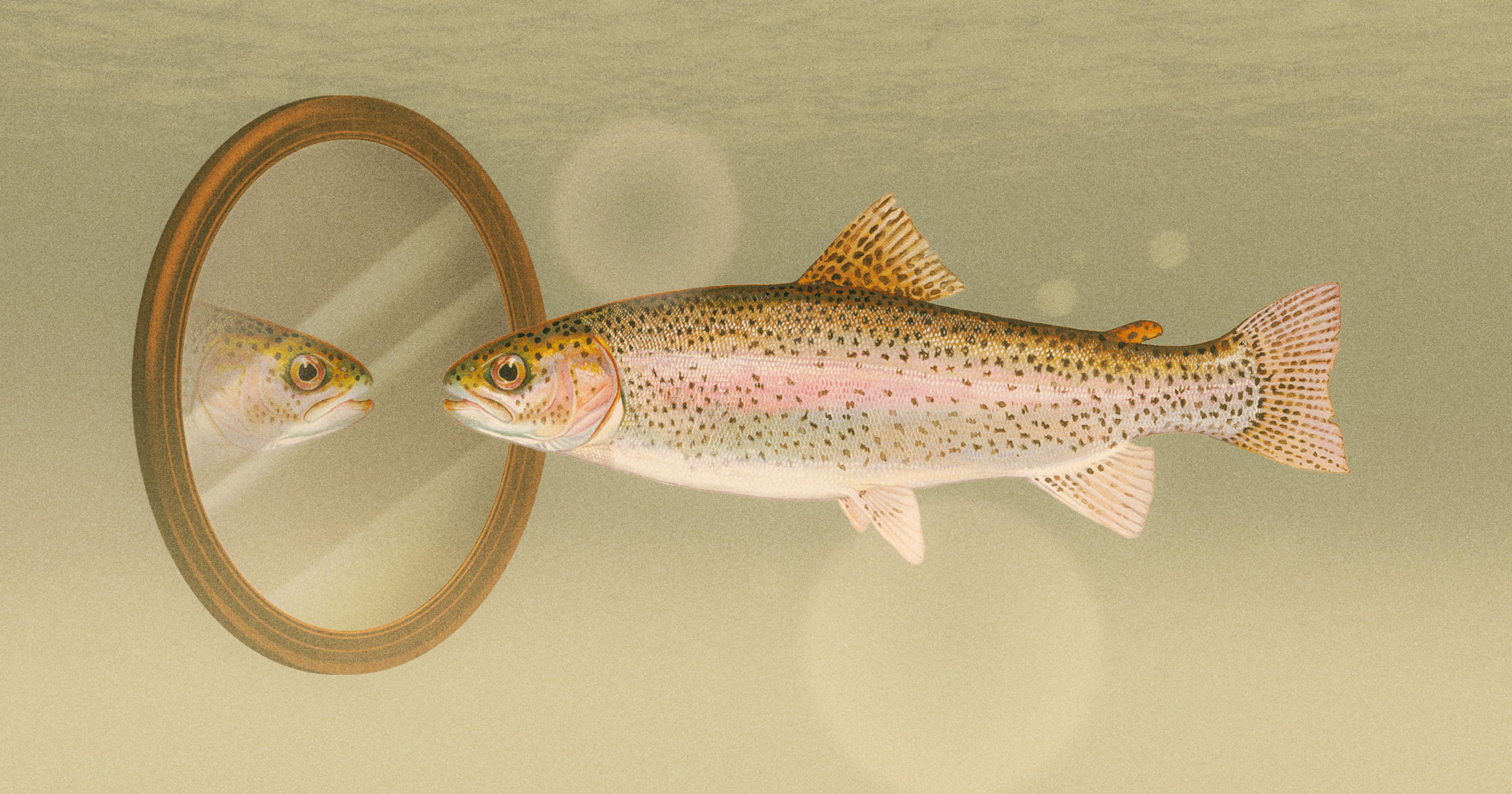
Research suggests they may be able to enjoy a massage, recognize themselves in a mirror, and get depressed. Are fish welfare standards next?
Fish are about as far away from humans as vertebrates get, evolutionarily speaking: Our last common ancestor lived roughly 450 million years ago.

That gulf limits our compassion for fish — and has made the idea that fish experience the world like we do the subject of long scientific debate. In the 1960s, South African ichthyologist J.L.B. Smith attributed the interest in the possibility of fish feeling pain to “a queer antagonism toward anglers,” and dismissed fish, and fish brains, as too primitive to experience pain. In the decades since, other researchers have continued to defend the basic thesis that fish “do not have the necessary neural machinery” for feeling pain, as Australian scientist Brian Key argued in 2014.
Yet a growing body of scientific work now suggests that fish experience pain — that in fact, their biological mechanisms for experiencing pain are “strikingly similar” to that of mammals — and that they exhibit other dimensions of sentience, like experiencing pleasure from a massage, becoming pessimistic after a breakup, and recognizing themselves in a mirror.
To be clear, it’s a complicated issue, and the science remains unsettled. Many in the scientific community still believe that, in lacking a cerebral cortex — where mammals process and interpret pain — fish definitively do not have the capacity to feel pain or fear. That said, emergent research is casting enough doubt to warrant further scrutiny.
***
Fish are unlike us, but they’re essential to our diets; an estimated 10 to 100 billion farmed fish are harvested globally every year, with trillions more caught in the wild. That number is increasing — the Food and Agriculture Organization of the United Nation estimated global aquaculture production at 104.1 million tons in 2025, up 2.7 percent from the year before. In 2022, aquaculture surpassed fisheries as the main source of seafood.
In the United States, fish are not protected from inhumane treatment under the Animal Welfare Act, despite being consumed in far greater numbers than land animals, and in other countries, including Canada, protections are piecemeal, varying between provinces and species. Some fish farmers are making changes nonetheless.
Cedar Crest Fish Farm, which operates under the brand name Springhills Fish, has been farming fish in southern Ontario for decades, and now produces rainbow trout, arctic char, coho salmon, and lake whitefish. Some of their breeding lines for rainbow trout go back 80 years, and are “part of the family,” said Arlen Taylor, the farm’s co-owner, who has presented humane treatment of fish as a fundamental part of their brand.
None of this definitively proves pain — without a way to communicate, we can’t know what is unfolding in a fish mind. But research to address suffering is nonetheless moving ahead.
Taylor, who took over operation of the farm from her father, said that in working closely with the fish, it’s obvious to her that they have the capacity to experience feelings such as pleasure and pain.
“I can stick my hand in a tank with my breeders and they’ll come and they’ll bop me and say hi. So the question of sentience for us has never been a question. They have always been sentient beings.”
Springhills Fish has nonetheless been proactive, Taylor said. Before welfare became a buzzword, they made changes to keep their fish happy, from ensuring appropriate diet and water chemistry to respecting social dynamics.
“We’ve learned over the years to keep them comfortable,” she said. By protecting fish well-being, Taylor said the operation also runs more smoothly. Yet pinning down what well-being means to a fish is a difficult question. One dimension has to do with the fundamental difference between fish and terrestrial animals.
In aquaculture operations and wild-caught fisheries, fishes’ ability to breathe is not guaranteed — water breathers need access to sufficiently oxygenated water, and in aquaculture enclosures or in a warming ocean, low dissolved oxygen levels can harm or kill fish.
“The question of sentience for us has never been a question. They have always been sentient beings.”
In December, a paper published in Issues in Science and Technology argued that breathing should be considered alongside the five freedoms — internationally accepted standards that set out a baseline for humane treatment.
“It’s clear in the welfare science that we have this terrestrial bias, this air-breathing bias,” said the paper’s co-author, Jennifer Jacquet, professor at the University of Miami. “As terrestrial mammals put a lot of emphasis on eating … but water breathers, they’re constantly worried about where they’re going to get oxygen.”
A study published in Nature in June estimated that, based on the available evidence (including behavioral indicators and neurophysiological measures) a rainbow trout killed by air asphyxiation experiences around 10 minutes of moderate to intense suffering. The authors noted that even 60 seconds of air exposure was enough to trigger a negative physiological response greater than that caused by longer-lasting stressors like handling and crowding.
The fact that oxygen is not considered a core part of animal welfare is a mistake, said Jacquet, who is also a vocal advocate for reducing fish consumption. Jacquet has suggested that the idea that fish don’t feel pain has been historically driven by fishing interests, though these claims have been met with some skepticism.
Until the early 2000s, little scientific work had gone into answering the question either way. But in 2003, a researcher named Lynne Sneddon published research showing that fish had nociceptors — the neurons that help detect damage to the body. Other research has also shown that fish will show behaviors associated with pain, including rubbing areas injected with acid against the gravel, or avoiding areas of tanks where they’d received electric shocks.
The authors note “the difficulty of projecting the pain experience of humans onto beings lacking the advanced self-reflective ability of humans.”
None of this definitively proves pain — without a way to communicate, we can’t know what is unfolding in a fish mind. Skeptics like Key argue that, because there is no corollary to a cerebral cortex to study, scientists often utilize behavioral response as a means to infer pain is felt. “Humans will typically extrapolate feelings of pain to animals if they respond physiologically and behaviourally to noxious stimuli,” he wrote in a research paper published in Biology & Philosophy.
Similarly, researchers Stuart Derbyshire and James Rose noted “the difficulty of projecting the pain experience of humans onto beings lacking the advanced self-reflective ability of humans,” as part of a robust debate over fish pain in a Fall 2020 edition of Issues in Science and Technology. Some researchers in the “can’t feel pain” camp also resented being tarred by association with J.L.B. Smith, who claimed Black South Africans did not feel pain as acutely as Whites.
But despite the lack of consensus, research to address fish suffering is moving ahead.
Albin Gräns, associate professor at the Swedish University of Agricultural Sciences, is investigating a range of welfare practices, including a survey of welfare practices for Mediterranean seabass and an investigation of humane slaughter techniques for channel catfish — such as stunning with a pressure wave or rapidly heating up the brain with a laser — as part of a project run by the Center for Responsible Seafood.
Gräns said many of the standard practices for treatment of farmed fish were designed for the comfort of human handlers, not the fish — for instance, the practice of stunning fish by putting them in ice. These fish appear unconscious, said Gräns, but his work has shown the fish are simply paralyzed, while still aware and highly stressed. He believes people are slowly moving away from that practice, as understanding of fish physiology grows.
Of course, even for chickens and other terrestrial farmed animals, welfare isn’t exactly guaranteed. In much of the United States for instance, invasive procedures such as castration of pigs and cattle take place without pain management. Gräns believes that in any industrial-scale system, the well-being of the animal can get forgotten.
Welfare standards for wild-caught fish, while promising, are “eons” from being applied.
Virtually none of the professional aquaculture or commercial fishing organizations have taken a stance on either side of the fish pain debate. Still, advocates say the mind-boggling number of fish affected makes it important to consider their welfare.
These advancements are about more than slaughter. For fish to be truly faring well, they need to be able to live as they would in their natural habitat, said Yannick Rohrer, aquaculture specialist for Fair Fish, an organization dedicated to improving fish welfare.
Fair Fish has compiled a database of almost 100 farmed species to assess their welfare in common farming methods, using a set of 10 parameters. One parameter that farmers are just starting to consider is enrichment, Rohrer said; many fish naturally live in complex environments, but are reared in barren tanks, nets, or raceways. Increasingly, research suggests that giving fish something to interact with improves their welfare, boosting growth and reducing aggression.
Rohrer is currently working with producers of rainbow trout in Switzerland, to experiment with whether putting simple stimulation inside tanks, in the form of hanging bars, can improve well-being. “That would also be one of the first … practical experiments to show that it is feasible to put structural enrichment into farms and still work normally and produce normally,” he said. “We desperately need some practical validation.”
The next welfare frontier is wild-caught fish. Fair Fish is beginning to work with harvesters to implement methods to minimize suffering, and Gräns is researching methods to address welfare concerns, including whether electrical stunning can be used to kill wild fish, rather than air asphyxiation. There are significant practical challenges in this, Gräns said — but there’s also growing receptiveness to the idea of welfare. Whether those changes in perception affect meaningful future change is yet to be determined.