A new predator is feeding on Georgia honeybees. Can it be stopped before it spreads?
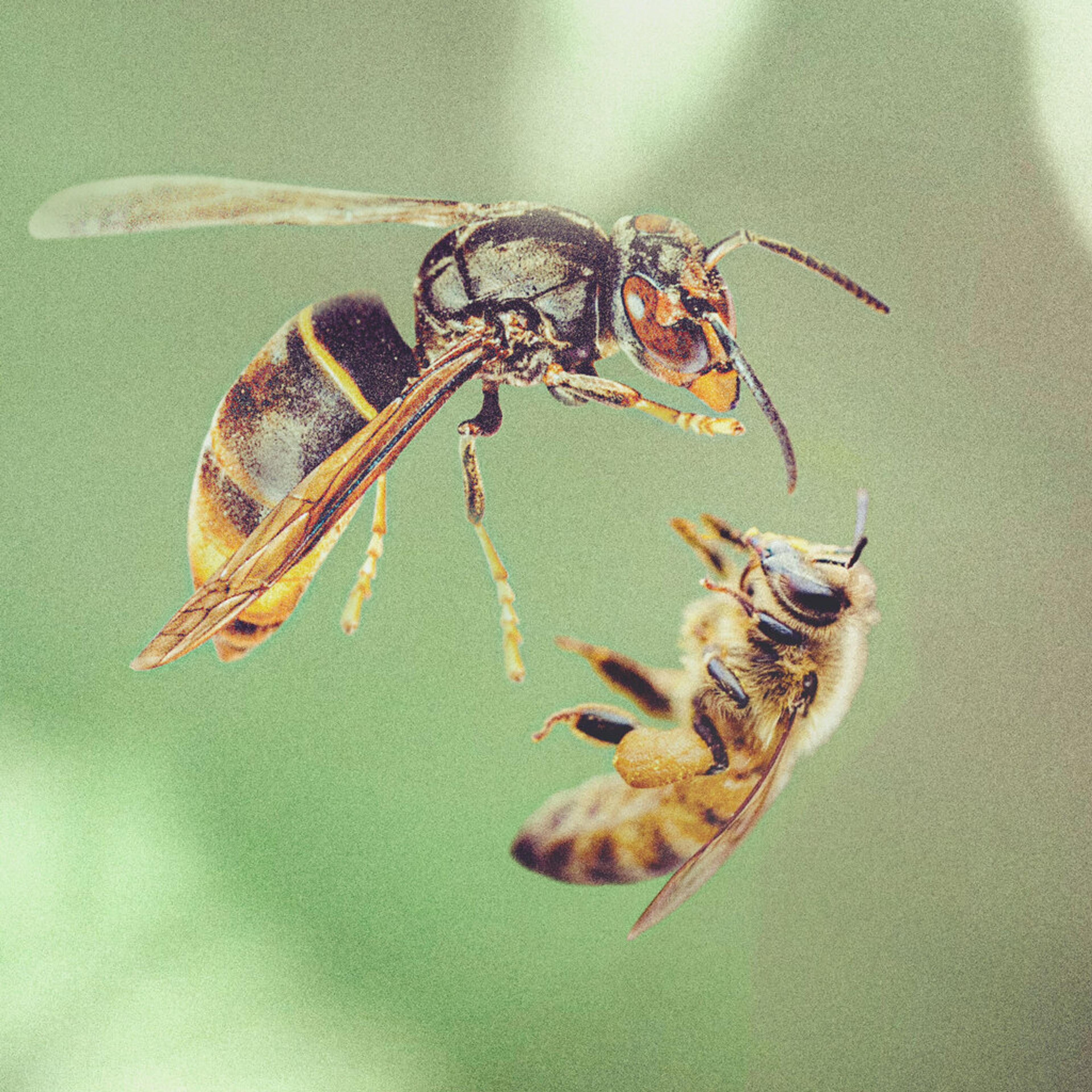
An invasive wasp from Southern China that feeds on honeybees and other pollinators is rapidly spreading throughout the Southeast. The yellow-legged hornet (YLH) was first detected near Savannah, Georgia, in 2023. It’s since expanded into South Carolina and North Carolina, with the Georgia Department of Agriculture eradicating 155 nests.
YLH are native to Southeast Asia, where it reproduces once a year, with colonies housing up to 6,000 hornets. “These are generalist voracious predators who may put a strain on all important insect populations, particularly as they can sustain their populations at a much higher level, due to having our honeybees to feed them’”, comments Lewis Bartlett, director of the bee program at University of Georgia.
The origin of Georgia’s YLH queen, thought to have arrived by boat, is undetermined, as was France’s founding queen, first recorded in 2004. Now well-established there, YLH populations are estimated to cost $35.9 million (USD) per year in damages due to colony loss. For French beekeepers, this translates to losing one in three hives each year and a quarter of their honey revenue.
In Georgia, beehives support several key crops including watermelons, cucumbers, blueberries, and peaches; more beehives means more seeds, higher yields, and bigger fruit. The annual contribution of honeybee pollination to Georgia’s agricultural economy is over $480 million; any reduction in pollination threatens both beekeepers and farmers.
How Do Hornets Impact Pollination?
Like other hornets; YLHs switch their diet seasonally. In spring, emerging worker YLHs can be found eating nectar from the same plants as honeybees. In summer, adult hornets prey on honeybees; in the fall, they eat ripening fruit before nesting for winter.
In 2023, 80 percent of agricultural technicians in Spain and Portugal observed YLHs damaging soft fruits including grapes, apples, and blueberries. Georgia’s pollinator-dependent blueberry industry is worth an estimated $348 million alone. Reduced pollination could reduce fruit yields, which could be compounded by hungry hornets eating the fruit.
As Bartlett shared, YLHs hunt honeybees, first hovering from a distance, then tracking the flight path of foraging bees, and finally pursuing individual, nectar-filled bees returning to the hive. Once caught, the hornet “butchers” the bee, and takes the protein-rich muscular thorax back to its nest to feed its own larvae.
The hornet “butchers” the bee, and takes the protein-rich muscular thorax back to its nest to feed its own larvae.
Researchers identified the most effective trap at capturing YLHs as the Velutina trap—its side entrances and circular column reportedly “confuse hornets” according to Michael Judd, a beekeeper with 23 hives in the South of France.
Trap effectiveness increases with homemade bait solutions. Judd alternates bait relative to the season. In spring and summer, worker hornets are drawn to sugar syrups laced with alcohol: beer, white wine, and blackcurrant liquor. “The bees don’t like white wine, whereas hornets do,” he said. By late summer, when YLH are at their most active—and carnivorous—switching to bait like fish or meat can be more effective.
To Judd and his fellow French beekeepers, positioning matters just as much as bait. “The traps don’t work if you put them on the hive, they must be next to it at the same level,” he said. Muzzles or small wired cages stuck to the front of hives, with holes sized to let bees pass whilst keeping hornets out, also help over the summer. “The muzzle adds a bigger mental stress, the hornets don’t like to be enclosed, so they don’t get so close to the hive,” said Judd.
Moving to Higher Ground
Judd moves his hives to higher altitudes (~2000m) to escape the hornets, after harvesting his honey in the summer. Spatial distribution models support his approach. Gard Otis, professor emeritus of behavioral ecology and apiculture at the University of Guelph, co-authored a study assessing YLHs worldwide invasion, confirming they favor lower altitudes and temperate climates—making Savannah, Georgia, a prime location.
For American beekeepers, lower altitudes are a trade-off. Beekeepers often keep hives in temperate climates in the early spring to give the colonies a head start before moving them north to pollinate crops like almonds and apples. “If you move towards colder climates to escape the hornet, you limit how quickly and early the colony can build,” said Lewis Bartlett, from the University of Georgia, “This is the knock-on for agriculture, there is loss of pollination because there’s loss of hives.”
Since moving hives to higher altitudes isn’t feasible for all beekeepers, trap installations are the first line of defense. At the Bee Academy in Avignon, France, where moving hives is impractical, Judd noted they’re placing giant electrical harps nearby to hives—that act as zappers providing fatal shocks to flying hornets before they can grab any honeybees.
Near his hives, Judd squashes hornets with a badminton racquet. A tool he trusts for precision, yet he’s been stung more than once, causing anaphylaxis. He stresses that the hornets can be deadly—multiple hornet stings killed a gardener in Northern France, Connexion reported. Beekeepers and farmers are urged to call in experts before approaching nests themselves. A hornet’s nest is not one you want to play with.
How Can One Queen Do So Much Damage?
The Southeast’s YLHs are believed to be from a single queen, though Bartlett notes that “as the current U.S. administration does not favor Chinese and American scientific collaboration, it is limiting our abilities to understand the genetics of the YLH in the U.S.” As it is suspected that only one queen came from Asia, it implies a reduction in genetic diversity, leading to inbreeding, the creation of sterile males, and reduced population growth. Yet as Otis points out, “You’d think there should be heavy inbreeding resulting in little opportunity to adapt. However, they seem to have overcome this.”
In Georgia, multiple nests have been found in one tree. Bartlett thinks that “American YLH colonies may be unable to recognize another as distinct, whereas in native ranges they attack one another, self-regulating their population.” This creates a challenge when it comes to eradication.
The University of Georgia Bee Program is investing in eradication to prevent YLH from permanently establishing. Bartlett noted, “It usually takes the eradication team two days from identifying an individual hornet to finding the nest.”
“As the current U.S. administration does not favor Chinese and American scientific collaboration, it is limiting our abilities to understand the genetics of the YLH in the U.S.”
For his part, Otis supports management rather than eradication, commenting, “I’ve been told the cost of eradicating a nest is $2000 … the focus should be on how we reduce the pressure on beehives, whether that’s localized trapping or more effective locating and destroying of nests near apiaries.” He thinks YLH populations will continue to expand in the U.S. in regions with temperate weather, including Maryland and Florida.
He suggests that beekeepers and farmers can learn to adapt and manage their impacts on hives, pollination and crop yields as they have done in Europe and South Korea. Michael advocates for beekeepers to meet regularly, and discuss local hornet behavior, climate hotspots, and trap effectiveness.
The importance is sharing what you see. If you spot a YLH, take a picture on your phone, complete the identification survey for Georgia Department of Agriculture, Clemson University’s Department of Plant Industry, or North Carolina Department of Agriculture and Consumer Services and let them kill it.