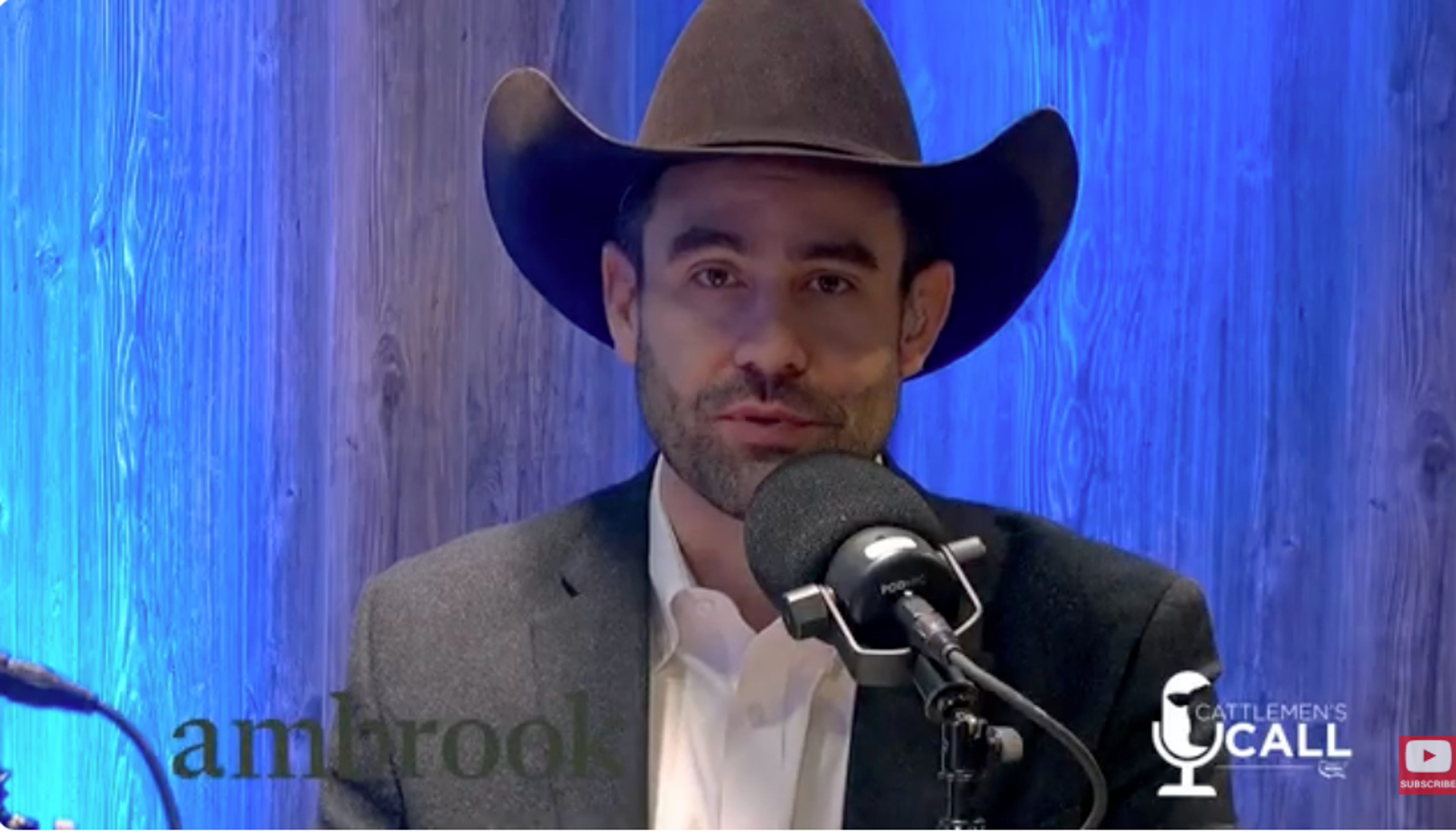
Cattleman Mike Williams joined NCBA’s Cattlemen’s Call podcast to talk about why knowing your numbers matters as much as knowing your cattle.
Ranching in America has been contracting. Nearly half of the beef cattle operations that existed when today’s working ranchers were in high school are gone. Drought, commodity cycles, thinning margins and regulatory pressure have steadily pushed producers out; many of them families that had ranched for generations.
Mike Williams knows that story personally. His grandparents lost their operation in the early 1980s. “They weren’t really on top of their financial situation,” he told host Lane Nordland on NCBA’s Cattlemen’s Call podcast. “A lot of different factors led to them losing the operation.”
Williams wasn’t supposed to become a rancher at all. He grew up in Idaho, spent nine years in the Army, and landed in Los Angeles County in 1994, shoeing horses, of all things, because that was the work he could find. “I always wanted to be a rancher, I just didn’t think I was able to do it,” he said. “A million well-meaning people told me I’d probably have a better chance of being a professional football player than starting my own operation. And I wasn’t a very good football player.”
His break came years later. A friend asked him to help gather cattle on a 1,500-head yearling place in the high desert north of Los Angeles. At the end of the day, Williams asked the rancher what he charged to run a yearling, then asked if he could put ten head of his own on the grass at the same rate. The rancher said yes. “In his mind, he’s getting, ‘I’m going to watch 1,500 head the same way I’m watching those 10’,” Williams said. “That was my break.”
Today, Williams runs Diamond W Cattle Co., a cow-calf operation between 3,000 and 5,000 feet of elevation, where rainfall averages ten to twelve inches in a good year, “...but you never get your average.” He keeps his own heifers because non-native cattle struggle to learn the country. He’s an advocate of low-stress stockmanship, the first vice president of the California Cattlemen’s Association, and immediate past chair of the U.S. Roundtable for Sustainable Beef.
He sees the sustainability conversation the same way he sees stockmanship: ranchers already have the story, they just don’t always get to tell it. “How you treat your animals is going to pay you in the long run. How you manage your pastures is going to pay you benefits,” he said. “It also happens to meet the concerns a lot of these different groups have.”
California, in his telling, is a test case. “They used to think less grazing was better, until the state started burning down.” As wildfires have mounted, the case for grazing as a working-landscape tool has gotten harder to ignore, and Williams credits the shift to ranchers showing up with science and data. “As cattlemen, we bring the receipts. When we make our cases, it’s solid.” He learned the value of that approach the hard way, when a state water-quality rule threatened the ground he was ranching, and the California Cattlemen’s Association helped him push back with research the state itself had been sitting on for years. “Ranchers working together in associations, working with scientists, bringing the receipts to these agencies and regulators, that’s a very good thing for the industry,” he said. “By yourself, you’re not going to get anything done.”
The ranches that endure, Williams says, are the ones that plan for the bad years before the bad years arrive. It’s a habit he picked up in the military. “Every operation, you start with an operation order,” he said. “As soon as the operation starts, things change rapidly, but you never start without it. Sometimes you’re up to your butt in alligators, and you forget you’re supposed to be draining the swamp.”
That discipline is what led him to use Ambrook. He’d tried to make QuickBooks fit for years. “Accounting is my weak point, partly because I don’t like to do it,” he said. “I wasn’t smart enough to set it up the way I needed, and I didn’t want to get smart enough. What I found with Ambrook is that it was developed by people with agriculture in mind.”
Now, Williams tracks each enterprise separately: the cow-calf herd, his retained heifers, a small direct-to-consumer beef business. He can see where there’s a leaking bucket. “You can nickel and dime yourself right to death,” he said. “I was amazed at how much those small expenses add up.” He sets a goal to update his books once a week from his phone, usually in under ten minutes, snapping photos of receipts instead of stuffing them in a glovebox.
“Ranchers working together in associations, working with scientists, bringing the receipts to these agencies and regulators, that’s a very good thing for the industry.”
When he walks into a bank or a USDA office, he brings the receipts. “It gives anybody you’re dealing with confidence in you and in your operation. It shows that you’re aware of what’s going on.”
Near the end of the conversation, Nordland asked Williams about the cowboy poetry he’s been known to share. Williams hesitated, then offered one he’d written in the middle of a bad drought, when he wasn’t sure he’d still be ranching on the other side of it. He called it “Thank You.”
“I led my horse from the corral, full of worry and stress, I was wondering how things could be such a mess. One of the things on my mind was a drought, and whether or not I’d survive it was somewhat in doubt. Another thing that had me concerned was my loan payment due was more than I’d earned. Expenses were higher and profits were lower, and stretching nickels to dimes was making me older.
So I saddled my horse, my mood tanked and blue, I didn’t know what I was going to do. But as I stepped in the stirrup and climbed up in the saddle, it seemed like my stresses began to unravel. And as I rode out I began to relax a bit, startled some deer down by the creek. I heard the screech of a hawk as he soared way up high, and as I topped out on the ridge to a beautiful sky.
I rode through the cattle, some nursing, some lounging, some grazing, and checked out the calves, some nursing, some playing. I was so overwhelmed with the peace and the love that God seemed to be sharing with me from above. I stepped off my horse and got down on a knee, and thanked God for the blessings he’d given me. I still had my stresses, I didn’t know how I’d get through it, but I had to thank God I was able to do it.”
That’s the posture of the ranchers who endure. Not certainty, but with gratitude, and the discipline to keep showing up the next day a little better than the last. “You can’t be perfect,” Williams said. “You want to be a little bit better this year than you were last year, and you want to be looking for ways to improve.”
Watch the full conversation on NCBA’s Cattlemen’s Call podcast.