
- Ambrook Tools
Our Home-Grown IDE
By Adnan KhayyatFor the last six months, Ambrook has run our software engineering interviews on a home-grown, multiplayer, hosted IDE.
After several good years as our software engineering interview platform, Replit pivoted to a vibecoding tool and became increasingly ill-suited for our needs. Engineering candidates expressed frustration navigating Replit’s new UI, and Ambrook’s interviewers needed an ever-longer setup checklist to get candidates set up on our once-trusty IDE.
So we rolled our own. Earlier this year, we built our own collaborative interview platform: Ambrook IDE. Designed to streamline our candidate experience, our build also created opportunities to rethink the interview itself. Without the limitations of off-the-shelf tools, we designed a tool and set of interviews that help us understand how engineers review, debug, and reason about software.
Our approach to assessment
At Ambrook, we continuously iterate on our hiring processes to make them higher signal for interviewers and a better experience for candidates. How we work has changed from 6, 12, and 24 months ago, and our technical assessments have grown with these changes.
Even in our early days, we rejected the LeetCode-style algorithms interviews that felt removed from the work we do at a startup. From our founding, we prided ourselves in bringing candidates real-world coding challenges that mirrored the kind of work they’d do at Ambrook.
However, as AI improved to be able to one-shot many of our coding questions, we made yet another change, focusing our interview on skills like understanding unfamiliar code, finding bugs, and reasoning through whether a proposed change actually solves the problem. Owning the platform gave us room to try those assessments ourselves.
What we tried
For many years, we hosted our technical interviews on Replit. However, after its major pivot into a vibe coding platform (to compete with Lovable, v0, and Base44), we found our use cases no longer well supported. We tried to make it work, but Replit’s changes made our internal interview SOP longer and more conditional; square peg, round hole. Setting up Replit for a simple Python sandbox required obscure navigation (avoiding their AI chat landing pages), adding and removing “organization members,” and immediately disabling 2-3 AI options that would one-shot the answer to our interview question.
We also tried out several Replit competitors:
- LeetCode was too underdeveloped for our needs and served mainly for mock interviews. It was also quite glitchy.
- CoderPad was overpowered for our use-case with enterprise first pricing, question banks, and end-to-end process ownership.
- HackerRank was expensive by charging per session with a cap that does not meet our interview frequency ($480/mo for 360 technical interviews/yr).
With no clear alternatives, we decided to try something different: build an interview IDE ourselves.
Rolling our own
In May of this year, alongside the release of Claude Opus 4.8, I built the first MVP of an interview IDE. Motivated by the desire to curate the candidate experience for technical interviews, I started hacking away during my free time. First I built the basic editor, then security features, then multiplayer niceties like avatars and colored cursors. A few days later, I brought the demo to our team. After some bug fixing and polish, it was ready for our first real technical interview.
We focused on improving candidate experience end-to-end:
- Candidates joined through a private link, so interviewers no longer had to add and remove organization members.
- We used a familiar editor and kept the candidate interface focused on the question and the code, with all of the niceties they expect from an IDE: syntax highlighting, keyboard shortcuts, and real time execution.
- Interviewer controls and private notes stayed on the interviewer’s side, integrated with the IDE.
- We built in native session time limits with interviewer-controlled extensions, and ensured that the links expire after everyone leaves.
Combined, these changes cut our interviewer SOP was cut in half and gave us more time for the problem.
On June 1st, 2026, we ran the first candidate assessment on Ambrook IDE. The neutral and unassuming UX allowed the candidate to get familiar with the platform quickly.
Thankfully, it was a hit! Candidates were in with one click, the editor felt familiar, and we could focus on the question at hand. Ashley (who has since joined Ambrook!) was one of the first candidates to try it out, and gave a rave review:
"The question and the coding platform was great! Adnan mentioned it was a new in-house shared coding platform, and I thought it was super easy and intuitive to use."
— Ashley Xu
How it works
Ambrook IDE is a React app built around Monaco Editor, with Yjs keeping edits and cursors synchronized over WebSockets. Each interview gets its own Cloudflare Durable Object to coordinate the room and persist its state, and Judge0 handles sandboxed code execution. For the code-review assessment, WebContainers runs the sample application directly in the browser. That’s what lets us put a running app in front of a candidate without asking them to set up a local development environment.
To stress-test our build, we ran mock interviews internally across different browsers and languages and also tested the multiplayer limits, with up to 20 people in one session, throttled networks, separate browsers, and people closing their laptops.
We also invested in making Ambrook IDE easier to maintain and extend. We added server-side access checks (defense in depth), unit and integration tests, and CI/CD.
Evolving our interview
Once the basic interview experience worked, we started experimenting with what else we could do with it. Later in the summer, we introduced an assessment built around code review and debugging. Candidates get a mini web app, an editor, and a “mini-GitHub PR” to review, all in the same interview environment.
This gives us a different conversation to have with a candidate. They can read the proposed change, run the application, and investigate how the two line up. We can spend time understanding how they get familiar with the code, what they choose to investigate, and how they explain what they find. These are skills we use constantly at Ambrook, and we wanted to make more room for them in our interviews.
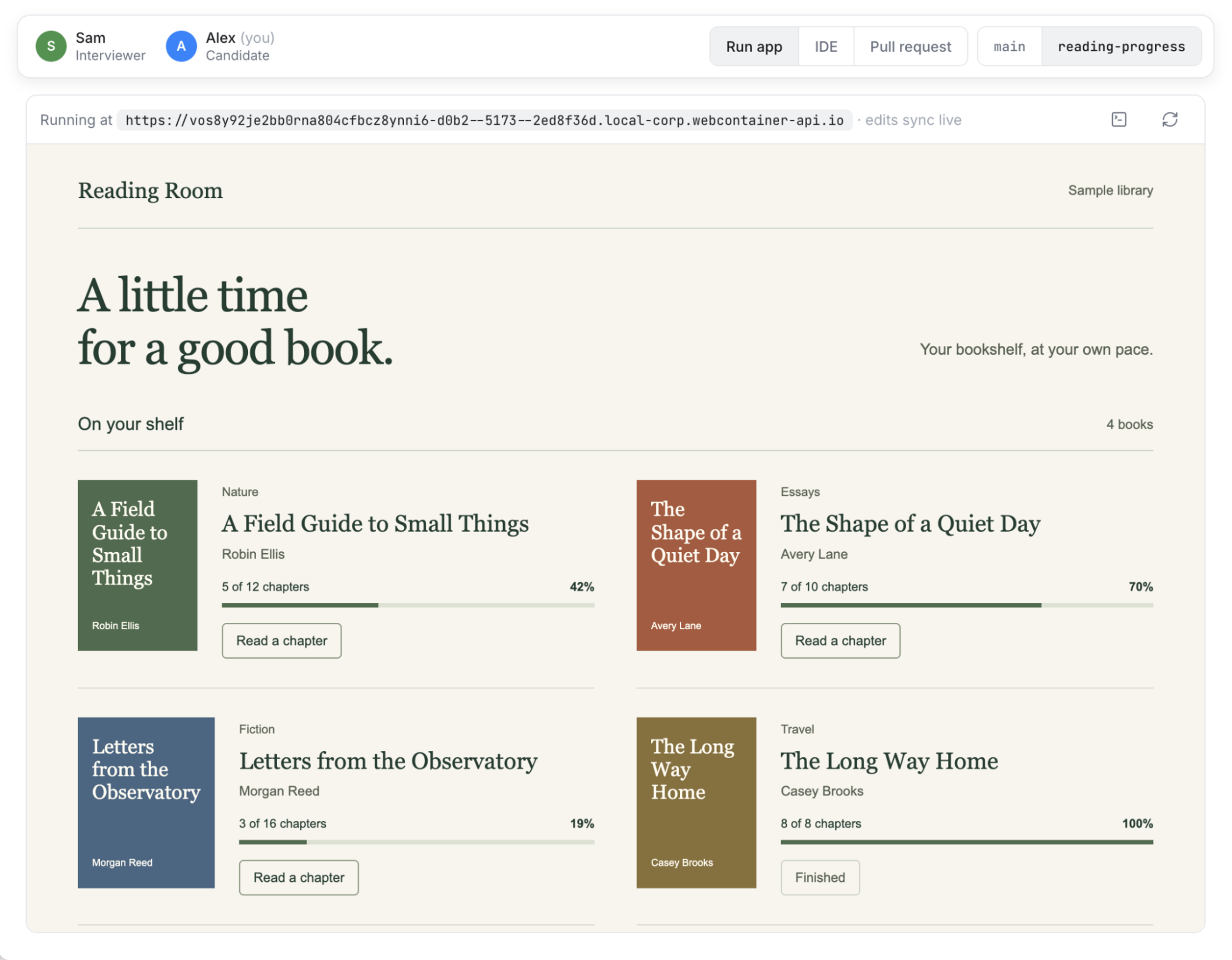
Building our interview scenario into the platform also made this interview much easier to run. Previously, we had to clone an actual repository and prepare a real pull request in GitHub, a process that added 15 minutes to each interview. It also made the new format easier to try: we could build the experience we wanted, run it with candidates, and improve it as we learned.
Unconstrained design
It was important to us that this interview tool, which for many is the first piece of Ambrook-built software they’ll use when getting to know us, left a strong first impression.
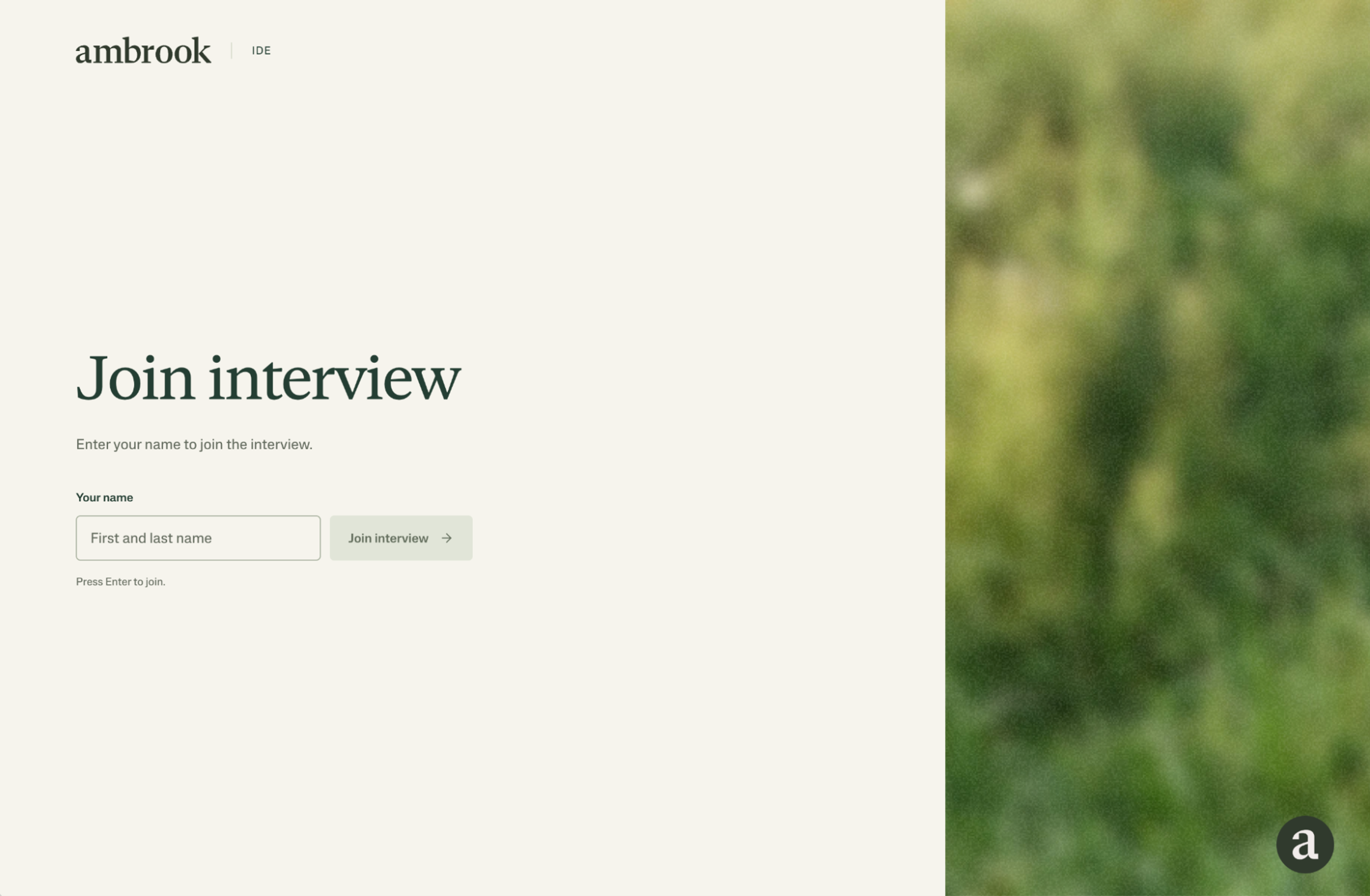
We love getting the details right in the software we build for customers, and applied a similar iterative process to our interview tool. After every interview, we asked interviewers to write down any process or app feedback alongside their interview notes. Then, after every session, we use those notes to identify and ship improvements. These have ranged from small animations to clearer copy and more intuitive UX.
“Hey Adnan, I just wanted to pass on a compliment about your PR interview platform. I used it with John Slinkman and it was hands-down the best code screen interview I've ever experienced!”
— Elias
We kept the color palette minimal, inspired by tools candidates may already know, like Linear or Graphite. We also paid attention to which controls each person actually needed. The invite button, for example, is only available to the host, and expands, highlights, and shows feedback when clicked. Small details like this help interviewers keep the session moving while keeping the candidate’s interface simple.

Never skimp on animations!
Continuous improvement
Today, Ambrook IDE has hosted dozens of real interviews and helped us hire several amazing new software engineers. What started as a way to make interviews less awkward has given us room to keep changing the interview itself. Code review and debugging were one step; giving candidates an AI agent to use during their assessment is another we’re exploring. As the way we build software changes, we can change what we ask candidates to do, too. The platform now has several internal contributors, and we’re continuing to have fun experimenting.
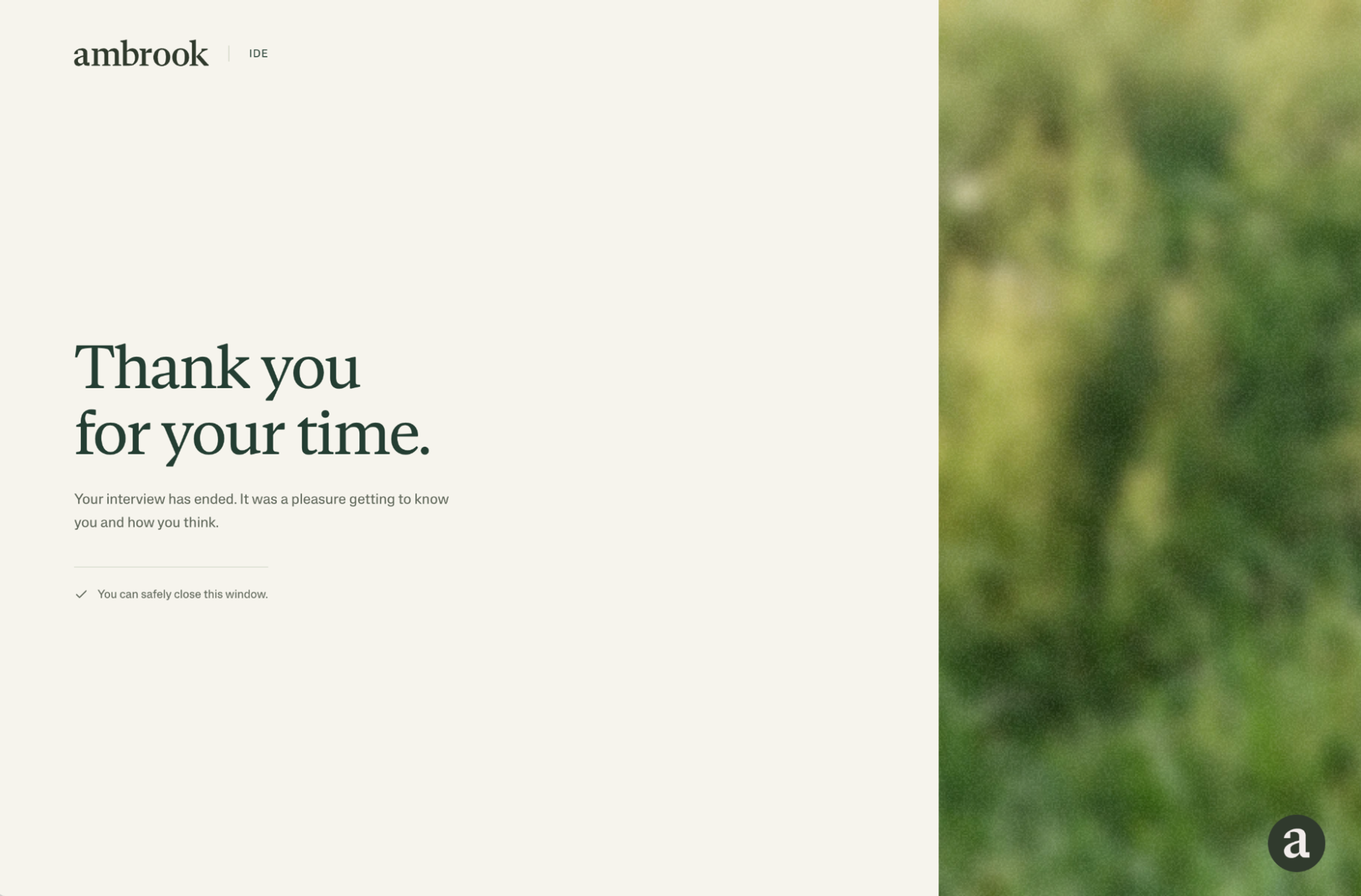
Want to try it out? Check out our careers page for open opportunities to give it a whirl.
- NextAI
Scaling Human Judgment with LLM Planning
We built a hybrid employee-agent system for modifying customer data that marries the scale and speed of LLMs with the quality of human judgment.
Build an exact model of an inexact world.